

















Commercial
Access Control for Glass Doors
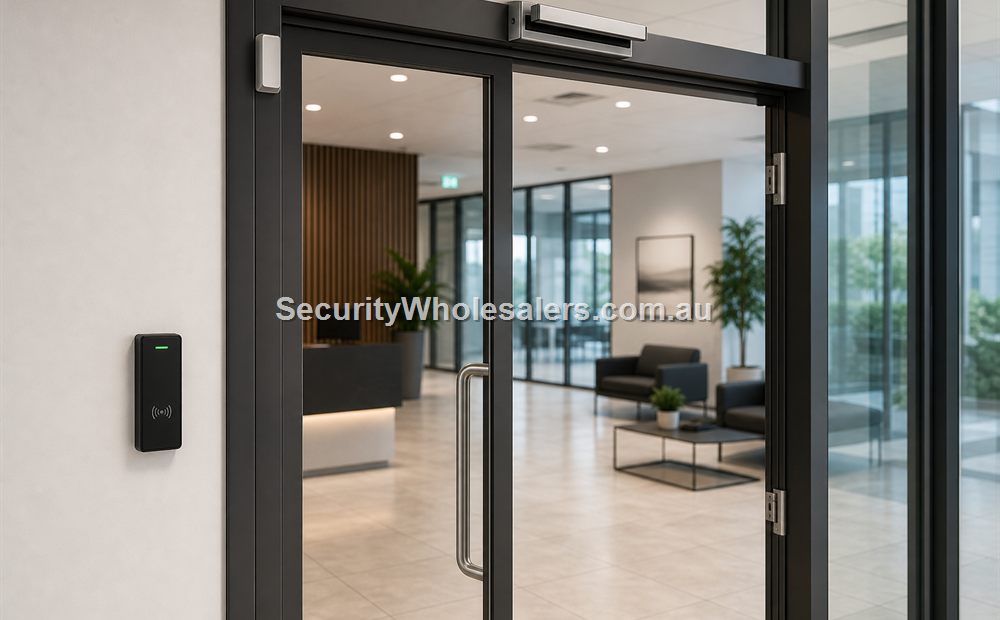
Door Type Guide
Short answer
For a glass shopfront door, the hardware decision is different. Many glass doors cannot be treated like a standard framed office door, so the lock type, bracket method, cable path, and exit method all need to be chosen carefully.
Glass doors often look simple from the front and become more complicated the moment access control is added. The frame detail, top rail, patch fittings, closer, and safe-side exit method all matter.
This is also where the mistake often happens: buying a reader and a maglock online before checking how the glass door actually closes, releases, and exits.
On this page:
What this means in practice
In simple terms, glass door access control is usually a lock-and-bracket question first and a reader question second. The reader is only one part of the system. The controller, lock, power supply, cabling, exit method, and software all need to work together.
| Glass door situation | What usually works | Why |
|---|---|---|
| Framed glass office or clinic door | Often a maglock or another glass-suitable controlled lock path | The frame and glass detail may not suit a conventional strike cut-in. |
| Aluminium-framed shopfront with latch hardware | Sometimes a strike path, sometimes a maglock path | This depends on the actual latch and frame detail, not on the glass panel alone. |
| Double glass entry doors | Often needs more deliberate leaf control and egress planning | The active leaf, closing sequence, and release behaviour matter. |
| Public-facing glass entry | Needs visitor, egress, and safety thinking early | The wrong hardware guess creates problems quickly. |
Some glass doors are good candidates for maglocks. Some are better handled another way. That is why a glass-door page should never promise one lock type as the default answer.
Real-world examples
Allied health clinic with framed glass front door
A framed glass clinic entry often needs controlled release for staff after hours and a clean inside exit method during business hours. The site may suit a maglock path, but it also may need intercom, exit-button, or request-to-exit logic depending on how the door is used.
Retail tenancy with aluminium-and-glass shopfront
A narrow-stile retail shopfront may look like a glass-door job, but the real decision could be in the aluminium frame and latch. If the frame already carries a suitable latch, an electric strike may still be the cleaner answer.
What usually works
- Start with door photos and the actual frame or patch detail before choosing hardware.
- Consider the whole opening: closer, active leaf, safe-side exit, and how the lock will hold or release the door.
- Use intercom plus access if the glass entry is visitor-facing rather than purely staff-only.
What to check
- If the door is part of a public entry or exit path, do not guess the hardware.
- Do not assume every glass door should use a maglock. Some aluminium-and-glass shopfronts suit a strike path instead.
- Cable paths and brackets need to be thought through before hardware is bought.
Things to check
- Buying a reader first and leaving the glass-door hardware for later.
- Assuming one bracket kit solves every glass-door job.
- Ignoring the inside release method because the outside looks tidy.
Buying considerations
- Whether the door is frameless glass, aluminium-framed glass, or part of a shopfront assembly.
- Whether the entry is staff-only, visitor-facing, after-hours only, or a public-access opening.
- Whether the site needs simple entry, managed users, intercom, or after-hours review.
When to ask for help
This is one of the strongest cases for sending photos first. A glass door can look like a standard entry from a distance and still need a very specific lock, bracket, and exit setup.
- Send the full door, top rail, side rail, closer, floor area, and inside exit side.
- If it is a double door, show both leaves and the meeting stile.
- If it is a commercial tenancy or public entry, have the hardware reviewed by a suitably qualified installer, locksmith, electrician, builder, or fire professional where required.
Door photo help
For Access Control for Glass Doors, if you are not sure which parts suit the door, send a photo of the door, lock area, frame and preferred reader position. We can help point you toward the right controller, reader, lock, exit button, and power supply.
Safety and compliance
Access control affects how people enter and exit a building. For commercial, public-access, exit-path, or fire-door applications, have the door hardware and egress method checked by a suitably qualified professional.
Related guides
Worked installer examples for glass doors
| Opening | Potential solution | Parts and cabling that must be allowed for |
|---|---|---|
| Framed aluminium-and-glass door with compatible latch | Electric strike and reader | Strike confirmed against latch/frame, reader, controller, calculated lock-power cable, OSDP/reader cable, contact and exit-input pairs, protected PSU and battery. |
| Frameless glass swing door | Purpose-made maglock/bracket arrangement where suitable | Maglock, glass-compatible brackets, reader, controller, REX, emergency release arrangement, contact, PSU/battery, concealed or protected lock power, reader cable and interface pairs. |
| Paired glass doors | Specialist double-door locking and monitoring design | Door-by-door lock state, double maglock or approved alternative, brackets, contacts for both leaves, calculated total current, individual protection and coordinated egress logic. |
Survey before ordering
Record whether the glass is framed or frameless, door thickness, head and rail dimensions, single or double leaf, handing, closer/floor spring, existing latch, clearances, exit path and cable route. Never assume adhesive, drilling or a generic bracket is acceptable for a glass assembly.
Relevant products and categories
- Access Control Products - Main category for controllers, readers, kits, locks, and related hardware.
- Maglocks - Common on some glass, aluminium, and selected gate or double-door applications.
- Intercoms - Useful where visitor verification belongs in the same workflow as entry release.
Frequently Asked Questions
- Can you put access control on a glass door?
Often yes, but the right lock path depends on the actual glass door construction, frame detail, closer, and egress requirements.
- Do glass doors always use maglocks?
No. Some do, but not all. Some aluminium-and-glass doors may suit a strike path depending on the latch and frame.
- Why is glass-door access control more specific than a timber office door?
Because the lock and bracket method is usually more specialised and the cable path and inside release method often need closer planning.
- Can I use a keypad on a glass shopfront?
You can sometimes use a keypad or a reader, but the credential device is separate from the question of how the lock will actually control the door.
- What photos should I send for a glass door?
Send the whole door, rails, frame, closer, floor area, and inside exit side. Those details usually decide the hardware path.
- What if the glass door is part of a public entry?
That should be treated carefully. Access control affects how people enter and exit, so the release method and egress path should be checked properly.
Plan this site door by door
Download the editable workbook, list every controlled opening, then email it with matching door photos to sales@securitywholesalers.com.au. Include the site suburb, installation requirement and target timing.
Review information
Content owner: SecurityWholesalers access control guide team. Revision: 17 July 2026. Use these examples as a starting point, then confirm the details against current product manuals, approved drawings and relevant authority requirements.
NCC access and egress | ACMA cabling requirements | OAIC biometric guidance | Access control definitions