











Commercial

Access Control for Factories
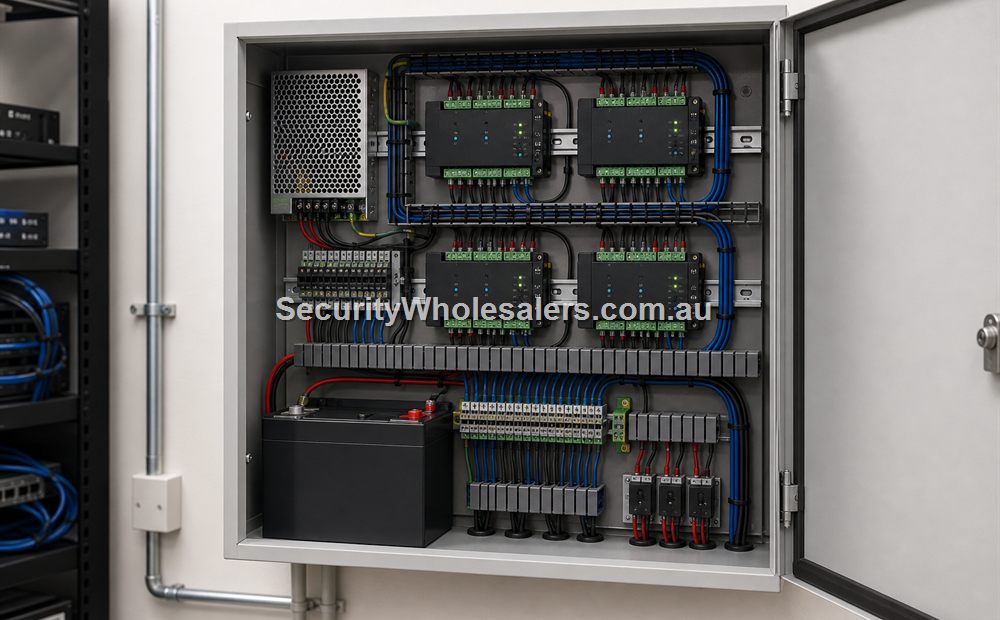
Factory access control usually has more in common with movement management than with a simple staff-door lock. Shift changes, plant rooms, contractor access, and the separation of office and production areas all push the project toward a clearer controller design.
Access control door hardware and controller scene
Access control door hardware image for this buying guide.

Sector Guide

Where this usually fits

Factory jobs are normally decided by how the site separates office, production, maintenance, contractor, and service access. That means the controller and cabinet layout matters early, because the building is usually managing several user groups and several kinds of opening at once.

Situation Usually the cleaner path Why it fits
One amenities or supervisor door Single Door Access Control Kit Possible if the opening is isolated and the factory does not expect stronger review or growth.
Office entry plus factory staff door 2 Door Access Control Kit The site already has separate movement types and named users.
Office, production, plant room, and maintenance store 4 Door Access Control Kit Several permission groups and a need for spare capacity make a four-door path cleaner.
Large factory with shifts, contractors, and many restricted zones Controller and software path The job is already an industrial permissions system.

Sample site scenarios

Example

Small fabrication workshop

A smaller fabrication site with one office entry, one workshop staff door, and one tool room can often be solved with a two-door or four-door path. The key is not overcomplicating it while still avoiding shared credentials that become impossible to police across shifts.

Example

Larger manufacturing floor with maintenance contractors

A larger manufacturing floor with shift staff, maintenance contractors, and restricted service rooms usually needs controller architecture and software from the start. The site has too many permission groups to leave on isolated standalone devices.

Typical hardware and software direction

These jobs are usually decided by the management layer as much as the lock hardware. The right reader or terminal only solves part of the problem if the permissions, schedules, and review workflow have been underspecified.

  • Controller path sized for current doors plus spare room for maintenance or plant-room growth.
  • Readers or terminals on staff and restricted-area doors, with proper lock and egress hardware on each opening.
  • Separate permissions for office staff, production staff, maintenance, contractors, and management.
  • UPS and central cabinet planning to keep the industrial head-end serviceable and protected.
  • If the site has gate or operator triggers, integrate them deliberately rather than treating them as an afterthought.

Common mistakes

  • Using one shared staff credential approach across office, production, and restricted service areas.
  • Forgetting how shift changes affect schedules and after-hours access.
  • Adding plant-room doors later and discovering the original kit had no spare capacity.

Relevant SecurityWholesalers product paths

Related guides

Frequently Asked Questions

  • Do factories usually need a controller-based system?

    Yes, once shift staff, contractors, restricted service rooms, or several openings are involved, controller design usually becomes the cleaner long-term answer.

  • Can a small workshop still use a simple door kit?

    It can on an isolated opening, but many workshops quickly outgrow that once office and production movement are separated properly.

  • Why do schedules matter so much on factory access?

    Shift work and contractor timing often change which users should be able to move through the building at different times.

  • What is the most common factory access-control mistake?

    Undersizing the system and then having no clean way to add restricted service rooms or maintenance access later.

  • Should factories treat gate and operator access separately?

    They should be integrated deliberately, with clear relay and responsibility boundaries, rather than improvised after the door system is already fixed.

  • Which page should someone read next?

    If the site already has several restricted rooms, the four-door kit and lift-and-controller guide are the next useful steps.

How to plan Access Control for Factories properly

The practical value of Access Control for Factories comes from how well it solves access control planning on a real Australian site. Before comparing model numbers, work through site layout, evidence value, user workflow, installation conditions and future expansion. Those details decide whether the system is useful in six months or merely impressive on the day it is installed.

For Access Control for Factories, the strongest quote is the one that explains why each device belongs on the site. It should identify which parts of the job are essential, which parts are optional, and where spending extra will actually improve evidence, safety, access control or response.

Small site

For Access Control for Factories, keep the design focused. Cover the highest-risk entry points or workflows first, choose equipment that is easy to use, and avoid adding features that nobody will maintain after handover.

Medium site

Separate critical views or doors from general coverage. Plan users, permissions, storage, power and network paths before filling every channel or controller output.

Complex site

For Access Control for Factories, document zones, responsibilities and expansion. Larger sites need a staged design so the system can grow without replacing the recorder, controller, cabling or user workflow too early.

What a 96/100 recommendation should include

  • A plain-English description of the incident, access event or workflow the system must solve.
  • Enough headroom for likely expansion, extra users, additional cameras, extra doors or future monitoring.
  • Installation notes covering cabling, power, mounting, weather, lighting, service access and handover.
  • A clear explanation of what the buyer should not overbuy and what would be a false economy.

Quote checklist for Access Control for Factories

Before ordering, ask for a short answer to these questions. They make the quote easier to compare and reduce the chance of buying hardware that does not match the site.

  • What exact problem is being solved: access control planning, deterrence, evidence, access control, safety, compliance or convenience?
  • What happens during poor light, bad weather, busy periods, after-hours events or staff changes?
  • Who will administer users, review events, export evidence and test the system?
  • Which part of the design is allowed to be basic, and which part must be strong because it proves the incident?

If those answers are vague, the buyer should pause before purchasing. Good security equipment becomes much more useful when the operating plan is written down before installation.

Final field note for Access Control for Factories

For Access Control for Factories, the final buying decision should be easy to explain to the person who will live with the system. The quote should identify the must-have outcome, the acceptable compromises, and the support path if users, doors, cameras, sensors or site conditions change later.

This is the difference between a list of products and a security design. The products matter, but the design is what makes them useful.

Final field note for Access Control for Factories

For Access Control for Factories, the final buying decision should be easy to explain to the person who will live with the system. The quote should identify the must-have outcome, the acceptable compromises, and the support path if users, doors, cameras, sensors or site conditions change later.

This is the difference between a list of products and a security design. The products matter, but the design is what makes them useful.

Final field note for Access Control for Factories

For Access Control for Factories, the final buying decision should be easy to explain to the person who will live with the system. The quote should identify the must-have outcome, the acceptable compromises, and the support path if users, doors, cameras, sensors or site conditions change later.

This is the difference between a list of products and a security design. The products matter, but the design is what makes them useful.

Final field note for Access Control for Factories

For Access Control for Factories, the final buying decision should be easy to explain to the person who will live with the system. The quote should identify the must-have outcome, the acceptable compromises, and the support path if users, doors, cameras, sensors or site conditions change later.

This is the difference between a list of products and a security design. The products matter, but the design is what makes them useful.

Real quote scenario for Access Control for Factories

When quoting Access Control for Factories, the useful starting point is door-by-door access planning. The buyer should be able to record the door type, lock type, reader position, exit method, power supply, fire requirement and daily user group. Without those details, two quotes can look similar while solving very different problems.

For Access Control for Factories, a shopfront door, warehouse staff door, server-room door and shared tenancy door can all need different hardware even when the software is the same. This is why a strong SecurityWholesalers guide should talk about the site, the workflow and the equipment together rather than treating the product category as a simple shopping list.

Budget-conscious path

Use the simplest reliable hardware that solves the main risk. Keep administration simple and avoid specialist features unless they change the outcome.

Balanced path

Add better management, verification or expansion headroom where the site is likely to grow. This is usually the best path for small businesses and shared buildings.

Higher-risk path

Document response, audit trail, permissions and fallback procedures. Higher-risk sites need clearer operating rules, not just stronger hardware.

The final Access Control for Factories quote should make the weak points visible. If cabling, power, monitoring, mobile app access, fire release, user management or future expansion are assumed rather than written down, the buyer is carrying risk that should have been solved during design.

Questions to ask before approving Access Control for Factories

  • What does the system need to prove or control on an ordinary day?
  • What is different after hours, on weekends, during staff changes or during an emergency?
  • Who will administer users, review events, export evidence or test the system?
  • What happens if the internet is unavailable, a user loses a credential, a sensor triggers falsely or a door does not release?
  • Which part of the system is easy to expand later, and which part would be expensive to change?

These questions are deliberately practical. They help separate a polished product list from a design that will remain useful after installation.

Extra buying notes for Access Control for Factories

The Access Control for Factories buying decision should be tested against normal use, after-hours use and failure conditions. If the quote cannot explain those three moments, it needs more design work before the customer commits. This is the kind of detail that helps a buyer compare quotes properly, because it turns the conversation from ?which model is cheapest?? into ?which design will still be useful after installation??

For Access Control for Factories, the best final check is to ask what would make the system fail in practice. Common answers include poor cabling, weak power planning, missed user permissions, unclear response duties, too little storage, unsuitable mounting positions, or a handover that nobody can follow. A strong quote names those risks and deals with them before hardware is ordered.

For Access Control for Factories, SecurityWholesalers should help buyers feel more confident, not more overwhelmed. The ideal outcome is a quote that is technically sound, easy to explain, and honest about where a simpler option is enough.

Extra buying notes for Access Control for Factories

The Access Control for Factories buying decision should be tested against normal use, after-hours use and failure conditions. If the quote cannot explain those three moments, it needs more design work before the customer commits. This is the kind of detail that helps a buyer compare quotes properly, because it turns the conversation from ?which model is cheapest?? into ?which design will still be useful after installation??

For Access Control for Factories, the best final check is to ask what would make the system fail in practice. Common answers include poor cabling, weak power planning, missed user permissions, unclear response duties, too little storage, unsuitable mounting positions, or a handover that nobody can follow. A strong quote names those risks and deals with them before hardware is ordered.

For Access Control for Factories, SecurityWholesalers should help buyers feel more confident, not more overwhelmed. The ideal outcome is a quote that is technically sound, easy to explain, and honest about where a simpler option is enough.

We make product support and ordering easy! Reach out to our help team :)
Trade Customers: Log In or Register to Unlock Even Better Prices.

Save & Share Cart
Your Shopping Cart will be saved and you'll be given a link. You, or anyone with the link, can use it to retrieve your Cart at any time.
Back Save & Share Cart
Your Shopping Cart will be saved with Product pictures and information, and Cart Totals. Then send it to yourself, or a friend, with a link to retrieve it at any time.
Your cart email sent successfully :)