













Commercial
Access Control for Aluminium Shopfront Doors
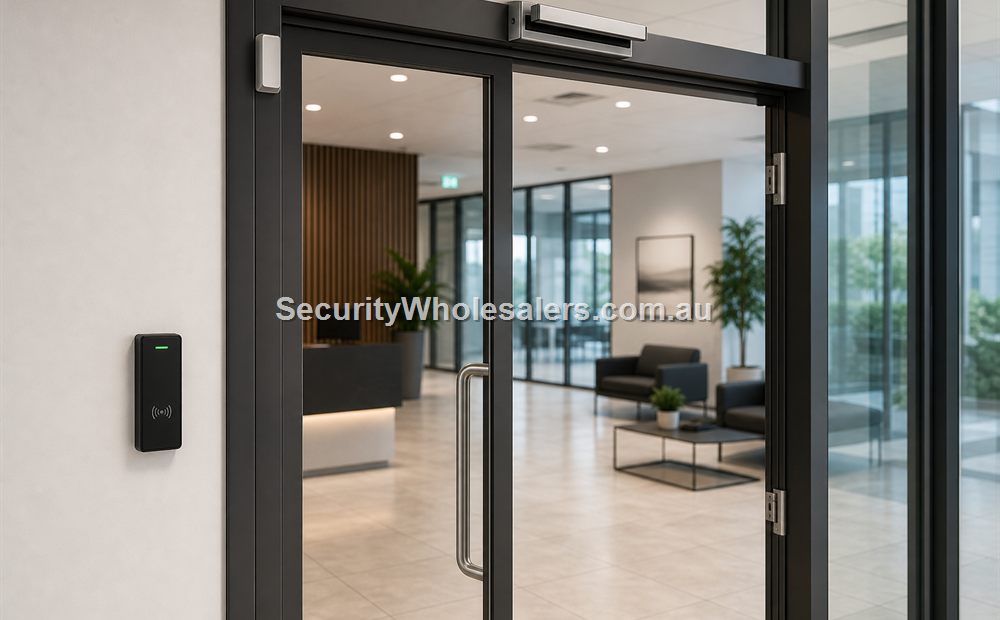
Door Type Guide
Short answer
Aluminium shopfront doors often suit access control well, but the hardware decision depends on the actual latch, frame, closer, and public-entry role. This is often a strike-versus-maglock decision, not a reader decision.
For an aluminium shopfront door, the mistake we often see is assuming the frame automatically wants a maglock because it is narrow. In reality, many shopfront doors are decided by the latch and frame detail.
This is also one of the most common retrofit jobs, which means cost and compatibility need to be looked at together.
On this page:
What this means in practice
Aluminium shopfront doors often live in the space between a standard office door and a glass-door job. If the existing latch and frame are suitable, an electric strike can be a clean and reliable answer. If the door geometry or public-entry workflow pushes things another way, the lock path may need to change.
| Door situation | What usually works | Why it tends to fit |
|---|---|---|
| Narrow-stile shopfront with usable latch | Often an electric strike path | The frame and latch may already support a cleaner latch-release method. |
| Shopfront with awkward existing hardware | Case-by-case assessment | The existing lock may be the main thing deciding the retrofit cost. |
| After-hours controlled staff entry | Strike or other latch-based release often suits | The door wants reliable relocking and simple daily use. |
| Public-facing entry with visitor release | Access plus intercom may be the cleaner path | The entry workflow matters as much as the lock. |
Real-world examples
Pharmacy side entry with aluminium frame
A pharmacy side entry may suit a strike path because staff use it repeatedly and the site wants clean relocking after every use. The important part is checking the latch and frame detail, not buying the strike on assumption.
Small office tenancy with front shopfront door
A small office shopfront door may look like a one-reader job, but if visitors arrive during the day and staff need release from inside, the door may actually need an intercom-led workflow.
What usually works
- Check the actual latch and frame detail before choosing the lock path.
- Use a strike when the latch and frame genuinely support it and the daily door behaviour suits it.
- Treat visitor-facing shopfront entries as workflow questions, not only lock questions.
What to check
- Do not assume all aluminium shopfront doors want the same hardware.
- If the opening is part of a public entry or exit path, do not guess the hardware.
- Narrow-stile readers, cable paths, and closer behaviour should be checked early.
Things to check
- Buying a maglock by habit when the frame really wants a strike.
- Ignoring the public-entry workflow because the door looks physically simple.
- Forgetting the inside release method and door contact.
Buying considerations
- Latch type and frame depth.
- Whether the door is a staff door, a public entry, or an after-hours only opening.
- Whether the site needs cards, PIN, intercom, or a managed controller path.
When to ask for help
If the site has an aluminium shopfront door and the owner is not sure what latch is in the frame, this is where a close-up photo saves guesswork and wasted hardware.
- Send photos of the full door, latch edge, frame strike area, closer, and inside release side.
- Show whether it is a single or double shopfront entry.
- If it is a public entry or exit-path door, have the hardware checked by a suitably qualified professional where required.
Door photo help
For Access Control for Aluminium Shopfront Doors, if you are not sure which parts suit the door, send a photo of the door, lock area, frame and preferred reader position. We can help point you toward the right controller, reader, lock, exit button, and power supply.
Safety and compliance
Access control affects how people enter and exit a building. For commercial, public-access, exit-path, or fire-door applications, have the door hardware and egress method checked by a suitably qualified professional.
Related guides
Worked installer example: aluminium shopfront with narrow-stile latch
A potential solution is a compatible monitored strike or electrified narrow-stile lock, an OSDP reader, protected controller, mechanical egress, door contact and supervised PSU. The exact hardware is selected only after identifying the latch model, frame cavity, handing, door alignment, closer and any fire or exit-path constraints.
| Circuit | Typical path | For installers check |
|---|---|---|
| Reader | Reader to controller using the supported OSDP/RS-485 cable | Mounting depth, metal effect, topology, shield treatment and reader tamper |
| Lock | Fused PSU to strike/electrified lock | Running/inrush current, voltage drop, flexible transfer if power enters the leaf, and mechanical alignment |
| Door state | Contact to supervised controller input | Closed, forced and held-open states |
| Exit | Mechanical exit device and any required REX input | Egress must not depend solely on software or a network service |
| Network | Cat6 from controller to nominated security network | VLAN, addressing, time sync, administrator access and offline behaviour |
Relevant products and categories
- Access Control Products - Main category for controllers, readers, kits, locks, and related hardware.
- Electric Strikes - Strike options for aluminium shopfronts, latch-based doors, and many standard commercial frames.
- Maglocks - Common on some glass, aluminium, and selected gate or double-door applications.
- Intercoms - Useful where visitor verification belongs in the same workflow as entry release.
Frequently Asked Questions
- Can you put access control on an aluminium shopfront door?
Often yes, but the latch and frame detail decide whether the clean path is a strike, a maglock, or another hardware approach.
- Do shopfront doors usually use electric strikes?
Many do, but not all. It depends on the latch and how the door is meant to behave in daily use.
- When does intercom matter on a shopfront entry?
When the opening is visitor-facing and staff inside need to verify who is there before release.
- Why is a photo important for a shopfront door?
Because the frame, latch, closer, and stile detail are what usually decide the hardware path.
- Can I keep the existing lock?
Sometimes, but sometimes the existing hardware is exactly what makes the retrofit messy. It should be assessed before parts are bought.
- What should be checked on a public-facing shopfront?
The lock, release method, power supply, and egress path should be considered together, especially if the door is part of a public or exit route.
Plan this site door by door
Download the editable workbook, list every controlled opening, then email it with matching door photos to sales@securitywholesalers.com.au. Include the site suburb, installation requirement and target timing.
Review information
Content owner: SecurityWholesalers access control guide team. Revision: 17 July 2026. Use these examples as a starting point, then confirm the details against current product manuals, approved drawings and relevant authority requirements.
NCC access and egress | ACMA cabling requirements | OAIC biometric guidance | Access control definitions