















Commercial
Access Control Power Supply Buying Guide
Product Buying Guide
Short answer
A power supply for access control should be sized around the lock and the wider door hardware, not treated as an afterthought. The supply has to support the lock current, the backup expectation, the cabinet layout, and the way the release hardware behaves.
Power supplies are one of the most common weak points in access control because they are often chosen late and only by voltage label.
For a basic strike job, the supply might be simple. For maglocks, multiple doors, backup expectations, and cabinet planning, the power decision becomes much more important.
On this page:
What this means in practice
The useful way to think about an access control power supply is by load and role.
| Power-supply question | Why it matters | Typical outcome |
|---|---|---|
| What lock is being powered? | A strike and a maglock do not create the same load pattern. | The lock type usually decides the first sizing step. |
| Is battery backup expected? | Some sites want continued controlled operation during a power event. | Cabinet space and battery sizing start to matter. |
| How many doors share the supply? | Several doors can change the current and distribution requirement quickly. | A neater cabinet and distributed path may be needed. |
| Is the supply close to the controller and release hardware? | Cable runs and cabinet planning affect reliability. | Long messy runs often create avoidable faults. |
The power supply is also part of troubleshooting logic.
Real-world examples
Single office strike on a small one-door system
A basic office rear-door strike may only need a modest, cleanly matched supply if the lock current and controller path are simple.
Two maglocked doors in a shared commercial entry
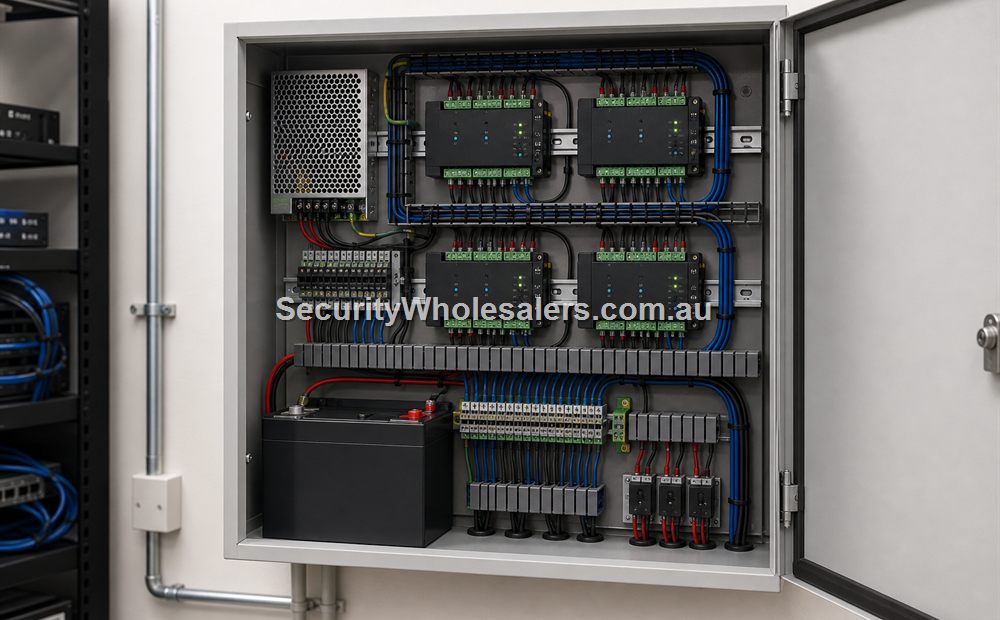
A shared commercial entry with maglocks and battery backup expectations usually needs more deliberate power planning. The supply, cabinet space, and backup path are part of the system design.
What usually works
- Size the supply around the lock load and backup expectation.
- Keep the power path tidy and documented so faults are easier to trace later.
- Think about cabinet space, batteries, and future door additions before buying.
A calculation installers can put on the door schedule
Calculate each cabinet independently. Start with current manufacturer data at the actual system voltage; do not size from a product-category label or from the reader alone.
- Continuous load: add controller, every reader, continuously energised locks, communications modules and auxiliaries.
- Peak case: add the maximum credible simultaneous lock inrush or operation. Check both normal access and the approved emergency state.
- Design allowance: apply the PSU/battery manufacturer's required margin and derating for temperature, battery age and expansion. Document the chosen allowance.
- Voltage drop: calculate the complete outgoing and return path:
Vdrop = 2 x one-way length x current x conductor resistance per metre. Verify voltage at the lock while loaded. - Battery: a first-pass estimate is
Ah = load amps x required hours / permitted usable fraction, then apply the battery/charger manufacturer's ageing and environmental factors.
Four continuously powered locks in one cabinet
Assume four locks at 0.50 A each, four readers at 0.12 A each, a controller at 0.35 A and auxiliaries at 0.20 A. Continuous load is 3.03 A. If the approved design method applies a 25% planning allowance, the design load becomes 3.79 A before any additional inrush, charger or future load check. For four hours at the raw 3.03 A load and an illustrative 80% usable fraction, the arithmetic gives 15.15 Ah before ageing, temperature and manufacturer derating. This example teaches the method; it is not a substitute for the selected PSU, battery and lock datasheets.
Recommended cabinet BOM fields
| Item | Record for each cabinet | Why |
|---|---|---|
| PSU/charger | Input, output voltage, rated current, charger current, fault outputs and approvals | Separates available load current from battery-charging demand. |
| Battery | Chemistry, voltage, Ah, quantity, enclosure rating and replacement date | Makes autonomy and maintenance auditable. |
| Lock circuits | Door ID, lock current, cable size/length, fuse/PTC rating and measured loaded voltage | Prevents one door fault from becoming an unexplained cabinet-wide fault. |
| Auxiliaries | Readers, relays, sounders, converters and network devices actually powered here | Stops 'small' loads disappearing from the calculation. |
| Emergency state | Which outputs release, remain secure or transfer under the approved cause-and-effect | Ensures the peak/current calculation matches real operation. |
What to check
- Do not treat the power supply as a generic add-on box.
- Do not mix lock expectations and battery expectations without checking the full load.
- If the opening is important, do not leave the power design until the end.
Things to check
- Choosing only by voltage label.
- Undersizing the supply because the reader current looked low.
- Forgetting that the lock and backup path are what usually drive the power decision.
Buying considerations
- Lock type and current draw.
- Battery-backup expectation.
- Number of doors on the supply.
- Cabinet size and installation layout.
When to ask for help
If the site has multiple doors, maglocks, backup expectations, or a messy existing cabinet, this is worth checking before parts are mixed together.
- Send photos of the controller, power supply, cabinet, and lock hardware if already installed.
- List how many doors and which lock types are involved.
- Say whether the site expects backup operation or only clean normal operation.
Door photo help
For Access Control Power Supply Buying Guide, if you are not sure which parts suit the door, send a photo of the door, lock area, frame and preferred reader position. We can help point you toward the right controller, reader, lock, exit button, and power supply.
Commercial site quote
If this is for an office, warehouse, school, gym, medical centre, strata building, rooming house, factory, or multi-tenant site, it is usually worth planning the full door schedule before buying hardware.
Related guides
Relevant products and categories
- Access Control Products - Main category for controllers, readers, kits, locks, and related hardware.
- Access control power supplies and accessories - compare cabinet size, battery support, and door load suitability.
- Maglocks - maglock current and release behaviour often drive the supply choice.
- Electric strikes - strike voltage and timing still need a clean supply path.
Frequently Asked Questions
- Why does the power supply matter so much in access control?
Because the lock path depends on it. A reader can appear normal while the opening still behaves badly if the power side is wrong.
- Is a maglock power supply choice different from a strike supply choice?
Often yes, because the load pattern and backup expectation can be different.
- Do I need battery backup?
That depends on the site expectation and the opening purpose. Some sites want cleaner continuity than others.
- Can one supply run more than one door?
Sometimes, but the lock load, backup requirement, and cabinet layout should be checked together.
- What causes doors to unlock badly or stay locked when the reader seems fine?
Power-path issues are a common cause, especially where lock current or backup expectations were not planned properly.
SecurityWholesalers product paths for Access Control Power Supply Buying Guide
Use these product paths as a practical starting point after the buying logic is clear. The right product list should follow the site design, not replace it.
Check compatibility before ordering
Email sales@securitywholesalers.com.au with the controller, reader and lock model numbers, door photos, required user method and installation context. For trade pricing, also include your trade account details.
Review information
Content owner: SecurityWholesalers access control guide team. Revision: 17 July 2026. Use these examples as a starting point, then confirm the details against current product manuals, approved drawings and relevant authority requirements.
NCC access and egress | ACMA cabling requirements | OAIC biometric guidance | Access control definitions