














Informational
Fail Safe vs Fail Secure
Decision Guide
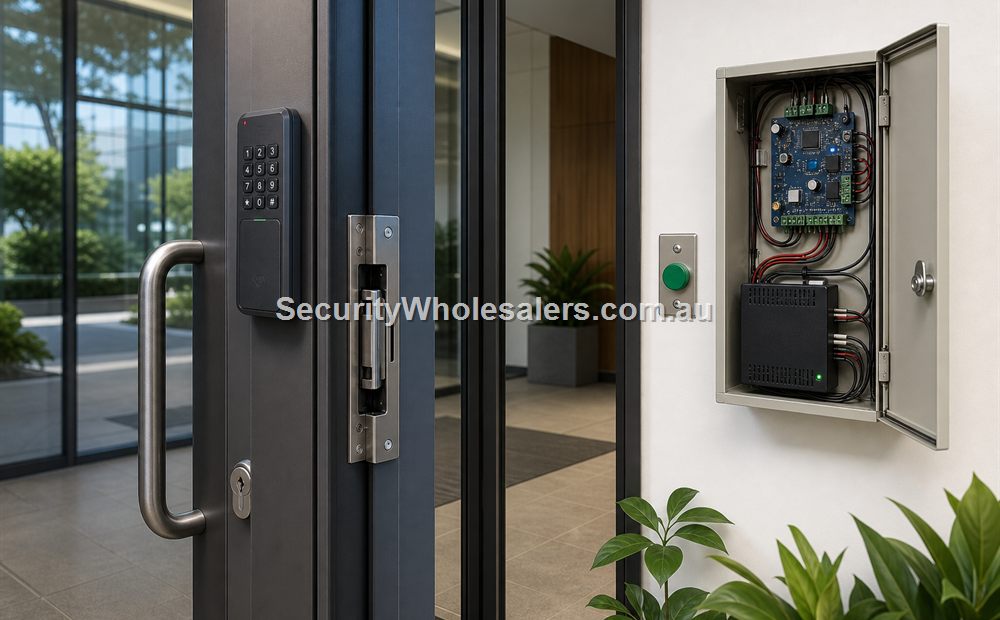
Fail safe versus fail secure is one of the most misunderstood parts of access control because it is often reduced to a lock label instead of being treated as a door-behaviour decision. The question is not only what the hardware does. It is what the opening should do when power is lost and whether that behaviour still makes sense for the site.
Main difference
| Mode | What usually happens on power loss | What the installer should think about |
|---|---|---|
| Fail safe | The opening releases when power is removed | Whether the site expects the opening to unlock rather than stay secure during a power event. |
| Fail secure | The opening stays secure when power is removed | Whether the site still has the right safe egress and emergency behaviour for that door. |
Internal office storeroom
A simple internal storeroom may only need the opening to stay secure in a normal power interruption while still having a clear exit path from the safe side. That is a different conversation from a public or shared entry where the building expects the opening to release when power is lost.
Shared building entry
A shared entry in a larger building may need the fail mode coordinated more carefully with the rest of the door behaviour, because people approach it differently and expect it to behave differently in an outage or emergency condition.
Questions that usually decide the fail mode
- What is the actual purpose of the door: public entry, staff-only room, restricted room, shared building opening, or service access?
- Should the opening remain secure or release when normal power is lost?
- How does the safe-side egress work if the lock path changes state unexpectedly?
- Does the site have any broader release or compliance expectation that affects the whole opening rather than only the lock body?
Why this should be decided early
The fail mode should be decided before the final lock hardware is fixed because it affects expectations, power planning, egress, and release logic. If it is left until the end of the quote, the site often inherits a lock path that works electrically but feels wrong operationally.
Door-by-door examples
| Opening | Potential solution | Parts and cabling to allow for | Decision still requiring approval |
|---|---|---|---|
| Staff entry with mechanical free egress | Fail-secure electric strike may suit a compatible latch and frame. | Strike, reader, protected controller, door contact, REX if used for event logic, lock power pair, reader cable, input cable and PSU/battery. | Whether remaining locked from the entry side on power loss matches the approved building and operational requirement. |
| Maglocked shared entry | Fail-safe maglock normally releases when lock power is removed. | Maglock and brackets, reader/controller, door contact, REX, approved emergency release arrangement, fire-interface circuit where required, continuously rated PSU and battery strategy. | The exact egress and fire cause-and-effect. A REX sensor alone must not be assumed to satisfy an independent emergency-release requirement. |
| High-security storeroom | Fail-secure strike or electrified lock may preserve entry-side security through a power interruption. | Lock, mechanical safe-side egress where required, reader, controller, contact, tamper, individually protected power and event monitoring. | Whether life-safety, fire-door or accessibility requirements override the preferred security behaviour. |
| External gate | Fail mode depends on pedestrian egress, emergency access, automation and site risk. | Weather-rated lock/reader, protected local controller, surge protection, underground pathway, gate-controller isolated interface and mechanical override. | The gate/door contractor, fire authority pathway and site emergency procedure must agree on the final state. |
Fail safe is not the same as compliant egress
'Fail safe' describes what the lock does when its power is removed. It does not prove that the door hardware, release devices, fire interface, signage, mounting and path of travel satisfy the project's approvals. The certifier, fire contractor, door/hardware specialist and access-control installer should sign off one door cause-and-effect schedule.
Relevant SecurityWholesalers product paths
- Door strikes and maglocks because fail mode is tied closely to the chosen lock path.
- Access control hardware for the wider door components that shape behaviour around the lock.
Related guides
Frequently Asked Questions
- What does fail safe mean in plain terms?
Fail safe usually means the opening unlocks when power is removed.
- What does fail secure mean in plain terms?
Fail secure usually means the opening stays secure when power is removed.
- Is fail safe always the better option?
No. The right choice depends on the purpose of the opening, the safety path, and how the building expects the door to behave during a power event.
- Why is this more than a hardware label?
Because fail mode affects not only the lock, but also the user expectation, release logic, and how the opening behaves under abnormal conditions.
- What is the biggest fail-mode mistake?
Choosing based on habit or shorthand without checking whether the door should remain secure or release in the actual site workflow.
- Which page should someone read next?
The fire and egress basics page is the natural next step because it connects fail mode to the wider door behaviour during emergencies.
Review information
Content owner: SecurityWholesalers access control guide team. Revision: 17 July 2026. Use these examples as a starting point, then confirm the details against current product manuals, approved drawings and relevant authority requirements.
NCC access and egress | ACMA cabling requirements | OAIC biometric guidance | Access control definitions