

















Informational
Strikes, Maglocks, Exit Buttons, and Door Sensors
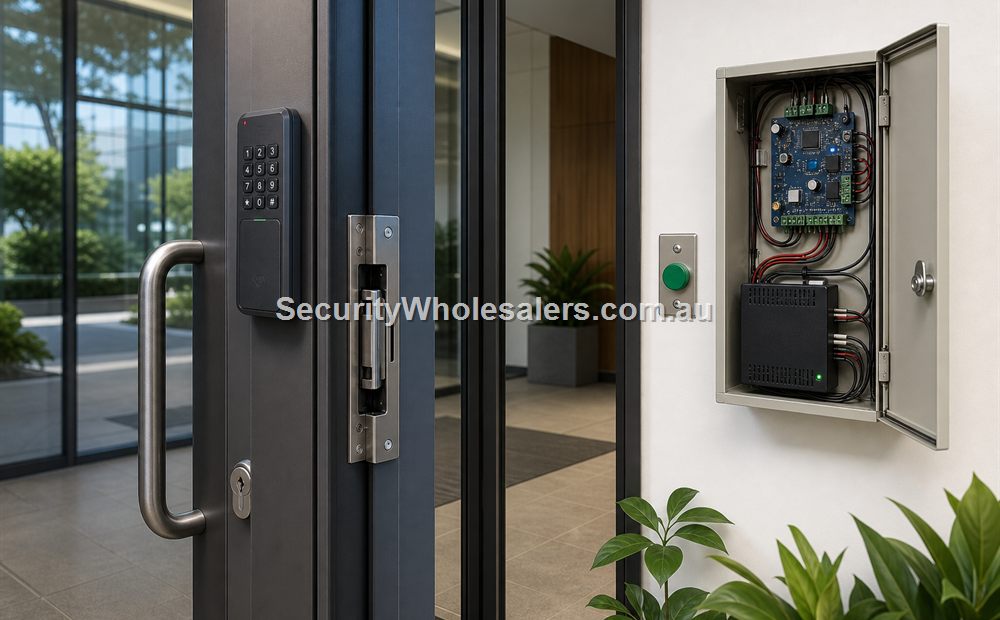
Supporting Guide
If the hardware layer is wrong, the user experience will feel wrong no matter how good the terminal looks. Doors will preload, unlock badly, fail to report properly, or force installers into awkward compromises. That is why the lock and egress design should be treated as part of the buying decision, not just an installation detail.
What Each Hardware Layer Actually Does
| Component | Typical Role | Why It Matters |
|---|---|---|
| Electric strike | Releases the latch on many hinged doors | Often a clean option for commercial doors where the frame and latch arrangement suit it. |
| Maglock | Magnetic holding on doors where that style is more practical | Can suit some door types, but egress, monitoring, and release logic must be correct. |
| Exit button or request-to-exit | Lets users leave safely and predictably | Without proper egress logic, the system becomes frustrating or unsafe. |
| Door contact or monitoring | Tells the system whether the door is closed or left open | Important for auditing, forced-door review, and troubleshooting. |
| Secure door module | Protects the lock-side wiring | Helps stop reader tamper from becoming a direct unlock path. |
Strikes vs Maglocks
In many commercial hinged doors, an electric strike is a natural first option because it works with the latch arrangement and keeps the door behaving like a normal locked door when not released. This is why categories such as Door Strikes deserve a serious look early in the project.
Maglocks can absolutely have a place, especially where the door construction or layout points that way, but they should not be treated as a shortcut. Buyers need to think carefully about how the door releases, how it is monitored, and how it behaves in real daily use. The right choice depends on the door, not on which hardware label sounds simpler.
Monitoring Is What Separates a Tidy System from a Guessing Game
A monitored strike or monitored maglock can help the site know whether the door actually closed and whether the lock state makes sense. That matters in higher-value rooms, busy staff entries, or anywhere the site may later need to explain whether the door was left open or forced.
Products such as the Lockwood ES9000 or the Trimec ES2000 show the kind of monitored strike thinking that becomes more useful as the door becomes more important.
Secure Modules and Reader Protection
When the front-end reader or terminal is on the unsecured side of the door, buyers should think about whether a secure door module is appropriate. A device such as the Hikvision DS-K2M061 exists for exactly this reason: to separate the vulnerable front-end terminal from the lock-side release wiring.
That may be unnecessary on the simplest single-door job, but it becomes more relevant once the buyer wants higher assurance or more sensitive doors.
Text Diagram: Typical Strike-Based Door Path
[Credential presented]
        |
        v
[Reader / terminal / controller decision]
        |
        v
[Strike output releases latch in frame]
        |
        v
[User enters through hinged door]
        |
   +----+--------------------+
   |                         |
   v                         v
[Exit button / REX]     [Door contact]
   |                         |
   +------> [Safe egress]    +--> [Closed / held / forced status]
Text Diagram: Typical Maglock and REX Path
[Credential presented]
        |
        v
[Reader / terminal / controller decision]
        |
        v
[Maglock power interrupted for release]
        |
        v
[Door opens]
        |
   +----+--------------------------+
   |                               |
   v                               v
[REX sensor or button]        [Door contact / monitor]
   |                               |
   +--> [Release from safe side]   +--> [Door secure or left open]
How an Installer Should Survey the Door Before Quoting Hardware
This is where a lot of bad access-control jobs begin. Installers should inspect the actual opening before promising a strike, maglock, or exit method, because the right answer depends on the door, frame, closer, latch, traffic pattern, and how people are meant to leave in normal operation. A lock type copied from the last job is usually a warning sign, not a shortcut.
- Confirm whether the door is hinged, outward-opening, inward-opening, aluminium framed, timber, glazed, or otherwise non-standard.
- Check whether the existing latch and frame can accept an electric strike cleanly or whether a maglock-style path is more realistic.
- Inspect closer strength, hinge alignment, and whether the door already re-latches reliably without access control.
- Decide how the safe-side egress will work before the lock hardware is fixed in place.
- Check whether the site wants held-open, forced-door, or not-closed reporting, because that affects whether monitored hardware and contacts should be quoted from day one.
Where Exit Buttons, Request-to-Exit, and Door Contacts Fit
The lock hardware does not live by itself. A good access-controlled opening also needs a safe-side release path and, on better systems, a way to tell whether the door is actually closed again afterward. Exit buttons are simple and can be perfectly fine on straightforward doors. Request-to-exit sensors become more attractive where flow is heavier, hands-free exit is preferred, or the installer wants a cleaner automatic release path tied into the lock logic.
Door contacts are what make the opening reportable instead of mysterious. Without a contact, the system may know a credential was accepted but not whether the door shut, whether it was propped, or whether someone forced it after the unlock window. That is why monitored hardware and contacts become more valuable as the room, door, or site gets more important.
How the Hardware Layer Should Be Commissioned
Hardware commissioning is where the installer proves that the physical door behaves the way the access platform thinks it behaves. If the strike releases but the latch still binds, or the maglock releases but the door contact reports nonsense, the system will frustrate the user no matter how tidy the software looks.
- Test multiple valid releases in a row to check preload, latch movement, and realistic entry timing.
- Test safe-side egress repeatedly so the door always releases cleanly without awkward or unsafe behaviour.
- Confirm the door contact changes state correctly when the door is closed, opened, or intentionally left open.
- Where monitored locks are used, verify the monitored feedback agrees with the real mechanical state of the opening.
- Show the client what a hardware fault looks like in the event log so future troubleshooting starts from evidence, not guesswork.
When This Page Should Drive the Buying Decision
If a buyer is still undecided about system tier, this page often tells them more than the reader page does. A site may look like a simple one-door job in theory, but if the actual opening needs careful strike work, monitored feedback, a secure module, and a cleaner REX path, then the installer is already dealing with a more serious hardware project than the badge on the wall suggests. That is why lock hardware and egress design should be used to steer the whole access conversation, not left until the very end.
Lock circuit design: the details that belong in the quote
| Item | Record before selection | Prove at commissioning |
|---|---|---|
| Mechanical opening | Door/frame material, handing, latch or exit device, closer, alignment, preload, fire/egress status and traffic | Reliable closing and relatching over repeated normal cycles |
| Electrical lock | Voltage range, normal/holding current, peak or inrush current, fail mode, duty rating and monitoring outputs | Voltage at the lock under load, correct fail behaviour and accurate monitored state |
| Power circuit | One-way distance, conductor size, voltage-drop result, fuse/output allocation and battery contribution | Operation at worst expected supply condition and after mains failure |
| Door contact | Normal state, supervision, mounting gap and relationship to lock monitoring | Closed, open, forced and held-open events |
| Exit path | Mechanical egress, REX/button purpose, emergency release and approved interfaces | Immediate safe exit during normal operation and each required fault/emergency condition |
Do not use nominal cable rules blindly
A two-core cable that works for a low-current strike at a short distance may be unsuitable for a maglock, long run or device with higher inrush. Calculate the circuit from the selected lock datasheet and actual route, then measure at the device while operating.
Relevant SecurityWholesalers Product Areas
- Door Strikes - Often the first place to look for many hinged-door jobs.
- Door Locks - Useful when comparing lock types and monitored options.
- Lockwood ES9000 - A good example of a more capable monitored strike.
- LOX MML2400 - An example of a monitored maglock-style approach for suitable doors.
- Hikvision DS-K2M061 secure door module - Relevant where the reader needs a more secure lock-side arrangement.
Source References
Frequently Asked Questions
-
Why does door hardware matter so much in access control?
Because the lock, sensor, exit device, and power path often determine whether the door behaves properly every day. A good reader on the wrong lock is still a bad system.
-
When is an electric strike a better choice than a maglock?
Electric strikes often suit many hinged commercial doors where the latch and frame arrangement allow them. Maglocks are sometimes chosen where the door design points that way, but they still need the right egress and monitoring logic.
-
What does door monitoring add?
Monitoring helps the system know whether the door is actually closed, held open, or behaving abnormally, which improves both security and troubleshooting.
-
What is a secure door control module for?
A secure module isolates the lock-side wiring from the front-end reader or terminal so tampering with the reader does not simply release the door.
-
Should this part of the site be marked on a plan before installation?
Usually yes. A marked-up plan helps confirm viewing direction, blind spots, mounting positions, and whether the chosen camera type still makes sense before hardware is finalised.
-
What matters more here: wide overview or clear identification detail?
That depends on the job of the camera. Some zones need a broad overview, while others need enough detail to identify a person, vehicle, or event clearly.
Review information
Content owner: SecurityWholesalers access control guide team. Revision: 17 July 2026. Use these examples as a starting point, then confirm the details against current product manuals, approved drawings and relevant authority requirements.
NCC access and egress | ACMA cabling requirements | OAIC biometric guidance | Access control definitions