

















Commercial
Access Control for Factories
Sector Guide
Where this usually fits
Factory jobs are normally decided by how the site separates office, production, maintenance, contractor, and service access. That means the controller and cabinet layout matters early, because the building is usually managing several user groups and several kinds of opening at once.
| Situation | Usually the cleaner path | Why it fits |
|---|---|---|
| One amenities or supervisor door | Single Door Access Control Kit | Possible if the opening is isolated and the factory does not expect stronger review or growth. |
| Office entry plus factory staff door | 2 Door Access Control Kit | The site already has separate movement types and named users. |
| Office, production, plant room, and maintenance store | 4 Door Access Control Kit | Several permission groups and a need for spare capacity make a four-door path cleaner. |
| Large factory with shifts, contractors, and many restricted zones | Controller and software path | The job is already an industrial permissions system. |
Sample site scenarios
Small fabrication workshop
A smaller fabrication site with one office entry, one workshop staff door, and one tool room can often be solved with a two-door or four-door path. The key is not overcomplicating it while still avoiding shared credentials that become impossible to police across shifts.
Larger manufacturing floor with maintenance contractors
A larger manufacturing floor with shift staff, maintenance contractors, and restricted service rooms usually needs controller architecture and software from the start. The site has too many permission groups to leave on isolated standalone devices.
Typical hardware and software direction
These jobs are usually decided by the management layer as much as the lock hardware. The right reader or terminal only solves part of the problem if the permissions, schedules, and review workflow have been underspecified.
- Controller path sized for current doors plus spare room for maintenance or plant-room growth.
- Readers or terminals on staff and restricted-area doors, with proper lock and egress hardware on each opening.
- Separate permissions for office staff, production staff, maintenance, contractors, and management.
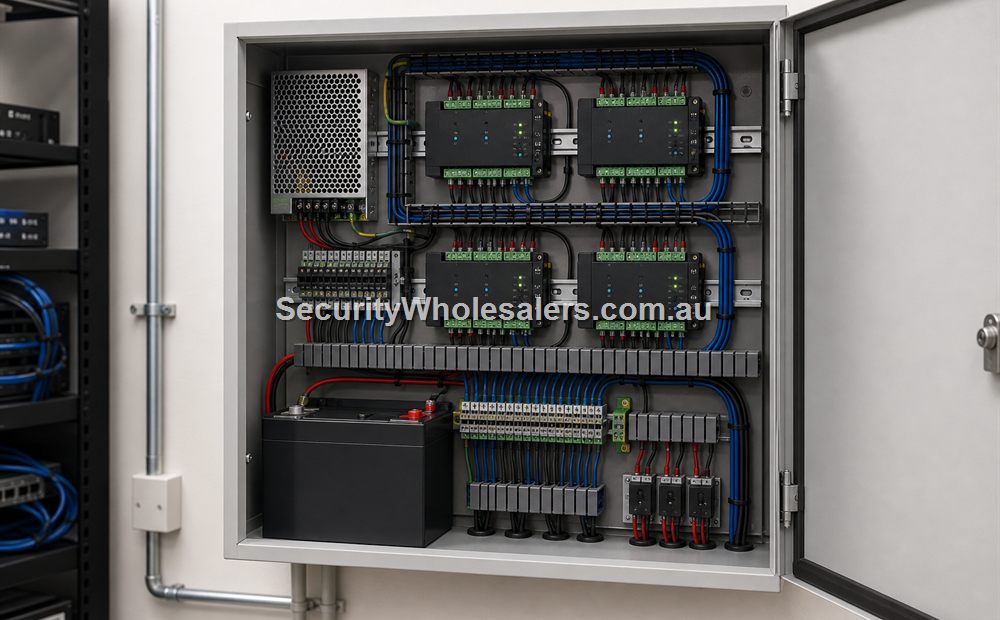
- UPS and central cabinet planning to keep the industrial head-end serviceable and protected.
- If the site has gate or operator triggers, integrate them deliberately rather than treating them as an afterthought.
Things to check
- Using one shared staff credential approach across office, production, and restricted service areas.
- Forgetting how shift changes affect schedules and after-hours access.
- Adding plant-room doors later and discovering the original kit had no spare capacity.
Relevant SecurityWholesalers product paths
- DS-K2704X for four-door industrial layouts.
- DS-K2708X for larger factory head-end planning.
- Hikvision Access Control Base License Package where the factory needs central scheduling and review.
Related guides
Frequently Asked Questions
- Do factories usually need a controller-based system?
Yes, once shift staff, contractors, restricted service rooms, or several openings are involved, controller design usually becomes the cleaner long-term answer.
- Can a small workshop still use a simple door kit?
It can on an isolated opening, but many workshops quickly outgrow that once office and production movement are separated properly.
- Why do schedules matter so much on factory access?
Shift work and contractor timing often change which users should be able to move through the building at different times.
- What is the most common factory access-control mistake?
Undersizing the system and then having no clean way to add restricted service rooms or maintenance access later.
- Should factories treat gate and operator access separately?
They should be integrated deliberately, with clear relay and responsibility boundaries, rather than improvised after the door system is already fixed.
- Which page should someone read next?
If the site already has several restricted rooms, the four-door kit and lift-and-controller guide are the next useful steps.
Plan this site door by door
Download the editable workbook, list every controlled opening, then email it with matching door photos to sales@securitywholesalers.com.au. Include the site suburb, installation requirement and target timing.
Review information
Content owner: SecurityWholesalers access control guide team. Revision: 17 July 2026. Use these examples as a starting point, then confirm the details against current product manuals, approved drawings and relevant authority requirements.
NCC access and egress | ACMA cabling requirements | OAIC biometric guidance | Access control definitions