












Informational
What Is a Hikvision Thermal Camera?
Explainer
Hikvision thermal camera definition
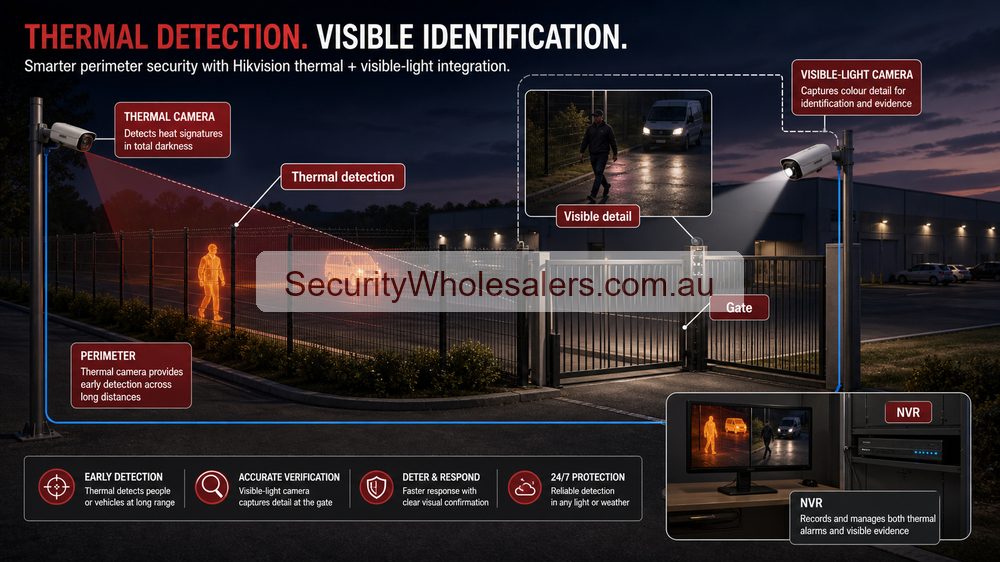
A Hikvision thermal camera detects the infrared energy naturally emitted by people, vehicles, machinery and other objects. It converts temperature differences into a visible heat image, so it does not need daylight, white light or infrared illumination to detect a target.
How does a Hikvision thermal camera work?
Every object above absolute zero emits infrared radiation. A thermal sensor measures differences in that energy and turns them into an image made from heat patterns. Warmer and cooler areas appear with different shades or colours, depending on the selected display palette.
Can a thermal camera see in darkness, fog, rain or smoke?
A thermal camera can detect heat in complete darkness because it does not rely on visible light. It is also generally less affected than an ordinary optical camera by glare, haze, light fog, rain and some smoke. However, it does not literally see through every obstruction. Heavy rain, dense fog, thick smoke, glass, solid objects and certain environmental conditions can reduce thermal range, contrast and accuracy.
Thermal detection is different from normal CCTV identification
Thermal cameras are excellent at showing that a warm target is present, even when the scene is dark. They are not designed to show normal colour, readable clothing detail or a familiar face in the same way as an optical camera. For doors, counters and everyday home driveways, a well-positioned visible-light camera is usually the better choice.
What is the difference between thermal-only and bi-spectrum?
A thermal-only camera provides a heat image. It suits situations where early detection, temperature differences or long-range perimeter monitoring are the main goals.
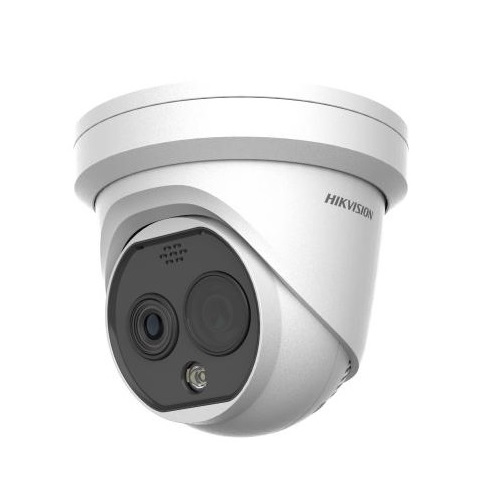
A bi-spectrum camera combines a thermal sensor with a normal optical camera in the same housing. The thermal channel detects the event, while the optical channel provides familiar visual context. This is often easier for operators because they can confirm what triggered the alert without relying on a separate nearby camera.
Where are Hikvision thermal cameras used?
- Perimeter protection: detecting people or vehicles around long boundaries, yards, farms, depots and critical infrastructure.
- Early fire-risk warning: monitoring waste, timber, stockpiles, battery areas, server rooms or industrial equipment for abnormal heat.
- Industrial temperature monitoring: identifying hot spots or temperature exceptions in machinery and electrical equipment.
- Difficult lighting: detecting activity where darkness, glare or low visual contrast makes an ordinary camera less reliable.
Example: plant room versus office corridor
Plant room: a thermal or bi-spectrum camera may be justified when the aim is to identify abnormal heat before equipment damage or visible smoke.
Office corridor: a normal optical camera is usually more useful because the goal is to see who walked through and what they were doing.
The key difference: the plant room needs heat awareness; the corridor needs visual identification. One camera technology should not be forced into both jobs.
What thermal cameras cannot do
- They do not show normal scene colour or clothing colour.
- They are not the first choice for facial identification or ordinary number-plate evidence.
- They do not see through walls, solid objects or standard glass in the way people sometimes assume.
- They do not remove the need for correct lens selection, mounting height and detection-zone design.
- They do not replace visible-light cameras when an operator needs familiar visual evidence.
Hikvision thermal camera vs normal CCTV camera
| Feature | Thermal camera | Normal optical camera |
|---|---|---|
| Creates an image from | Infrared heat energy and temperature differences | Visible light or reflected infrared illumination |
| Complete darkness | Can detect targets without added light | Usually needs infrared or white-light illumination |
| Colour and familiar detail | Does not provide normal scene colour | Better for faces, clothing, vehicles and everyday evidence |
| Typical strength | Early detection, heat anomalies and difficult visibility | Identification, recognition and normal playback context |
| Best system design | Often paired with an optical camera or selected as bi-spectrum | Used for the main evidence views across most properties |
How to choose a Hikvision thermal camera
| Question | Why it matters |
|---|---|
| Is the goal security detection or temperature measurement? | Security thermal and thermography models are designed for different jobs and should not be treated as interchangeable. |
| Do you need thermal-only or bi-spectrum? | Bi-spectrum adds an optical channel for visual verification, while thermal-only focuses on heat imaging. |
| What distance and area must be covered? | Detection distance, lens and thermal resolution need to suit the target size and field of view. |
| Is temperature measurement required? | Not every security thermal camera provides the same thermographic accuracy or alarm functions. |
| What should happen after an alarm? | An alert is only useful when it reaches the right person and there is a clear response procedure. |
Hikvision thermal resolution explained briefly
Thermal resolution is not the same as the megapixel rating on a normal CCTV camera. Common Hikvision thermal tiers such as 160 x 120, 256 x 192 and 384 x 288 describe the number of measuring pixels in the thermal sensor. Higher thermal resolution generally provides more heat detail or supports a larger scene, but lens choice, distance and target size are equally important. Read the full Hikvision thermal resolution guide before choosing by resolution alone.
Hikvision thermal camera examples
These models show the difference between entry-level HeatPro, bi-spectrum and more specialised thermographic cameras.
- DS-2TD1217-2/QA HeatPro turret - Shows what an entry-level thermal and optical turret looks like in the real Hikvision range.
- HeatPro DS-2TD1228T-2/QA - A good example of a bi-spectrum model that combines thermal and visible channels.
- DS-2TD2637T-10/QY - Shows the more serious thermographic end of the range.
Sources and Further Reading
Frequently Asked Questions
-
What does a Hikvision thermal camera see?
It sees differences in heat across the scene. It does not depend on visible light the way ordinary CCTV does.
-
Is a thermal camera the same as a night camera?
No. A night camera still uses a visible-light image sensor. A thermal camera uses a thermal sensor to read heat differences.
-
Can a Hikvision thermal camera see through fog, rain or smoke?
Thermal imaging is generally less affected than visible-light CCTV by darkness, glare, light fog, rain and some smoke, but it cannot see through every obstruction. Dense fog, heavy rain, thick smoke, glass and solid objects can reduce or block the result.
-
Why do some Hikvision thermal cameras have two lenses?
Those are bi-spectrum models. One lens is for thermal imaging and the other is a visible-light optical channel for ordinary scene context.
-
Can a thermal camera read number plates or show clothing colour?
Not in the way a normal visible-light camera does. Thermal is better treated as a detection and anomaly layer, not a replacement for every identification task.
-
When is thermal usually unnecessary?
It is usually unnecessary on small ordinary scenes like a front door, checkout, or driveway where a good fixed visible-light camera already answers the question well.
-
Does Hikvision thermal suit fire detection?
Yes, selected Hikvision thermal and bi-spectrum models are used for temperature exception and fire-risk applications, but the camera still needs to be selected and installed around the actual risk area.
Related Pages
Hikvision Thermal Cameras Buying Guide
The main Hikvision thermal guide for perimeter, fire, and bi-spectrum buying decisions.
Hikvision Thermal vs ColorVu vs IR Night Vision
A practical thermal versus visible-light night strategy comparison.
Hikvision Thermal Resolution Explained: 160 x 120 vs 256 x 192 vs 384 x 288
A practical explanation of Hikvision thermal resolution tiers.
How to Choose a Hikvision Camera
Work out which Hikvision camera type fits the job, the lighting, and the installation.