












Commercial
Hikvision Thermal Cameras Buying Guide
Buying Guide
What a Hikvision thermal camera actually does
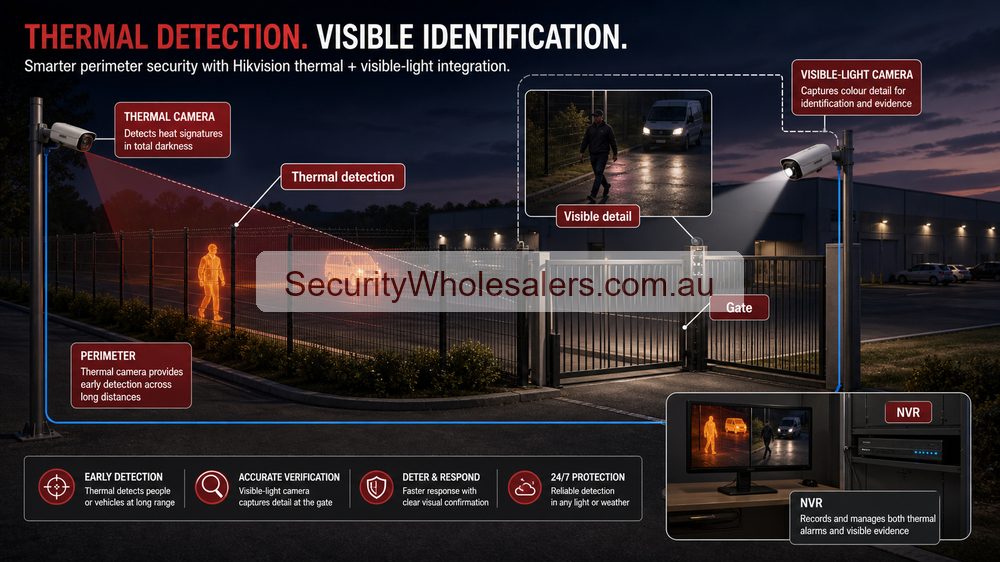
A Hikvision thermal camera measures heat differences across the scene and turns those differences into a thermal image. It is not mainly there to show clothing colour, number plates, or facial detail. Its value is that it can detect people, vehicles, hotspots, and heat-related anomalies in conditions where ordinary cameras can become inconsistent.
That distinction matters because many buyers first look at thermal as if it were simply another night camera. It is not. The question is not whether the thermal image looks prettier than ColorVu or infrared. The real question is whether the site has a detection or fire-risk problem that visible-light CCTV is poorly suited to solve.
Thermal versus ColorVu versus infrared night vision
ColorVu and Smart Hybrid Light are still visible-light camera strategies. They try to improve what a normal CCTV camera shows at night. Thermal is different. It changes the detection method altogether by looking at heat rather than reflected light.
| Technology | Usually strongest for | Main limitation |
|---|---|---|
| Thermal | Perimeter detection, heat anomaly detection, difficult darkness, smoke, glare, and open-ground jobs | Does not replace ordinary colour detail or identification footage |
| ColorVu or Smart Hybrid Light | Entrances, driveways, gates, and business frontages where night-time colour context matters | Still depends on the visible scene and can be affected by spill light, reflections, fog, or harsh scene conditions |
| Infrared night vision | General black-and-white night coverage at ordinary doorways, paths, and perimeter points | Provides less scene colour context and usually offers less detection confidence on very large or difficult sites |
Security thermal, thermography, and bi-spectrum are not the same buying decision
Security thermal is usually about intrusion or perimeter detection. Thermography thermal is more about temperature trends, hotspots, or plant-risk monitoring. Bi-spectrum products sit in the middle by giving the job both thermal detection and a visible-light view for context. Buyers get better results when they decide which of those conversations they are really having before they shortlist cameras.
| Thermal path | Usually strongest for | Typical examples |
|---|---|---|
| Security thermal | Perimeter, open-ground detection, difficult darkness or glare scenes | Farms, quarries, larger boundaries, remote yards |
| Thermography thermal | Heat anomalies, electrical or plant monitoring, early fire-risk thinking | Industrial plant, switchboards, higher-risk process areas |
| Bi-spectrum thermal | Sites that want both thermal detection and visible scene context | External industrial edges, fire-smoke use cases, harder outdoor approaches |
Product options that make sense on SecurityWholesalers today
The current thermal category on SecurityWholesalers already shows the main tiers buyers need to think about.
- 160 x 120 entry-level HeatPro models such as the DS-2TD1217-2/QA are a practical starting point for shorter-range heat and fire-risk awareness where budget matters.
- 160 x 120 bullet models such as the DS-2TD2617-6/QA start to make more sense when the thermal job is mounted outdoors and needs a more directional field of view.
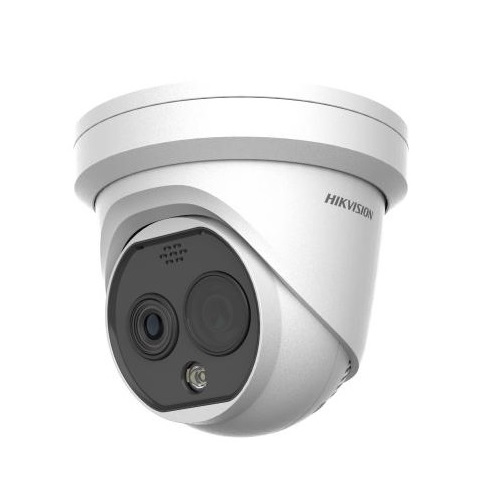
- 256 x 192 bi-spectrum turrets and bullets such as the DS-2TD1228T-2/QA and DS-2TD2628T-7/QA are often the stronger middle ground because they improve thermal detail while keeping a visible optical channel for context.
- 384 x 288 thermographic bullets such as the DS-2TD2637T-10/QY sit in the more serious end of the category where the detection zone is larger or the fire-detection requirement is more demanding.
- Thermal PTZ models such as the DS-2TD4228T-10/S2 belong on broader sites where patrol, tracking, and dual-spectrum observation matter more than one fixed view.
Where Hikvision thermal is usually justified
Thermal usually becomes easier to justify on farms, quarries, mining support sites, remote yards, larger open boundaries, difficult car-park or perimeter edges, and selected fire-risk or plant-monitoring jobs. It can also make sense where visible-light cameras are already in place but the site still struggles to detect activity early enough in darkness, smoke, or glare-heavy conditions.
The key point is that thermal is solving a specific problem. If the site only needs a normal front door, cashier position, driveway, or internal corridor camera, a good visible-light camera is still usually the better answer. If the site needs to detect movement or abnormal heat across distance and difficult conditions, thermal becomes more relevant.
Example: perimeter protection on a remote yard
Situation: A regional equipment yard has a long, poorly lit rear boundary and occasional after-hours trespass. The owner already has ordinary bullet cameras near the office and gate, but the back fence line is still difficult to watch properly because of distance, fog, and light spill from neighbouring properties.
Solution used: A directional thermal bullet was added to watch the actual crossing line, while ordinary optical CCTV stayed in place near the entry points and office area.
Why this was chosen: The job was not to identify a face at the rear fence from a long distance. The job was to detect that someone or something crossed the boundary in the first place. Thermal suits that kind of problem much better than simply adding another visible-light overview camera.
Installation notes: The important part was not just camera choice. The installer had to confirm the field of view against the boundary line, decide whether a single fixed view or PTZ patrol made more sense, and make sure the alarm setup actually reached someone after hours.
Example: early fire detection on a waste or stockpile site
Situation: A waste yard or timber processing site wants earlier warning of abnormal heat near stockpiles and operating areas after hours. The owner does not want to rely on waiting until flames are visible to a normal camera.
Solution used: A bi-spectrum thermal camera with temperature exception and fire-related capability was mounted to cover the known risk area, with the visible optical channel used for context and event review.
Why this was chosen: This kind of site benefits from thermal because the first useful question is whether heat is building where it should not be. A visible-light camera may show smoke or flames only once the event is already well developed.
Installation notes: The installer still has to decide what happens after the alarm. If the alarm only appears on an unattended monitor, the design is incomplete. The escalation path may need app notification, relay output, or a managed response workflow.
Thermal resolution explained in practical terms
Thermal resolution is not just a spec-sheet number. It affects how much useful heat detail the camera can extract from a scene.
| Resolution | Practical meaning | Typical fit |
|---|---|---|
| 160 x 120 | Entry-level thermal detail for smaller scenes or shorter-range work | Short-range fire-risk awareness, small yards, indoor plant rooms, narrow outdoor approaches |
| 256 x 192 | Noticeably stronger detail and often the more practical middle ground | Outdoor perimeter work, stockpile watching, mixed security and fire jobs, bi-spectrum perimeter cameras |
| 384 x 288 | Higher-end thermal detail for larger or more demanding scenes | Critical infrastructure, longer-range perimeter work, more serious thermographic use, premium fire-detection jobs |
This is why a resolution change is often more important than a cosmetic feature change. On a large scene, stepping up from 160 x 120 to 256 x 192 can matter much more than adding a nicer visible-light image around the edge of the job.
Thermal installation and commissioning points
- Confirm the exact target distance and the width of the zone being watched.
- Decide whether the job is intrusion detection, heat anomaly detection, smoke or fire-risk monitoring, or a mix.
- Check whether the site also needs ordinary visible context from the same mount point.
- Confirm whether the alarm goes to an app, recorder, relay, monitoring workflow, or local staff only.
- Test the rules in the real environment, including night conditions, plant heat, exhaust heat, and reflective surfaces where relevant.
- Protect the camera and network connection properly if the thermal channel is part of a business-critical or after-hours response plan.
Even the right thermal camera still sits inside a recorder, network, and power plan. If it is part of a remote or business-critical detection path, the same storage, UPS, and review discipline still applies.
Relevant SecurityWholesalers Categories and Products
These are the main Hikvision thermal directions visible on SecurityWholesalers now: smaller 160 x 120 HeatPro models, stronger 256 x 192 bi-spectrum units, higher-end 384 x 288 thermographic bullets, and selected PTZ thermal models for larger sites.
- Hikvision thermal cameras category - The main starting point for thermal and bi-spectrum project research.
- DS-2TD1217-2/QA HeatPro turret - A lower-cost 160 x 120 entry point for short-range thermal awareness and small fire-risk jobs.
- HeatPro DS-2TD1228T-2/QA - A practical 256 x 192 bi-spectrum turret for shorter-range fire and perimeter work with visible context.
- HeatPro DS-2TD2628T-7/QA - A stronger 256 x 192 bullet option where the site wants fire and smoke features with more outdoor reach.
- DS-2TD2637T-10/QY thermographic bullet - A higher-resolution 384 x 288 option for more demanding perimeter or fire-related applications.
- DS-2TD4228T-10/S2 thermal PTZ - Useful where the site needs wider outdoor patrol, smart tracking, and both thermal detection and optical context.
Sources and Further Reading
Thermal design checklist
- Decide whether the job needs detection, identification, heat-risk monitoring or all three.
- Use visible-light cameras where faces, colours, number plates or familiar scene context are required.
- Check distance, lens, mounting height and field of view before assuming a thermal resolution is enough.
- Plan alerts, schedules and operator workflow so thermal events are actually acted on.
- Discuss signage, privacy and record retention for commercial and shared sites.
Frequently Asked Questions
-
What is a Hikvision thermal camera in simple terms?
In simple terms, it is a camera that reads heat differences in the scene rather than depending only on visible light. That makes it useful for detection in darkness, smoke, glare, open ground, and selected fire-risk applications.
-
When are Hikvision thermal cameras genuinely worth considering?
They are worth considering when ordinary visible-light cameras struggle to give reliable detection because of darkness, distance, smoke, glare, or the need to watch large outdoor areas more intelligently.
-
Do thermal cameras replace normal CCTV?
Usually no. Thermal is often best treated as a specialised detection layer, sometimes paired with visible-light cameras for context and identification.
-
What is a bi-spectrum thermal camera?
A bi-spectrum camera combines a thermal channel with a visible-light optical channel. That is useful when the project needs both heat-based detection and ordinary scene context for review.
-
Which Hikvision thermal resolution is usually enough?
160 x 120 can be enough for short-range or smaller heat-detection jobs, 256 x 192 is often the stronger middle ground, and 384 x 288 usually belongs on more demanding perimeter or thermographic work where the scene size or target distance is larger.
-
Are thermal cameras only for large industrial sites?
No, but they make most sense where the detection problem is real enough to justify them. That may be a farm perimeter, a remote yard, a quarry edge, a waste site, or a fire-risk or plant-monitoring situation.
-
What should the installer confirm before thermal selection?
The target distance, the detection objective, the expected mounting environment, the need for visible context, and whether the job is security thermal or more thermography-driven. Thermal should be selected to solve a defined problem, not because it sounds advanced.
-
Can Hikvision thermal cameras identify faces?
Thermal cameras are not chosen for normal face identification. They are mainly used for detection and heat contrast, often alongside visible-light cameras for identification.
Related Pages
What Is a Hikvision Thermal Camera?
A plain-language thermal explainer for Hikvision buyers.
Hikvision Thermal vs ColorVu vs IR Night Vision
A practical thermal versus visible-light night strategy comparison.
Best Hikvision Thermal Cameras for Perimeter Protection
Perimeter-focused Hikvision thermal buying guidance.
Best Hikvision Thermal Cameras for Fire Detection
Fire-detection buying guidance for Hikvision thermal cameras.