Informational

When to Use Bi-Spectrum Hikvision Thermal Cameras

Bi-spectrum cameras are often the most practical thermal cameras for real security jobs because they combine a thermal channel and a visible optical channel in the same unit. That gives the site both earlier detection and ordinary scene context.

Explainer

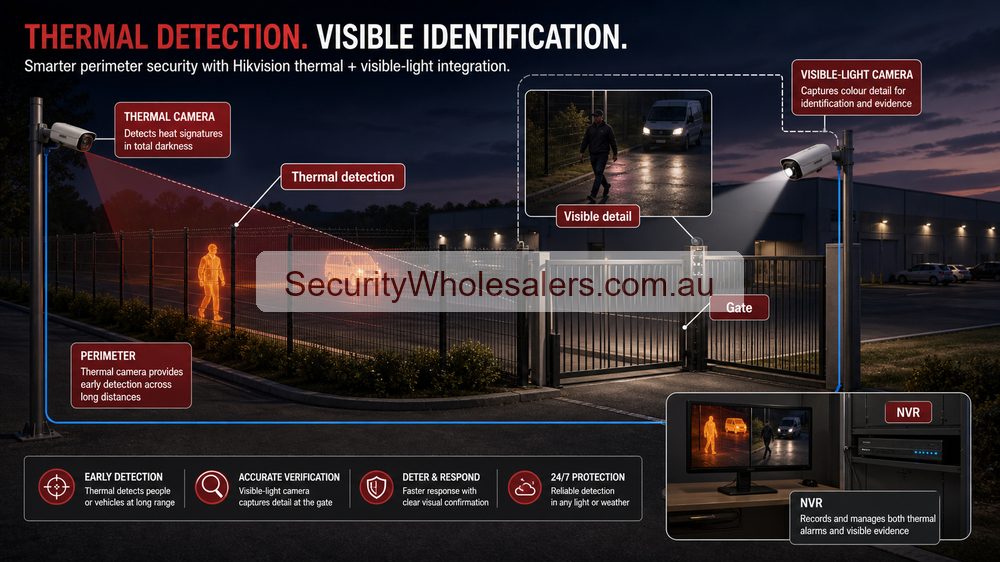
Hikvision thermal detection and visible light identification design diagram
Thermal is strongest for detection. Visible-light cameras still matter when the site needs familiar detail, faces, vehicle colour or context.
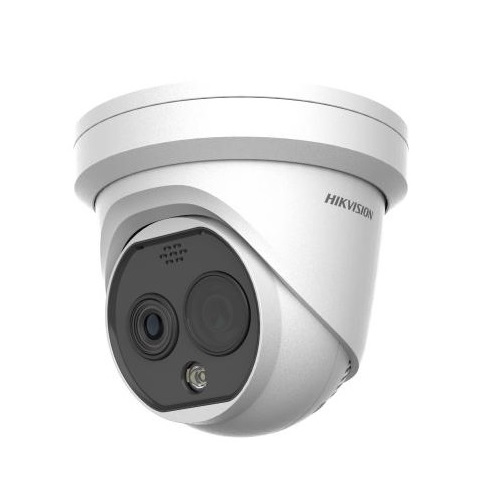
Hikvision bi-spectrum thermal camera example
Bi-spectrum Hikvision models combine a thermal view and a visible-light view in the same device, which is why they are often easier for operators and clients to work with than thermal-only cameras.

Bi-spectrum is often the practical middle ground

Many buyers like the detection strength of thermal but still need the site to show an ordinary optical scene when someone reviews the event. Bi-spectrum is the answer to that. It gives the operator both views without forcing a separate thermal camera and separate visible camera at the same position.

When bi-spectrum usually makes sense

  • Perimeter jobs where thermal detects the event but staff still want an ordinary visual view of the same scene
  • Fire-risk or heat-anomaly jobs where the operator wants to see the surrounding scene, smoke movement, access routes, or nearby vehicles
  • Sites where adding a second nearby visible-light camera would complicate the design without adding much value

When bi-spectrum may be unnecessary

If the thermal job is very compact, very specific, and the site already has adequate visible CCTV nearby, a thermal-only or simpler thermal-led design may be enough. Bi-spectrum earns its keep when the combined thermal-plus-optical view actually improves how the site will respond.

Example: waste transfer site

Situation: A waste site wants earlier warning of abnormal heat and also wants staff to understand what part of the yard is affected when an alarm triggers.

Solution used: A bi-spectrum bullet was chosen instead of a thermal-only unit.

Why this was chosen: The thermal channel can raise the alert, while the optical channel gives the operator ordinary scene context on the same risk area.

Installation notes: This reduces the need to match two separate cameras to the same zone and can simplify review if the camera position is chosen well.

Example: remote gate or yard approach

Situation: A rural gate or remote yard approach needs stronger after-hours awareness, but the owner still wants some optical review of the same entry line.

Solution used: A bi-spectrum thermal camera was preferred over a thermal-only device.

Why this was chosen: The thermal channel improves early detection, while the optical channel helps the operator understand the normal scene and confirm what is happening.

Installation notes: If the camera is used on a gate or approach line, the installer should still decide whether a separate close-up visible camera is needed elsewhere for identification or plates.

Relevant SecurityWholesalers Categories and Products

These Hikvision products are good examples of the bi-spectrum path because they combine thermal and visible channels in one device.

Sources and Further Reading

Thermal design checklist

  • Decide whether the job needs detection, identification, heat-risk monitoring or all three.
  • Use visible-light cameras where faces, colours, number plates or familiar scene context are required.
  • Check distance, lens, mounting height and field of view before assuming a thermal resolution is enough.
  • Plan alerts, schedules and operator workflow so thermal events are actually acted on.
  • Discuss signage, privacy and record retention for commercial and shared sites.

Bi-spectrum quote scenarios

Site Why bi-spectrum helps
Dark perimeter gate Thermal can detect movement while the visible channel gives context at the choke point.
Industrial yard Operators can see both heat signature and normal scene layout.
Remote boundary Detection can be more stable than relying only on visible light.

Bi-spectrum quote scenarios

Scenario Why bi-spectrum helps Design note
Dark boundary line Thermal detects movement while optical video gives context. Still plan the alarm response and visible verification path.
Waste or storage yard Thermal can support heat-risk awareness while optical helps operators understand the scene. Do not treat it as a certified fire system without proper compliance advice.
Industrial perimeter Bi-spectrum gives better review context than thermal alone. Lens, mounting height and detection distance still decide success.

Practical buying scenarios

Small site: use Hikvision thermal only where detection, heat risk or perimeter crossing is the real problem. Medium site: pair thermal detection with visible cameras so operators can understand the event. Complex site: design zones, schedules, response workflow and false-alarm handling before choosing the camera model.

Quote-ready checks

  • What exact incident or workflow is this page trying to solve?
  • Which views need identification detail and which only need overview?
  • Does the recorder or management platform support the finished camera count?
  • What must be tested at handover: live view, playback, alerts, export, users and account ownership?
  • Where would this system become the wrong choice and need a different product family?

For When To Use Bi Spectrum Hikvision Thermal Cameras, the strongest Hikvision quote should read like a site plan, not a box list. It should explain why each camera or recorder path is being chosen, where the buyer should avoid overbuying, and what happens if the site expands later.

Small, medium and complex examples

Site size Practical direction What to avoid
Small Keep the system simple and solve the main evidence points first. Buying specialist features before the basic views are right.
Medium Plan recorder headroom, remote access and stage-two expansion. Filling the recorder or ignoring storage assumptions.
Complex Document permissions, network design, response workflow and handover. Choosing models without a support and review plan.

This extra planning step is often what separates a useful Hikvision system from a quote that only looks good on paper.

Thermal camera field notes

Thermal is a specialist tool: use it for detection, heat awareness or harsh environments, not because it looks impressive. It does not replace normal visible identification footage.

Pairing matters: most practical projects combine thermal detection with visible cameras for verification. Operators need to know both that something happened and what they are looking at.

Quote example: a remote boundary might use thermal to detect crossing and a visible camera to verify. A plant room might use thermal for heat trend awareness and visible footage for maintenance review.

Final buyer rule

For When To Use Bi Spectrum Hikvision Thermal Cameras, the final Hikvision choice should be easy to defend on site: the view is useful, the recorder is sized properly, and the handover proves the buyer can find footage later.

Thermal camera field notes

Thermal is a specialist tool: use it for detection, heat awareness or harsh environments, not because it looks impressive. It does not replace normal visible identification footage.

Pairing matters: most practical projects combine thermal detection with visible cameras for verification. Operators need to know both that something happened and what they are looking at.

Quote example: a remote boundary might use thermal to detect crossing and a visible camera to verify. A plant room might use thermal for heat trend awareness and visible footage for maintenance review.

Final buyer rule

For When To Use Bi Spectrum Hikvision Thermal Cameras, the final Hikvision choice should be easy to defend on site: the view is useful, the recorder is sized properly, and the handover proves the buyer can find footage later.

Frequently Asked Questions

  • What does bi-spectrum mean on a Hikvision thermal camera?

    It means the camera has both a thermal channel and a visible optical channel.

  • Why is bi-spectrum often more useful than thermal-only?

    Because it gives the site both heat-based detection and normal visual context for review.

  • When is bi-spectrum worth paying for?

    It is worth paying for when the site needs both thermal awareness and ordinary scene context from the same area.

  • Is bi-spectrum good for perimeter protection?

    Yes. It is often a very practical way to detect an event thermally while still showing the optical scene for operators and playback.

  • Is bi-spectrum useful for fire detection?

    Yes, especially where the site wants thermal warning plus a visible image of the same risk area.

  • Does every thermal job need bi-spectrum?

    No. Some compact or highly specific thermographic jobs may not need it, but many practical security jobs benefit from it.

Related Pages

Hikvision Thermal Cameras Buying Guide

The main Hikvision thermal guide for perimeter, fire, and bi-spectrum buying decisions.

Best Hikvision Thermal Cameras for Perimeter Protection

Perimeter-focused Hikvision thermal buying guidance.

Best Hikvision Thermal Cameras for Fire Detection

Fire-detection buying guidance for Hikvision thermal cameras.

What Is a Hikvision Thermal Camera?

A plain-language thermal explainer for Hikvision buyers.

How to quote When To Use Bi Spectrum Hikvision Thermal Cameras properly

The practical value of When To Use Bi Spectrum Hikvision Thermal Cameras comes from how well it solves early detection on a real Australian site. A strong recommendation should talk about detection zones, heat sources, visible verification, false-alarm tuning and response procedure, because those details decide whether the system is useful after the installer leaves.

Thermal is strongest when the buyer needs detection in difficult light, smoke, dust or long perimeter conditions. It is not a face-identification camera. This is where a good buying guide should help: it should make the trade-offs visible before the customer spends money, not after the first incident exposes a weak view.

Small site

For a small Hikvision When To Use Bi Spectrum Hikvision Thermal Cameras project, focus on the few views that would prove the most likely incident. It is better to have fewer well-planned cameras than more cameras that miss faces, plates, doors or night detail.

Medium site

For a medium When To Use Bi Spectrum Hikvision Thermal Cameras site, separate identification views from overview views. Use stronger cameras where people, vehicles or high-value stock must be identified, and use practical overview cameras where the goal is movement context.

Complex site

For a complex When To Use Bi Spectrum Hikvision Thermal Cameras site, plan the recorder, permissions and expansion path before finalising cameras. Larger jobs often fail because the hardware is good but the storage, network or user workflow was never properly designed.

What a 95/100 Hikvision quote should include

  • A short explanation of what each recommended camera is expected to prove.
  • Enough recorder storage and spare channels for realistic future expansion.
  • Notes on night performance, glare, weather exposure, mounting height and service access.
  • A simple handover plan covering app access, playback, footage export and user permissions.

For When To Use Bi Spectrum Hikvision Thermal Cameras, the best buying decision is the one that still feels obvious six months later. If the buyer can understand why each device was chosen, how footage will be found, and where the system can grow, the quote is far more likely to deliver long-term value.

Final checks before ordering When To Use Bi Spectrum Hikvision Thermal Cameras

Before ordering When To Use Bi Spectrum Hikvision Thermal Cameras, ask the installer or sales team to describe the weakest part of the proposed design. That question is useful because every security system has a trade-off: lens width versus detail, deterrence versus discretion, recorder cost versus retention, or simplicity versus future expansion.

For When To Use Bi Spectrum Hikvision Thermal Cameras, the better Hikvision purchase is usually the one with a clear explanation rather than the longest specification sheet. The quote should say which views are for identification, which are for overview, which settings need commissioning, and which parts of the system should be reviewed after the first few weeks of real use.

A final practical check for When To Use Bi Spectrum Hikvision Thermal Cameras is supportability. Choose a system that can be explained to the person who will actually use it: how to open the app, find yesterday's event, export a clip, add a user, and understand when a camera or recorder needs attention. That day-to-day clarity is what separates a decent product list from a genuinely useful Hikvision security solution.

Wrap up EOFY with extra bonus savings :) Use Coupon code: EOFY26 on orders over 800.
Trade Customers: Log In or Register to Unlock Even Better Prices.

Save & Share Cart
Your Shopping Cart will be saved and you'll be given a link. You, or anyone with the link, can use it to retrieve your Cart at any time.
Back Save & Share Cart
Your Shopping Cart will be saved with Product pictures and information, and Cart Totals. Then send it to yourself, or a friend, with a link to retrieve it at any time.
Your cart email sent successfully :)