








Thermal design checklist
- Decide whether the job needs detection, identification, heat-risk monitoring or all three.
- Use visible-light cameras where faces, colours, number plates or familiar scene context are required.
- Check distance, lens, mounting height and field of view before assuming a thermal resolution is enough.
- Plan alerts, schedules and operator workflow so thermal events are actually acted on.
- Discuss signage, privacy and record retention for commercial and shared sites.
Fire-risk monitoring scenarios
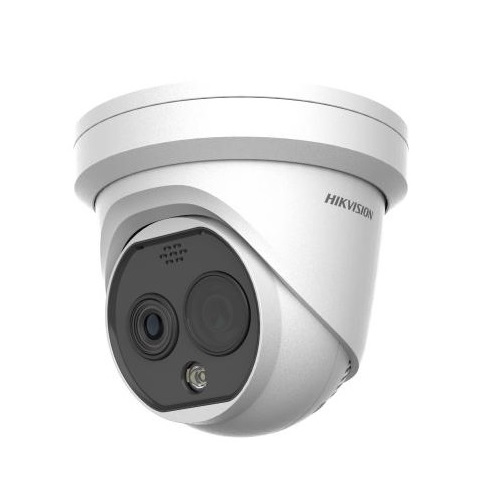
Hikvision thermal cameras can be useful where a site wants earlier warning around heat build-up, outdoor storage, plant rooms, waste areas, battery charging, recycling, workshops or other risk zones. They should be treated as a specialist monitoring layer, not as a substitute for compliant fire detection, fire engineering or building safety systems.
For a small workshop, a thermal camera may watch a battery charging bench or a waste area after hours and trigger an alert if the temperature crosses a chosen threshold. For a warehouse, thermal may focus on specific high-risk storage zones rather than trying to cover the whole building. For industrial yards, thermal may help monitor waste piles, plant, external storage or machinery areas where visible cameras alone do not show heat.
Fire detection planning checklist
- Identify the exact heat-risk object or zone, not just the room name.
- Confirm the expected normal temperature range before setting alarm thresholds.
- Use visible verification cameras so responders can understand what is happening.
- Avoid placing the camera where steam, reflective surfaces or changing sun exposure will confuse the scene.
- Document who receives alerts and what escalation process follows.
- Keep fire compliance, insurance and site safety obligations separate from CCTV convenience features.
What to ask before quoting thermal for heat monitoring
| Question |
Why it matters |
| What material or asset is being watched? |
Different heat profiles need different alarm expectations. |
| Is the site staffed when the risk occurs? |
After-hours response depends on alert routing and escalation. |
| Is visible verification available? |
Thermal detects heat; visible cameras help explain the incident. |
| What happens after an alert? |
The response plan is as important as the camera selection. |
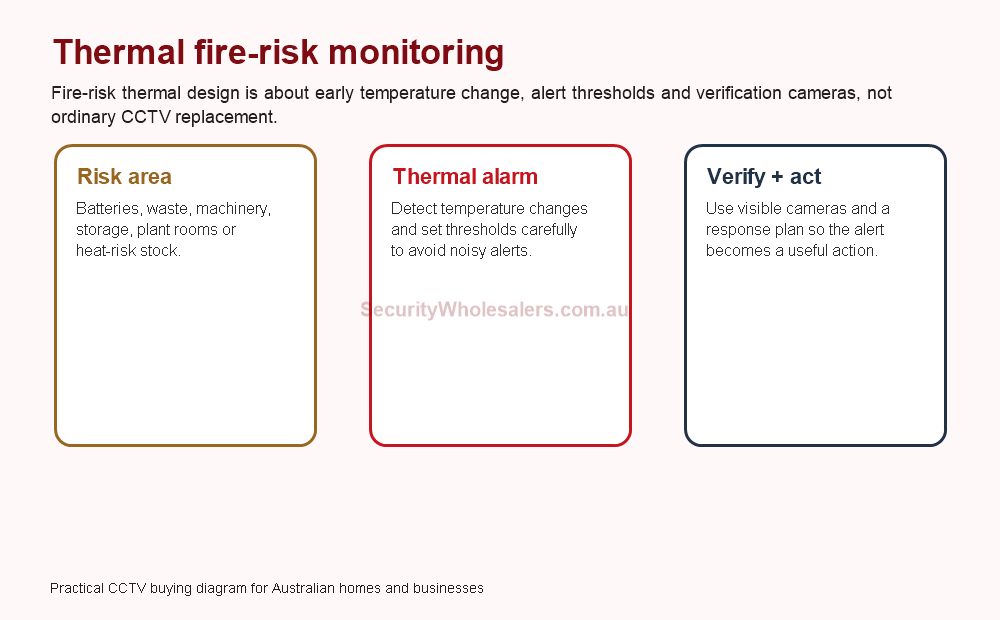
The strongest fire-risk thermal designs are narrow and practical. They choose a defined risk, test the normal scene, set sensible thresholds and make sure somebody can respond.
How to make thermal fire-risk monitoring useful
The strongest projects begin with a named risk: a battery charging area, waste pile, timber storage zone, plant room, switchboard, workshop bench or machinery area. The camera is then selected and aimed around that risk. Vague coverage of a large room is rarely as useful as focused monitoring of the zone where heat is most likely to matter.
Alarm thresholds should be set after understanding normal site behaviour. A surface that is hot every afternoon from sun exposure needs different thinking from an indoor charging cabinet. A dusty workshop, steam-prone area or reflective metal surface can create practical challenges. The buyer should expect commissioning and adjustment, not just installation.
Thermal fire monitoring handover
- Document the risk area and the reason the camera was installed.
- Record the normal temperature range observed during commissioning.
- Test the alert path and make sure someone receives it.
- Pair thermal alerts with visible verification where possible.
- Explain that CCTV thermal monitoring does not replace compliant fire systems.
- Schedule review after the first operating period to tune thresholds if needed.
Good fit and poor fit
| Good fit |
Poor fit |
| Defined heat-risk zones with a response plan. |
General room viewing with no clear risk object. |
| After-hours monitoring of materials, plant or charging areas. |
Trying to replace required fire detection or compliance systems. |
| Sites that can receive and act on alerts. |
Sites where nobody owns the response process. |
Fire-risk project examples
Battery charging area: a focused thermal view can monitor a known charging zone after hours. The alert should go to someone who can respond, not just sit in a recorder log.
Waste or recycling area: thermal may provide earlier visibility of abnormal heat in piles or bins, but the scene should be designed around the actual risk and supported by visible verification.
Plant or electrical room: a compact thermal view can be useful where a known panel, cabinet or machine needs closer monitoring. Normal heat patterns should be understood before thresholds are finalised.
Buyer expectations to set
Thermal fire-risk monitoring is valuable, but it is not magic. It needs a defined target, realistic thresholds, clean camera placement and a response process. It should sit alongside proper fire safety obligations, not replace them. Buyers who understand that boundary are much more likely to end up with a useful system rather than an expensive misunderstanding.
Practical buying scenarios
Small site: use Hikvision thermal only where detection, heat risk or perimeter crossing is the real problem. Medium site: pair thermal detection with visible cameras so operators can understand the event. Complex site: design zones, schedules, response workflow and false-alarm handling before choosing the camera model.
Quote-ready checks
- What exact incident or workflow is this page trying to solve?
- Which views need identification detail and which only need overview?
- Does the recorder or management platform support the finished camera count?
- What must be tested at handover: live view, playback, alerts, export, users and account ownership?
- Where would this system become the wrong choice and need a different product family?
For Best Hikvision Thermal Cameras For Fire Detection, the strongest Hikvision quote should read like a site plan, not a box list. It should explain why each camera or recorder path is being chosen, where the buyer should avoid overbuying, and what happens if the site expands later.
Small, medium and complex examples
| Site size |
Practical direction |
What to avoid |
| Small |
Keep the system simple and solve the main evidence points first. |
Buying specialist features before the basic views are right. |
| Medium |
Plan recorder headroom, remote access and stage-two expansion. |
Filling the recorder or ignoring storage assumptions. |
| Complex |
Document permissions, network design, response workflow and handover. |
Choosing models without a support and review plan. |
This extra planning step is often what separates a useful Hikvision system from a quote that only looks good on paper.
Thermal fire-detection design notes
Thermal fire detection is early warning, not a replacement for compliance systems. It can help identify abnormal heat in waste, timber, plant rooms or electrical areas, but the buyer still needs appropriate fire engineering and site procedures.
Temperature expectations: the quote should explain whether the camera is being used for trend awareness, alarm thresholds, visual verification or operational monitoring. These are different jobs.
Quote example: a waste yard may use thermal views over stockpiles plus visible cameras for context. A plant room may use a tighter thermal view, alarm thresholds and a clear escalation path.
Final buyer rule
For Best Hikvision Thermal Cameras For Fire Detection, the final Hikvision choice should be easy to defend on site: the view is useful, the recorder is sized properly, and the handover proves the buyer can find footage later.
Thermal fire-detection design notes
Thermal fire detection is early warning, not a replacement for compliance systems. It can help identify abnormal heat in waste, timber, plant rooms or electrical areas, but the buyer still needs appropriate fire engineering and site procedures.
Temperature expectations: the quote should explain whether the camera is being used for trend awareness, alarm thresholds, visual verification or operational monitoring. These are different jobs.
Quote example: a waste yard may use thermal views over stockpiles plus visible cameras for context. A plant room may use a tighter thermal view, alarm thresholds and a clear escalation path.
Final buyer rule
For Best Hikvision Thermal Cameras For Fire Detection, the final Hikvision choice should be easy to defend on site: the view is useful, the recorder is sized properly, and the handover proves the buyer can find footage later.
Thermal fire-detection design notes
Thermal fire detection is early warning, not a replacement for compliance systems. It can help identify abnormal heat in waste, timber, plant rooms or electrical areas, but the buyer still needs appropriate fire engineering and site procedures.
Temperature expectations: the quote should explain whether the camera is being used for trend awareness, alarm thresholds, visual verification or operational monitoring. These are different jobs.
Quote example: a waste yard may use thermal views over stockpiles plus visible cameras for context. A plant room may use a tighter thermal view, alarm thresholds and a clear escalation path.
Final buyer rule
For Best Hikvision Thermal Cameras For Fire Detection, the final Hikvision choice should be easy to defend on site: the view is useful, the recorder is sized properly, and the handover proves the buyer can find footage later.
Fire-risk thermal examples
Waste or recycling yard: thermal can help identify abnormal heat before smoke or flame is obvious. The site still needs a response process and should not treat the camera as a replacement for proper fire systems.
Electrical or plant area: thermal can support maintenance awareness, but the quote should define what is being monitored and what threshold triggers action.
Timber or stockpile site: camera position, distance and material layout matter. A good design explains blind spots, environmental limits and who receives alerts.
Related Pages
The main Hikvision thermal guide for perimeter, fire, and bi-spectrum buying decisions.
A practical guide to choosing Hikvision bi-spectrum thermal cameras.
A practical explanation of Hikvision thermal resolution tiers.
Compare Hikvision AX PRO and AX Hybrid Pro in practical deployment terms.
How to quote Best Hikvision Thermal Cameras For Fire Detection properly
The practical value of Best Hikvision Thermal Cameras For Fire Detection comes from how well it solves early detection on a real Australian site. A strong recommendation should talk about detection zones, heat sources, visible verification, false-alarm tuning and response procedure, because those details decide whether the system is useful after the installer leaves.
Thermal is strongest when the buyer needs detection in difficult light, smoke, dust or long perimeter conditions. It is not a face-identification camera. This is where a good buying guide should help: it should make the trade-offs visible before the customer spends money, not after the first incident exposes a weak view.
Small site
For a small Hikvision Best Hikvision Thermal Cameras For Fire Detection project, focus on the few views that would prove the most likely incident. It is better to have fewer well-planned cameras than more cameras that miss faces, plates, doors or night detail.
Medium site
For a medium Best Hikvision Thermal Cameras For Fire Detection site, separate identification views from overview views. Use stronger cameras where people, vehicles or high-value stock must be identified, and use practical overview cameras where the goal is movement context.
Complex site
For a complex Best Hikvision Thermal Cameras For Fire Detection site, plan the recorder, permissions and expansion path before finalising cameras. Larger jobs often fail because the hardware is good but the storage, network or user workflow was never properly designed.
What a 95/100 Hikvision quote should include
- A short explanation of what each recommended camera is expected to prove.
- Enough recorder storage and spare channels for realistic future expansion.
- Notes on night performance, glare, weather exposure, mounting height and service access.
- A simple handover plan covering app access, playback, footage export and user permissions.
For Best Hikvision Thermal Cameras For Fire Detection, the best buying decision is the one that still feels obvious six months later. If the buyer can understand why each device was chosen, how footage will be found, and where the system can grow, the quote is far more likely to deliver long-term value.
Final checks before ordering Best Hikvision Thermal Cameras For Fire Detection
Before ordering Best Hikvision Thermal Cameras For Fire Detection, ask the installer or sales team to describe the weakest part of the proposed design. That question is useful because every security system has a trade-off: lens width versus detail, deterrence versus discretion, recorder cost versus retention, or simplicity versus future expansion.
For Best Hikvision Thermal Cameras For Fire Detection, the better Hikvision purchase is usually the one with a clear explanation rather than the longest specification sheet. The quote should say which views are for identification, which are for overview, which settings need commissioning, and which parts of the system should be reviewed after the first few weeks of real use.
A final practical check for Best Hikvision Thermal Cameras For Fire Detection is supportability. Choose a system that can be explained to the person who will actually use it: how to open the app, find yesterday's event, export a clip, add a user, and understand when a camera or recorder needs attention. That day-to-day clarity is what separates a decent product list from a genuinely useful Hikvision security solution.