












Commercial
Hikvision PTZ Buying Guide
PTZ Guide
Quick answer
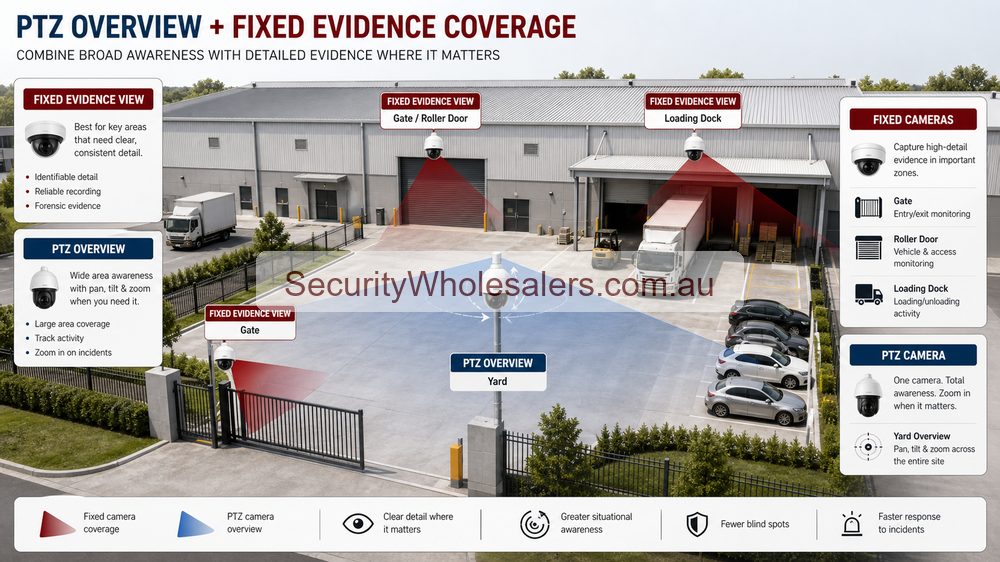
Most sites should start with fixed evidence cameras first. Move into a Hikvision PTZ only when the site is large enough that one wider overview scene, operator-controlled zoom, or broader live awareness genuinely adds value. If the real need is one overview plus one tighter working view from the same camera position, compare this page with TandemVu.
When a PTZ is actually worth considering
Best fit
Broader yards, depots, larger school frontages, transport sites, and bigger commercial exteriors where someone will actually use the camera for live overview or investigation support.
Usually not worth it
Small homes, normal shopfronts, narrow driveways, and scenes where a fixed turret, bullet, or motorised varifocal would already solve the problem more simply.
Natural step-up
Move from fixed cameras into PTZ once the scene size and workflow justify it, not simply because the customer wants something more premium on the quote.
What a Hikvision PTZ is really for
PTZ stands for pan, tilt, and zoom, but the useful buying question is simpler: does the site benefit from a controllable camera that can help an operator understand a bigger outdoor scene? On a normal fixed scene, the answer is often no. On a larger yard, school edge, depot, or forecourt, the answer can become yes, especially if staff will actually use the camera to inspect activity or keep broader context in view.
That still does not make a PTZ a replacement for fixed evidence cameras. Gates, office doors, roller doors, side entries, and plate-capture points still need their own stable views.
Choose by scene, not by excitement
| Scene | Usually start with | Why |
|---|---|---|
| Front entry, door, counter, roller door | Fixed turret or bullet | The site usually needs stable evidence more than live camera movement. |
| Long frontage or awkward loading area | Motorised varifocal | Tuning freedom is often more valuable than a full PTZ. |
| Broad yard, depot, or school frontage | PTZ or TandemVu support camera | The operator may genuinely benefit from wider live awareness or controllable zoom. |
| Perimeter detection in difficult conditions | Thermal | The job may already be drifting beyond a normal visible-light PTZ conversation. |
Real Hikvision PTZ scenarios
School frontage and car park edge
A PTZ can make sense when management wants a wider live view of the frontage, but the fixed entry and walkway cameras still do the main evidence work.
Transport depot or wider yard
A PTZ becomes much more honest on a site where the operator will actually use zoom to inspect truck movement, loading activity, or a larger external zone.
Car yard or forecourt
PTZ can support the overview role, but the fixed office entry, gate, and test-drive areas still carry the key evidence requirements.
Small shop or home frontage
This is usually where a buyer should step back. A fixed or motorised camera is often the cleaner answer than forcing a PTZ into a scene that does not need it.
Standard PTZ, TandemVu, or just better fixed cameras?
| If the real job is⦠| Usually start with | Why it usually works better |
|---|---|---|
| Watching a broad yard live and checking activity as it unfolds | Standard PTZ | The operator can use presets, patrols, and zoom in a way that genuinely adds value. |
| Holding a wide scene live while still having a tighter working view | TandemVu | The wider view does not disappear every time the camera zooms in. |
| Getting reliable evidence at a gate, door, roller shutter, or plate point | Fixed or motorised evidence camera | The site usually wants stable framing more than camera movement. |
| Detecting people or vehicles in difficult night or perimeter conditions | Thermal or specialist perimeter path | The problem may already sit outside a normal visible-light PTZ conversation. |
Hikvision PTZ vs TandemVu
| If you really want⦠| Usually start with | Reason |
|---|---|---|
| A more traditional controllable overview camera | PTZ | Best when the operator will actively use pan, tilt, and zoom on a broader scene. |
| One camera position with a wider view and a tighter working view together | TandemVu | Best when the site wants broader context kept live while still having tighter detail available. |
| A simple fixed evidence view | Fixed or motorised camera | Most normal entries, doors, and narrow scenes do not need PTZ at all. |
What makes a PTZ successful on a real site?
Someone will actually use it
A PTZ is strongest where a manager, guard, or operator will use presets or zoom to inspect a bigger external scene. If nobody will touch it, the site may be overbuying.
Fixed evidence cameras still do the hard work
The PTZ should support the overview role while fixed cameras handle entry points, vehicle approaches, staff doors, and any other scene where the site needs reliable evidence.
The recorder setup is sized properly
A larger outdoor PTZ setup often sits inside a broader system, so the NVR, switching, and UPS planning still matter. PTZ is rarely just one isolated buying decision.
Recommended Hikvision PTZ system setupways
| Site type | Likely PTZ role | Usually pair it with | Why this path tends to work |
|---|---|---|---|
| School frontage or car park edge | Overview support | Fixed entry and walkway cameras, sensible NVR growth | The PTZ helps with broader awareness, while fixed cameras keep the key paths stable and reviewable. |
| Depot or transport yard | Live scene inspection | Fixed gate, loading, and office cameras; stronger switching and UPS | The PTZ adds value only because the yard is broad enough to justify operator use. |
| Car yard or larger forecourt | Broader external overview | Fixed office entry, gate, and test-drive coverage | The site usually wants the PTZ as a support layer, not as the main evidence camera. |
| Large commercial exterior | Preset or patrol support camera | Fixed evidence views plus a recorder with spare headroom | The PTZ becomes part of a larger structured system rather than a one-camera solution. |
Installation and recorder planning
PTZ decisions are not only about the camera. They also affect the recorder, network, and support plan. A larger or more specialised camera belongs in a system that has sensible NVR headroom, clean switching, and a realistic UPS plan. The next best page after this one is usually How to Choose a Hikvision NVR.
It also matters whether anyone will actually use the PTZ. If the site has no operator workflow and mainly reviews footage later, a PTZ can easily become a more expensive camera that spends most of its life acting like an awkward fixed one.
Hikvision PTZ directions
Compact PTZ-style option
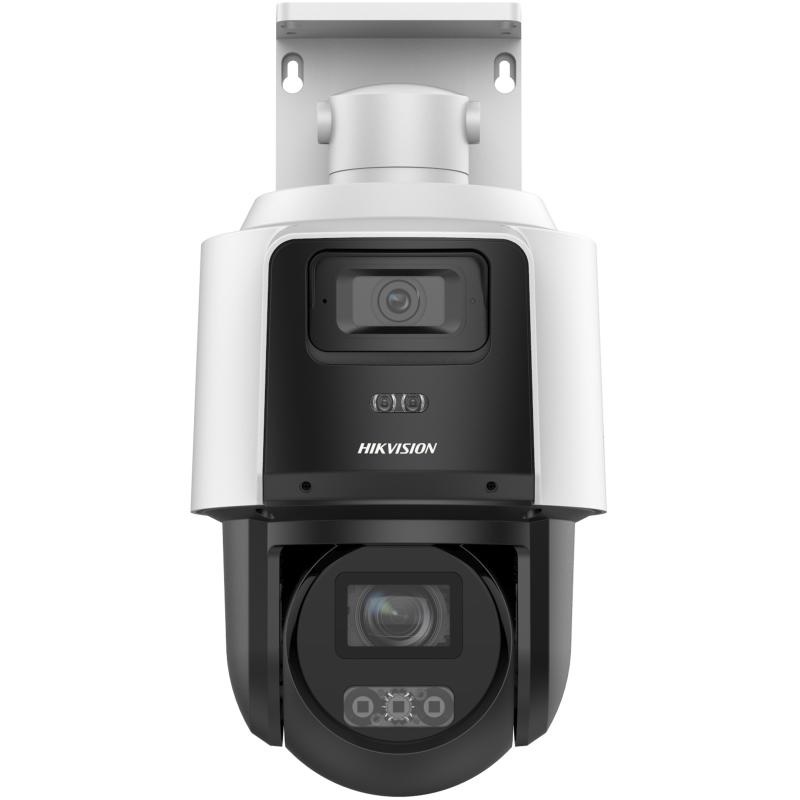
A useful starting reference for buyers who are just entering the specialist outdoor overview conversation.
ColorVu PTZ direction
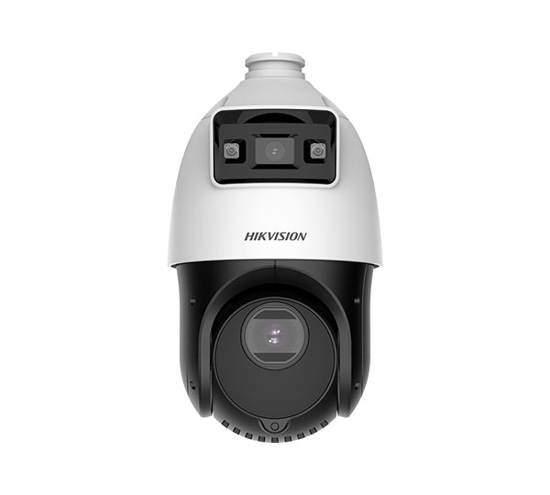
Worth considering where a more premium low-light outdoor overview role is part of the design.
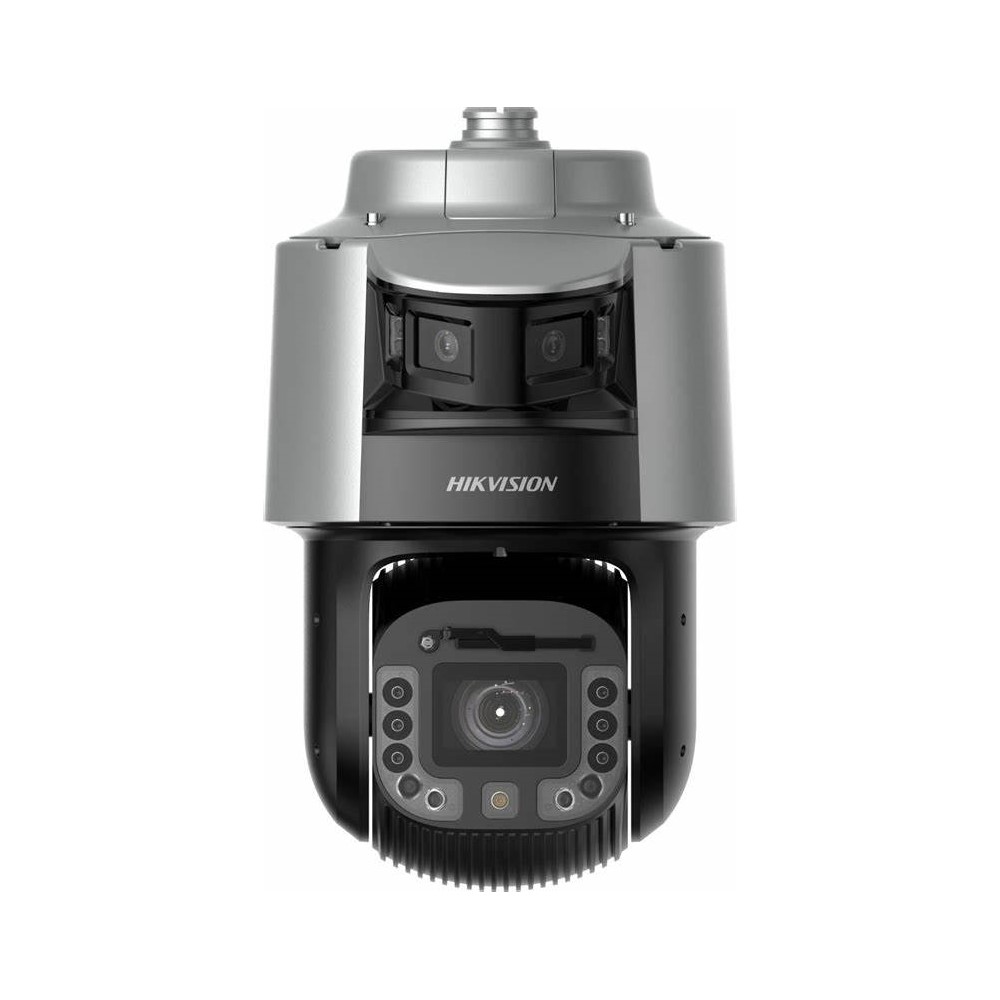
Larger overview PTZ path
A stronger commercial option where the site genuinely needs wider awareness and deeper zoom reach on one outdoor branch.
Related Pages
How to Choose a Hikvision Camera
Return here if the site may still be better served by a fixed or motorised camera option.
Hikvision TandemVu Cameras Buying Guide
Use this if you are really comparing overview plus tighter view from one camera position.
How to Choose a Hikvision NVR
Use this once the site is clearly moving into a larger or more specialised recorder setup.
PTZ buying FAQs
-
When is a Hikvision PTZ actually worth buying?
A PTZ is usually worth it when the site has a genuinely broad scene and someone will use presets, patrols, or zoom to inspect activity. On a smaller or simpler site, fixed cameras are often the more honest answer.
-
Can a PTZ replace fixed cameras?
Usually no. Fixed cameras still do the main evidence work at gates, doors, roller shutters, and other key points where the view needs to stay stable.
-
Should I choose PTZ or TandemVu?
Choose PTZ when the real need is a controllable overview camera. Choose TandemVu when the site wants a wider live scene plus a tighter working view from the same position.
-
Does a PTZ usually mean a bigger recorder plan?
Often yes, because PTZ tends to sit inside a broader outdoor system. That makes NVR headroom, switching, and UPS planning more important than on a small basic job.
-
Can a Hikvision PTZ replace several fixed cameras?
Usually no. PTZ is excellent for overview and zoom, but fixed cameras should still cover repeatable evidence points such as gates, doors, loading docks and entrances.
PTZ quote scenarios
| Site | PTZ role | Fixed camera role |
|---|---|---|
| Warehouse yard | Overview, zoom and patrol presets. | Gates, docks and roller doors. |
| Car yard | Live inspection across rows. | Entrances, exits and high-value choke points. |
| Farm or depot | Broad machinery or perimeter overview. | Gate, shed, tank and house approach evidence. |
A PTZ should support the fixed-camera plan. If the PTZ is looking the wrong way during an incident, fixed cameras are what preserve repeatable evidence.