












Commercial
Hikvision TandemVu Cameras Buying Guide
TandemVu
Quick answer
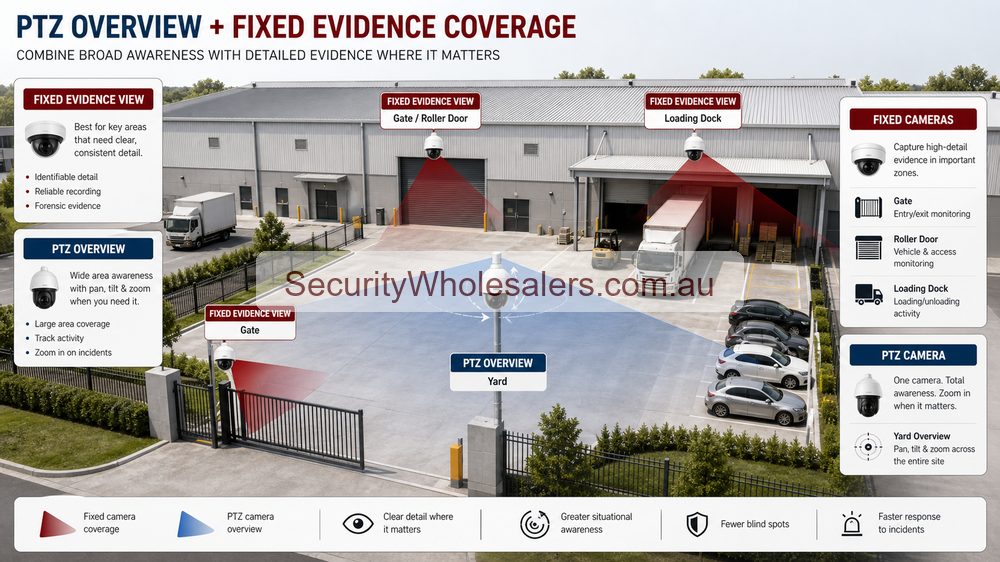
Use TandemVu on gates, car yards, transport depots, warehouse yards, forecourts, and other broader commercial outdoor scenes where overview plus zoom has a real operational purpose. Do not use it to avoid putting fixed evidence cameras in the right places.
View entry TandemVu example
View ColorVu TandemVu example
View larger TandemVu example
When TandemVu earns its place
Best fit
TandemVu earns its place when the operator really benefits from keeping the big picture live while also having a tighter working view available.
Usually not worth it
If the site really just needs a good fixed gate view, a motorised varifocal, or a normal PTZ, TandemVu is often more camera than the job needs.
Natural step-up
The step-up is usually about operator workflow and broader scene management, not just buying a more expensive camera for the sake of it.
What TandemVu actually is
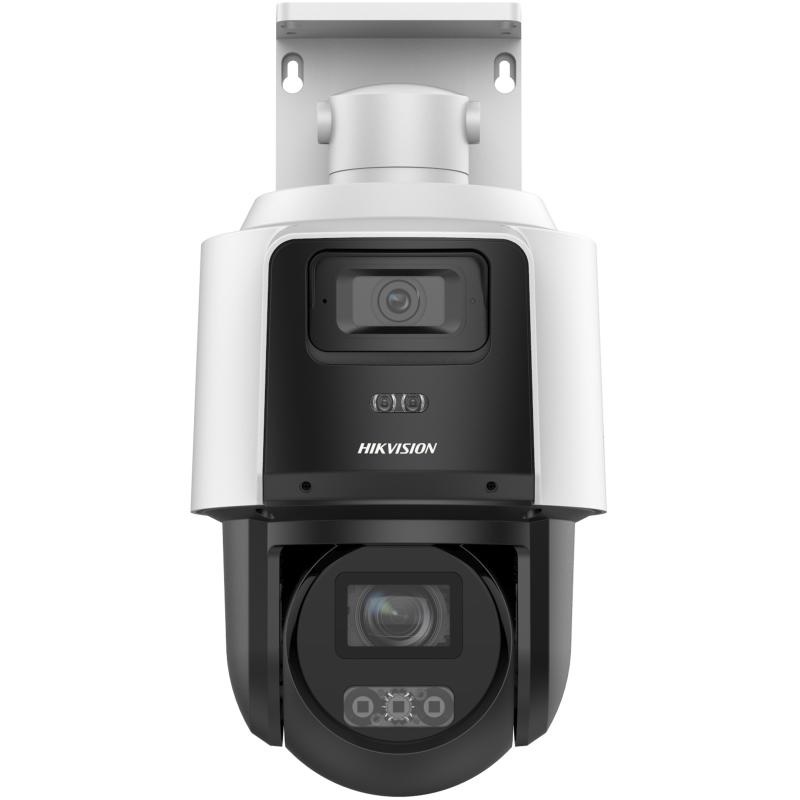
In practical buying terms, TandemVu is Hikvision's way of combining two jobs in one camera position: a broader, always-on overview and a second view that can zoom or observe more selectively. That can be useful when the operator wants context and detail together without sacrificing the big picture every time the zoom view moves.
That is very different from saying TandemVu solves the whole site. A depot gate may still need a proper fixed gate camera. A car yard may still need fixed lot-entry or office-entry views. A warehouse yard may still need stable evidence at the roller door and fence line. TandemVu helps one camera position do two jobs. It does not make the rest of the layout disappear.
Where TandemVu usually fits best
| Site type | Why TandemVu may help | What it still does not replace |
|---|---|---|
| Car yards and forecourts | One camera position can hold the broad frontage or lot while the tighter view helps the operator inspect a specific vehicle approach or movement. | Fixed entry, office, or key-control views. |
| Transport depots and logistics yards | Useful for broader loading zones, truck movement, or gate-adjacent overview where the operator still wants a closer look without losing context. | Fixed gate, dispatch, and dock evidence views. |
| Warehouse yards and external aprons | Can support wider site awareness on larger yards or outer faces. | Fixed cameras on roller doors, side doors, and narrow incident points. |
| Larger commercial gates or campuses | Helps where one camera position needs to keep a wider entry scene live while still giving zoom support. | Dedicated plate capture or face-capture views where required. |
When TandemVu is worth it and when it is not
Worth it
When the site is already large enough that one camera position genuinely needs overview plus zoom support, and the operator will actually use that capability.
Usually not worth it
When the site really only needs a fixed gate view, a motorised varifocal, or one simpler PTZ. TandemVu should not be a premium workaround for poor layout thinking.
Common mistake
Using TandemVu to avoid placing fixed evidence cameras on the real decision points, then expecting the specialist camera to fill every gap.
How TandemVu compares with the rest of the Hikvision range
| If you are saying⦠| Usually start with | Why |
|---|---|---|
| "We need a wide scene and a tighter view together." | TandemVu | This is the core reason to consider it. |
| "We only need a strong fixed gate or doorway view." | Standard fixed or motorised varifocal | A simpler camera often does the job better. |
| "We want cleaner alerts on a normal site." | AcuSense | The real issue is event filtering, not specialist overview workflow. |
| "We want better colour or deterrence at night." | ColorVu or Live Guard | The real issue is night performance or warning behaviour, not overview plus zoom. |
Sample TandemVu case studies
Case study: car yard frontage
The yard wanted one camera position to hold the broad frontage while also giving the operator a tighter look at activity around the main lane. TandemVu made sense there, but the office entry and vehicle gate still needed fixed views.
Case study: depot loading yard
The depot wanted better live awareness across a broad apron without losing the context view each time the operator zoomed in. TandemVu was useful because the operator would actually use that workflow.
Case study: large gate with plate-capture confusion
The customer first hoped TandemVu would also do number plates. It still needed a dedicated gate or plate-focused view. TandemVu helped the overview job, not the whole gate design.
Case study: school frontage where management wanted broader live awareness
The school did not need TandemVu everywhere. It only made sense on the larger frontage where management wanted to keep the whole entry scene in view while still being able to inspect activity more closely.
Recommended TandemVu buying options
2SE3C404MWG-E/14
A good entry TandemVu direction for buyers who want to understand the concept without jumping straight to a much larger premium model.
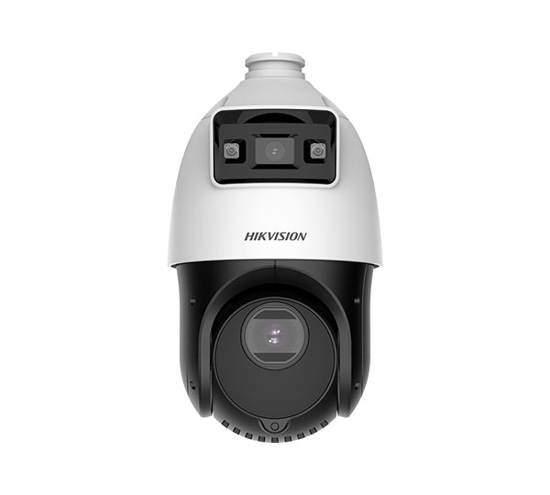
DS-2SE4C425MWG-E/14F0
A stronger commercial path where TandemVu and ColorVu-style low-light performance overlap for more premium yard, frontage, or depot scenes.
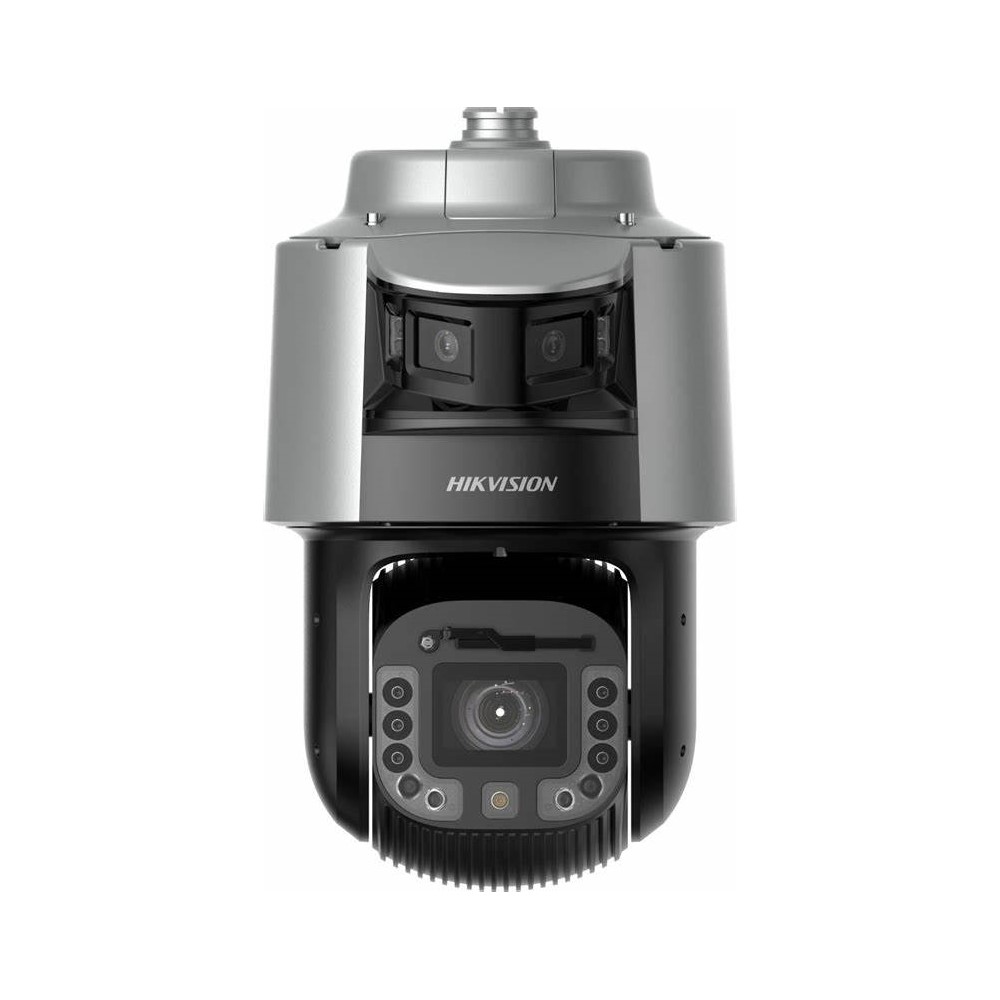
180 degree overview plus 42x zoom path
A more serious TandemVu direction for larger sites that genuinely need wide scene awareness and much stronger zoom reach from the same camera position.
Installation and design notes
- Mount TandemVu where the overview scene is genuinely worth keeping stable all the time.
- Do not let the specialist camera become the excuse for weak fixed coverage at gates, roller doors, office entries, or number-plate points.
- Check the network, PoE, and recorder setup early. More advanced specialist cameras belong in a system that has the NVR and storage to support them properly.
- Be honest about operator workflow. TandemVu is more valuable when someone will actually use the added viewing flexibility rather than just admire it on install day.
Common mistakes with TandemVu
- Using TandemVu as a shortcut instead of designing the fixed evidence cameras properly.
- Expecting it to solve number plates, face capture, and every other identification task by itself.
- Buying it for a site where nobody will actually use the wider operator workflow.
- Forgetting that the recorder, network, and storage plan still need to support a more advanced camera properly.
What TandemVu still does not solve
TandemVu does not automatically solve plate capture, face capture, or forensic identification at long range. Those jobs still depend on correct camera placement, angle, lens choice, and scene design. It also does not replace thermal when the real problem is perimeter detection in difficult conditions. It is a specialist visible-light option, not a universal answer.
TandemVu FAQs
- Is TandemVu better than a normal PTZ?
It can be better when the site needs a stable overview and a tighter working view at the same time. A normal PTZ may still be enough when the operator only needs occasional zoom.
- Does TandemVu replace fixed cameras?
No. Fixed cameras are still the better choice for repeatable evidence at gates, roller doors, counters, entries and narrow target points.
- Is TandemVu worth it for warehouses?
It can be worthwhile on larger warehouse yards, loading aprons and gate approaches where the operator benefits from overview plus zoom. It is usually unnecessary for small internal warehouse views.
- Which TandemVu model should a small commercial site start with?
Smaller sites should usually start by comparing the compact TandemVu options against a standard PTZ or motorised varifocal camera. Larger sites with bigger frontage or yard requirements may justify the wider overview and stronger zoom models.
Related Pages
Hikvision Camera Series Explained
Use this if you are still working out whether TandemVu is really the right technology family at all.
How to Choose a Hikvision Camera
Return here if the site may still be better served by a simpler fixed, motorised, or standard PTZ path.
Hikvision 2026 Camera and NVR Picks
Use this if you want current Hikvision models alongside the family-level explanation.
Hikvision Thermal Cameras Buying Guide
Use this when you are drifting toward perimeter detection or heat-risk problems that visible-light PTZ cannot solve properly.