












Commercial
Hikvision Motorised Varifocal Cameras Buying Guide
Lens Guide
Quick answer
Use a Hikvision motorised varifocal when the scene depth is uncertain, the frontage is awkward, the loading area is hard to judge, or the customer is likely to want framing refined during commissioning. If the view is already simple and predictable, a fixed turret or bullet is often the cleaner and cheaper answer.
When a motorised varifocal is worth it
Best fit
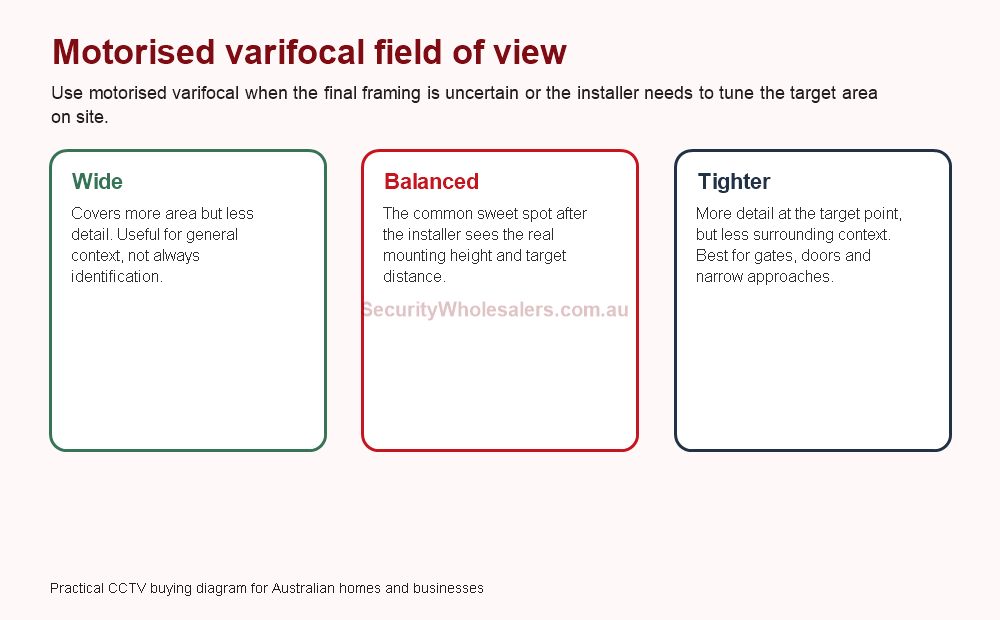
Long driveways, awkward shopfronts, loading aprons, mixed-depth scenes, and broad approaches where the final framing is hard to judge before the installer is on site.
Usually not worth it
Simple front doors, predictable corridors, counters, and compact scenes where a fixed turret or bullet can already be framed confidently from the start.
Natural step-up
It is often the next honest step after a fixed lens, long before the job needs to drift into PTZ or other specialist cameras.
What you are really paying for
The biggest benefit is not simply zoom. It is installation flexibility. A motorised varifocal lets the installer tune the target point, compress or open up the scene, and adjust once the real mounting height, lighting, and sightline are known. That is very different from ordering a fixed lens and hoping it feels right when the job is finally live.
This becomes especially useful when the customer keeps saying things like "we want to see a little further down the approach" or "we are not exactly sure how tight the scene needs to be yet".
Choose by scene
| Scene | Usually start with | Why |
|---|---|---|
| Simple door, counter, corridor | Fixed lens | The scene is already predictable enough that motorised adjustment is usually unnecessary. |
| Driveway, longer gate approach | Motorised varifocal | The final balance between width and target detail often needs tuning on site. |
| Loading apron or awkward frontage | Motorised varifocal | This is one of the classic scenes where fixed lenses are easiest to misjudge from a plan alone. |
| Very large yard or broader live overview role | PTZ or TandemVu | If the scene has become too large for normal framing, the answer may be more than just a varifocal lens. |
Fixed lens vs motorised varifocal in plain language
| If the scene feels like⦠| Usually start with | Why |
|---|---|---|
| Simple and predictable | Fixed lens camera | The installer already knows roughly what the view should look like, so extra adjustment is often unnecessary. |
| Longer and harder to judge | Motorised varifocal | The site benefits from being able to tune width and target detail during commissioning. |
| Trying to do too many jobs from one position | Two fixed cameras | One motorised camera can help, but it cannot always replace a dedicated wide view plus a dedicated tighter evidence view. |
| Broad live overview rather than evidence framing | PTZ or TandemVu | The issue may no longer be lens flexibility. It may be that the job has drifted into a more specialised camera role. |
Scene geometry where motorised usually earns its keep
Driveway or gate approach
The customer often wants a little more reach without losing too much width. That is exactly where motorised tuning can make the install feel much more precise.
Roller door and loading bay
These scenes often need the door line, apron movement, and approach depth balanced properly, which is hard to lock in with one fixed-lens guess.
Shopfront with uneven setback
If the footpath, entry, and parked vehicles all sit at awkward depths, a motorised lens gives the installer room to land the framing more cleanly.
Long narrow side path or side gate
A motorised lens often helps when the scene is not huge, but still has too much depth to trust a one-size-fits-all fixed view.
Typical Hikvision motorised scenarios
Retail frontage with uncertain framing
The customer wants a stronger look at the entry and footpath edge, but the ideal width is hard to judge from the quote stage. A motorised varifocal is often the honest answer.
Warehouse roller door and apron
The scene may need to show forklift movement, door access, and a wider apron. That is exactly where motorised tuning saves time and guesswork later.
Long residential driveway
A fixed lens may work, but if the customer cares about getting the depth just right, a motorised option can be the cleaner path.
Commercial gate that keeps changing in the design phase
When the final mounting point or gate layout may still shift, a motorised varifocal gives the installer more freedom to land the view properly.
Turret or bullet for a motorised scene?
| If the site wants⦠| Usually lean toward | Why |
|---|---|---|
| A more compact look at entries, walkways, or mixed business scenes | Motorised turret | Often a cleaner fit where the scene does not need the more directional look of a bullet. |
| A more outward-facing driveway, gate, or perimeter-style view | Motorised bullet or more directional housing | The site may benefit from a shape that feels more purpose-built for an external approach. |
| Maximum simplicity on an easy scene | Fixed turret or bullet | If the job is already straightforward, motorised capability may not be the best use of budget. |
Recommended motorised system setupways
| Scene | Likely starting path | Usually pair it with | Why this path works |
|---|---|---|---|
| Retail frontage with uncertain framing | Motorised turret | A suitable NVR choice and possibly stronger night-lighting decisions | The job is still basically fixed-view CCTV, but the scene benefits from fine tuning on site. |
| Warehouse door and apron | Motorised turret or bullet | Recorder headroom, sensible external lighting, and sometimes a second fixed support view | The installer can tune the active work area instead of guessing the lens at quote stage. |
| Long driveway or gate | Motorised external view | Possibly a second fixed overview camera if the customer wants both context and tighter detail | One motorised camera may solve it, but the real answer depends on whether one view can honestly do both jobs. |
| Broad yard drifting into overview work | PTZ or TandemVu comparison | Fixed evidence cameras and a more deliberate NVR plan | At some point the site has outgrown normal lens adjustment and moved into a different camera conversation. |
Hikvision motorised directions
6MP motorised turret example
A practical step-up when the scene needs tuning flexibility plus stronger modern low-light behaviour.
8MP motorised turret example
A more capable option where scene width, target detail, and more premium low-light expectations all land in the same conversation.
Compare with fixed cameras first
The best buying decision is often simply knowing when a motorised lens is actually worth paying for.
Installation and recorder planning
Once the camera can be tuned more tightly, the site often also becomes more honest about recorder expectations. If the customer ends up choosing several more detailed views, better night paths, or audio-enabled cameras, the next stop should be How to Choose a Hikvision NVR so storage and growth still make sense.
Motorised does not mean set-and-forget. The value comes from using the adjustment properly during commissioning and confirming the final target area while the installer still has the ladder out.
Related Pages
How to Choose a Hikvision Camera
Use this if you still need to compare fixed, varifocal, PTZ, and deterrence paths more broadly.
Hikvision PTZ Buying Guide
Move here if the scene has become large enough that the conversation is no longer only about lens flexibility.
Hikvision ColorVu Cameras Buying Guide
Use this if low-light quality is becoming the main reason you are stepping up from a simple fixed lens.
Motorised varifocal FAQs
-
When is a Hikvision motorised varifocal worth it?
It is usually worth it when the scene depth is uncertain, the frontage is awkward, or the installer needs real flexibility to tune width and target detail properly on site.
-
Is motorised always better than fixed lens?
No. Many simple doors, counters, corridors, and compact scenes are still better handled by a fixed lens because the view is already predictable.
-
Should I use one motorised camera or two fixed cameras?
If one camera would be trying to do both a broad overview and a tighter evidence role, two fixed cameras are often the cleaner result.
-
When should I move up to PTZ or TandemVu?
Move up when the site wants broader overview behaviour rather than just better framing flexibility. That is usually the sign the conversation has gone beyond a normal motorised lens.