












Comparison
Hikvision ColorVu vs Smart Hybrid Light
Comparison Guide
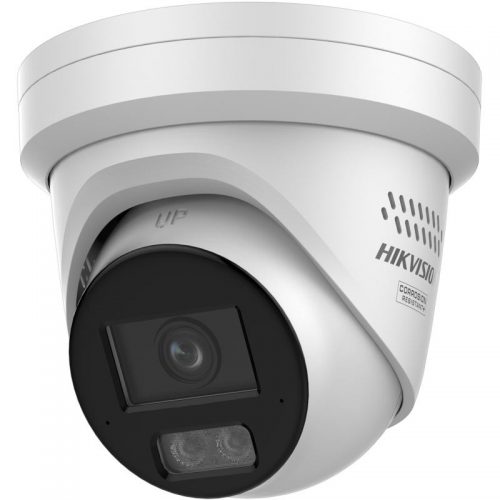
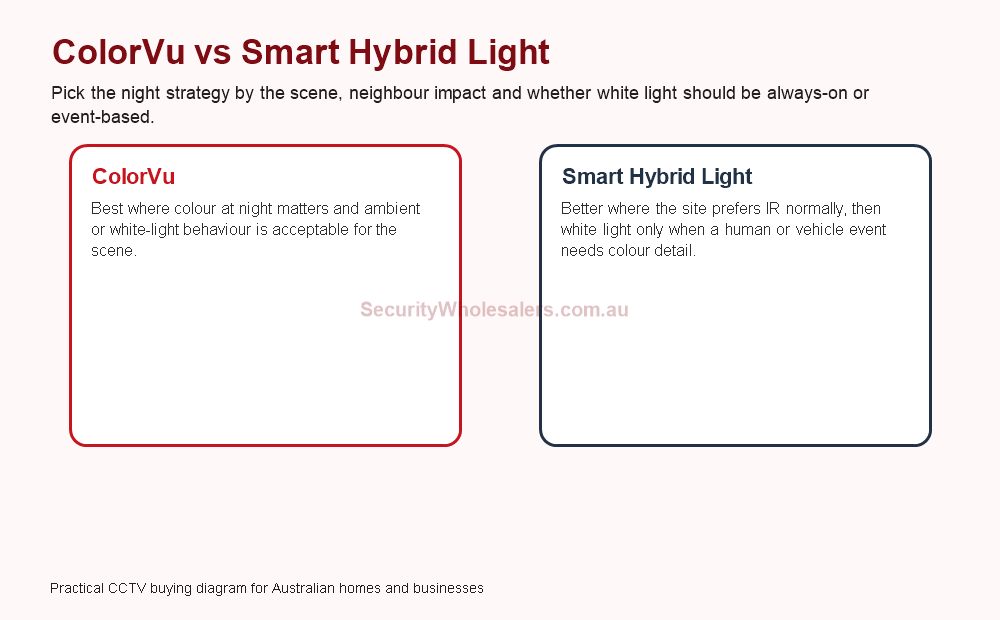
Australian night-lighting examples
| Scene | Usually better | Reason |
|---|---|---|
| Driveway with street lighting | ColorVu or ColorVu-style camera | Useful colour can be gained without making every event feel intrusive. |
| Side path beside a neighbour | Smart Hybrid Light or IR-first design | Always-on white light may create nuisance and complaints. |
| Rear lane with repeat nuisance activity | Smart Hybrid Light or Live Guard style path | Event-triggered white light or deterrence is more purposeful than passive colour alone. |
Both paths are about better night footage, but not in the same way
ColorVu and Smart Hybrid Light are both answers to the same problem: standard night footage can be too vague, too dark, or too detached from what the customer expected to see. But they do not solve that problem in the same way. ColorVu leans harder into continuous useful colour, while Smart Hybrid Light gives the design more flexibility in how it handles darkness and activity.
ColorVu is strongest where one view really matters all night
ColorVu is often the better choice when you have a few key views that need consistent night-time colour, such as a front entry, a cash-facing area, a home front yard, or a business frontage where clothing colour, vehicle colour, or fine scene context matters to later review.
The important installation point is not to waste that strength on scenes that are too wide or badly placed. Full-colour night performance helps most when the camera is aimed at a meaningful target area rather than everything at once.
Smart Hybrid Light is about flexibility and practical site behaviour
Smart Hybrid Light becomes more attractive when the site wants a camera that can respond more flexibly to night-time events, or when the job also leans toward deterrence and warning behaviour in some circumstances. It can be a very sensible fit where one fixed full-colour strategy across the whole night is not the most practical answer.
That does not automatically make it better. It simply means you should be honest about whether they want always-on colour or a more adaptive night-time behaviour.
Installation insight: choose the low-light path after the night survey, not before
The installer should test the scene in actual darkness, not only daytime shadow. Street spill, white walls, vehicles, nearby signage, and reflective surfaces can all change what a low-light camera really does on site. That is why night surveys and commissioning checks matter so much on higher-expectation low-light jobs.
If the view is especially important, it can also be worth sketching the target scene in the Camera Planner first so the customer understands which part of the scene is being prioritised.
Relevant SecurityWholesalers Categories and Products
These Hikvision categories and models are the clearest way to show how low-light strategy changes once full-colour imaging or speaker-and-strobe behaviour is part of the brief.
- Hikvision ColorVu category - The best place to start when the site wants strong 24/7 colour on important views.
- DS-2CD2387G3-LIS2UY/SL ColorVu 3.0 turret - A stronger current example for a high-end full-colour and hybrid-light Hikvision night-time camera option.
- Hikvision ColorVu packages - Useful where you are happy to standardise around the same ColorVu family across several cameras and wants a faster buying option.
Sources and Further Reading
Choosing by site tolerance
ColorVu and Smart Hybrid Light should be chosen by the scene, not by the more exciting product name. A quiet residential side path may prefer a calmer approach. A driveway or shopfront may benefit from event colour. A rear business door may justify stronger light response after hours.
- Check neighbour and customer impact before using visible light.
- Test reflective surfaces at night.
- Choose evidence quality over dramatic demo footage.
Frequently Asked Questions
-
When is ColorVu usually the better choice?
ColorVu is usually the better choice when one important view genuinely benefits from strong night-time colour all the time, such as a front entry, a retail frontage, or a key driveway or gate.
-
When is Smart Hybrid Light the better fit?
Smart Hybrid Light is often the better fit when the site wants more flexibility between infrared and white-light behaviour, or when you also value deterrence features and does not want every night-time scene treated the same way.
-
Does low-light strategy affect installation placement?
Yes. Low-light cameras should be placed with realistic expectations about scene width, reflectivity, white-light spill, and the point that actually matters to the customer after dark.
-
Should every camera on a site be ColorVu or Smart Hybrid Light?
Usually not. Many jobs only need those features on the views that really matter after dark. The stronger design is often a mix rather than treating every camera as a low-light flagship.
-
Can these cameras also help with deterrence?
Some Smart Hybrid Light and active-deterrence models can, especially where strobe or warning audio is useful after hours. The site should still be selective rather than assuming every scene needs an audible response.
-
What should the installer test at commissioning?
They should test the scene after dark, confirm useful detail at the target point, and check that illumination or deterrence behaviour matches the customer expectation rather than just looking impressive on install day.
Related Pages
How to Choose a Hikvision Camera
Work out which Hikvision camera type fits the job, the lighting, and the installation.
Hikvision ColorVu Cameras Buying Guide
Move here if you have already decided that stronger night colour is the real driver and now wants the best current product options.
Hikvision AcuSense Cameras Buying Guide
Use this when the bigger issue is cleaner human and vehicle events, not just better night imaging.
Hikvision Live Guard Cameras Buying Guide
Use this when the job is moving toward speaker, strobe, and warning response after hours.
Hikvision IP vs Turbo HD
Choose between Hikvision IP and Turbo HD based on cabling, expansion, and analytics.
How to Choose a Hikvision NVR
Choose the right Hikvision NVR for channel count, PoE, AI, storage, and growth.