











Informational
Access Control Maintenance Checklist
Explainer Guide
What Good Maintenance Actually Looks Like
Good maintenance is regular, boring, and deliberate. It is not waiting until staff are locked out or a manager discovers that five departed users still have access. A healthy access-control system is one where the opening relatches cleanly, the event history is meaningful, the power backup still has real runtime, and the admin workflow is kept tidy.
Suggested Review Rhythm
| Timing | What to Review | Why It Matters |
|---|---|---|
| Monthly | Door relatching, user changes, log review, and obvious wear or damage. | Catches the small problems before they become service calls or security gaps. |
| Quarterly | Test exit path, denied events, temporary users, schedule accuracy, and any visitor workflow. | Keeps the system aligned with how the site actually operates rather than how it operated last quarter. |
| Annually | Review UPS health, cabinet condition, credential policy, backup expectations, and whole-system handover notes. | Protects long-term reliability and stops the system becoming undocumented building folklore. |
Physical Door and Hardware Checks
- Make sure the door closes and latches cleanly every time without slamming or bouncing.
- Check that the strike or maglock alignment has not drifted as the door or frame has settled.
- Confirm exit buttons and request-to-exit sensors still release the door reliably.
- Review any door contacts or held-open alarms so the site is not blind to a door that is not securing properly.
- Inspect any external readers, intercoms, or exposed cabling for weather or impact damage.
User, Credential, and Policy Checks
- Remove staff, residents, or contractors who no longer need access.
- Review shared codes and ask whether they should be replaced with named credentials.
- Check temporary users, cleaners, or after-hours contractors have the right time limits.
- Confirm managers still know who is allowed to add users, revoke users, and change schedules.
- Review whether the credential format still matches the security level the site now expects.
Controller, Software, and Power Checks
- Review recent logs to make sure events are readable and still useful for auditing.
- Confirm controller IP, cabinet labels, and handover notes still match the live system.
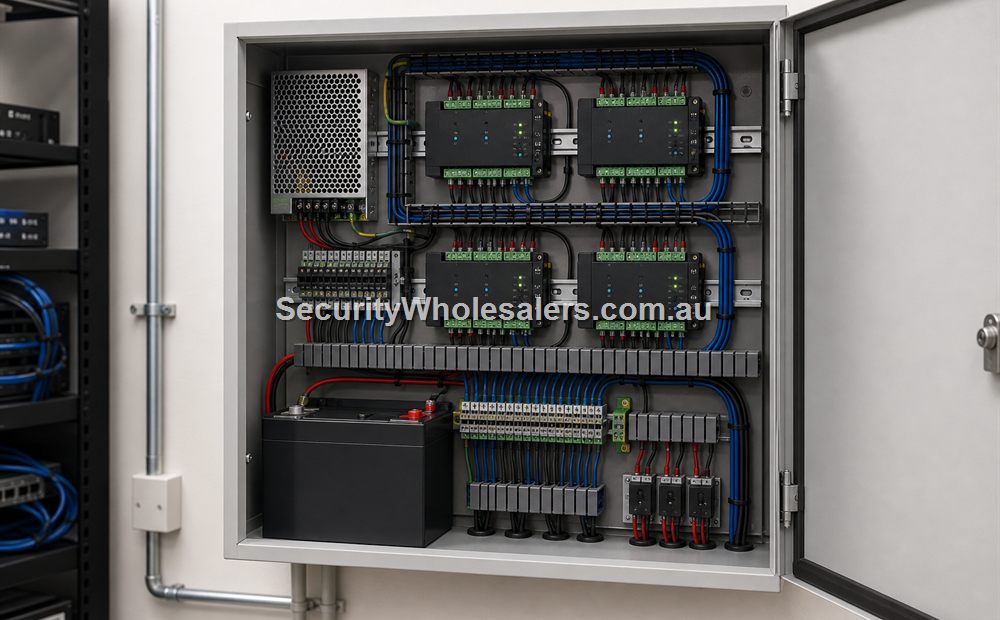
- Check the health and expected runtime of UPS-backed equipment rather than assuming batteries are still healthy.
- Make sure the network path supporting the access system is still appropriate for the way the site uses remote release or phone entry.
- Verify the site can still access the management layer and is not locked out of its own admin workflow.
Useful Rule for Operators
If a site has not reviewed users, door relatching, and UPS behaviour in the last year, it does not really know what state its access-control system is in. It only knows the last time the reader beeped successfully.
When It Is Time to Book Service
Book service when doors begin to misalign, relatching becomes inconsistent, readers intermittently fail, logs become unclear, or managers are no longer confident about who still has access. Access control is easiest to maintain when the system is still working "mostly fine," not after the site has normalised daily faults.
Relevant SecurityWholesalers Product Areas
- Access Control - Useful for replacement readers, controllers, credentials, and supporting lock hardware when maintenance exposes ageing or underspecified components.
- Intercoms - Relevant where front-door visitor workflows are part of the wider maintenance and handover routine.
- Hikvision Access Control Base License Package - Helpful where the site needs a cleaner software layer for reviewing users, schedules, and event history.
- UPS Backup Time Calculator - Useful when the client wants to check whether the UPS expectation for controllers, switches, and routers is realistic.
Related Guides in This Series
Source References
Frequently Asked Questions
-
Why does access control need maintenance if the doors are still unlocking?
Because many access-control faults start as small issues such as misalignment, weak UPS runtime, stale users, or poor relatching before they become total failures.
-
What should be checked most often?
Door closing and relatching, exit behaviour, user administration, event logs, and the health of any power backup or network path should all be checked regularly.
-
How often should UPS performance be reviewed?
It should be reviewed as part of routine maintenance rather than left until a real outage exposes a weak battery or unrealistic runtime expectation.
-
What is the most common administration problem?
The most common problem is user sprawl: old staff, old residents, shared codes, or unreviewed temporary credentials that were never cleaned up properly.
-
Should the site test the whole opening, not just the credential read?
Yes. Good maintenance checks the full opening: reader, lock, exit device, door contact, closer, logs, and the admin workflow behind it.
-
Which related guide should I read next?
Read the fail safe versus fail secure guide next, then move into the hardware guide on strikes, maglocks, exit buttons, and door sensors.
Quote checklist for Access Control Maintenance Checklist
Before ordering, ask for a short answer to these questions. They make the quote easier to compare and reduce the chance of buying hardware that does not match the site.
- What exact problem is being solved: access control planning, deterrence, evidence, access control, safety, compliance or convenience?
- What happens during poor light, bad weather, busy periods, after-hours events or staff changes?
- Who will administer users, review events, export evidence and test the system?
- Which part of the design is allowed to be basic, and which part must be strong because it proves the incident?
If those answers are vague, the buyer should pause before purchasing. Good security equipment becomes much more useful when the operating plan is written down before installation.
Final field note for Access Control Maintenance Checklist
For Access Control Maintenance Checklist, the final buying decision should be easy to explain to the person who will live with the system. The quote should identify the must-have outcome, the acceptable compromises, and the support path if users, doors, cameras, sensors or site conditions change later.
This is the difference between a list of products and a security design. The products matter, but the design is what makes them useful.
Final field note for Access Control Maintenance Checklist
For Access Control Maintenance Checklist, the final buying decision should be easy to explain to the person who will live with the system. The quote should identify the must-have outcome, the acceptable compromises, and the support path if users, doors, cameras, sensors or site conditions change later.
This is the difference between a list of products and a security design. The products matter, but the design is what makes them useful.
Final field note for Access Control Maintenance Checklist
For Access Control Maintenance Checklist, the final buying decision should be easy to explain to the person who will live with the system. The quote should identify the must-have outcome, the acceptable compromises, and the support path if users, doors, cameras, sensors or site conditions change later.
This is the difference between a list of products and a security design. The products matter, but the design is what makes them useful.
Final field note for Access Control Maintenance Checklist
For Access Control Maintenance Checklist, the final buying decision should be easy to explain to the person who will live with the system. The quote should identify the must-have outcome, the acceptable compromises, and the support path if users, doors, cameras, sensors or site conditions change later.
This is the difference between a list of products and a security design. The products matter, but the design is what makes them useful.
Real quote scenario for Access Control Maintenance Checklist
When quoting Access Control Maintenance Checklist, the useful starting point is door-by-door access planning. The buyer should be able to record the door type, lock type, reader position, exit method, power supply, fire requirement and daily user group. Without those details, two quotes can look similar while solving very different problems.
For Access Control Maintenance Checklist, a shopfront door, warehouse staff door, server-room door and shared tenancy door can all need different hardware even when the software is the same. This is why a strong SecurityWholesalers guide should talk about the site, the workflow and the equipment together rather than treating the product category as a simple shopping list.
Budget-conscious path
Use the simplest reliable hardware that solves the main risk. Keep administration simple and avoid specialist features unless they change the outcome.
Balanced path
Add better management, verification or expansion headroom where the site is likely to grow. This is usually the best path for small businesses and shared buildings.
Higher-risk path
Document response, audit trail, permissions and fallback procedures. Higher-risk sites need clearer operating rules, not just stronger hardware.
The final Access Control Maintenance Checklist quote should make the weak points visible. If cabling, power, monitoring, mobile app access, fire release, user management or future expansion are assumed rather than written down, the buyer is carrying risk that should have been solved during design.
Questions to ask before approving Access Control Maintenance Checklist
- What does the system need to prove or control on an ordinary day?
- What is different after hours, on weekends, during staff changes or during an emergency?
- Who will administer users, review events, export evidence or test the system?
- What happens if the internet is unavailable, a user loses a credential, a sensor triggers falsely or a door does not release?
- Which part of the system is easy to expand later, and which part would be expensive to change?
These questions are deliberately practical. They help separate a polished product list from a design that will remain useful after installation.
Extra buying notes for Access Control Maintenance Checklist
The Access Control Maintenance Checklist buying decision should be tested against normal use, after-hours use and failure conditions. If the quote cannot explain those three moments, it needs more design work before the customer commits. This is the kind of detail that helps a buyer compare quotes properly, because it turns the conversation from ?which model is cheapest?? into ?which design will still be useful after installation??
For Access Control Maintenance Checklist, the best final check is to ask what would make the system fail in practice. Common answers include poor cabling, weak power planning, missed user permissions, unclear response duties, too little storage, unsuitable mounting positions, or a handover that nobody can follow. A strong quote names those risks and deals with them before hardware is ordered.
For Access Control Maintenance Checklist, SecurityWholesalers should help buyers feel more confident, not more overwhelmed. The ideal outcome is a quote that is technically sound, easy to explain, and honest about where a simpler option is enough.


