












Comparison
Hikvision Thermal vs ColorVu vs IR Night Vision
Comparison
These three options answer different questions
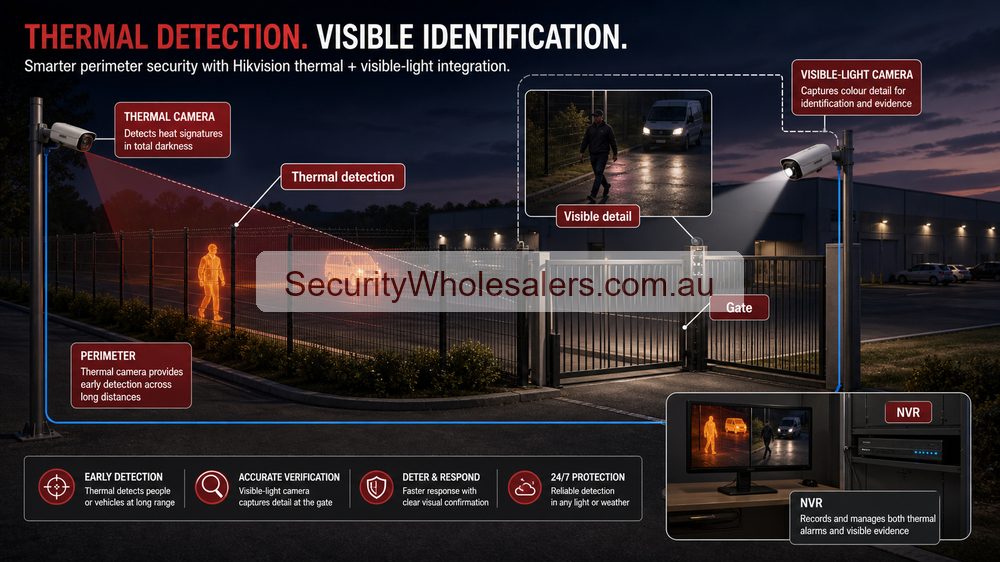
Thermal asks whether there is a heat-based event or target in the scene. ColorVu asks whether the site needs stronger colour detail at night. IR night vision asks whether a standard black-and-white night camera is enough for the job. Buyers get better results when they frame the decision that way instead of assuming all three are competing to do the same thing.
Direct comparison table
| Technology | Best for | What you should expect |
|---|---|---|
| Thermal | Perimeter detection, heat anomaly detection, large dark scenes, smoke or glare-heavy environments | Strong detection logic, less ordinary scene detail, often paired with visible CCTV |
| ColorVu | Front doors, business frontages, gates, driveways, and key scenes where night-time colour matters | Much better visible colour context, but still a visible-light camera strategy |
| IR night vision | Ordinary after-hours coverage on general external and internal views | Usually the lowest-cost night option and still perfectly workable for many sites |
Where thermal is the wrong upgrade
If a retailer simply wants a better front-door night image, thermal is usually the wrong upgrade. The site probably needs a better visible-light camera, perhaps ColorVu or Smart Hybrid Light, not a thermal sensor. Thermal is a specialist answer, not the automatic premium answer.
Example: rear boundary versus customer entry
Situation: A transport depot needs stronger after-hours coverage on a long rear fence and also wants cleaner night footage at the front vehicle entry.
Solution used: Thermal was considered for the rear fence line, while ColorVu or Smart Hybrid Light remained the better choice at the front gate where vehicle colour and visible scene context still mattered.
Why this was chosen: The rear fence question was whether there was movement on the boundary. The front gate question was what vehicle arrived and what the scene looked like. Those are different requirements.
Installation notes: The site may still use one NVR and one broader CCTV system, but the camera types change by scene.
Example: smoke-prone waste yard versus standard shopfront
Situation: A waste yard and a standard suburban shopfront both need after-hours cameras.
Solution used: The waste yard may justify a thermal or bi-spectrum camera because smoke, distance, and fire-risk are part of the problem. The shopfront would usually stay on ordinary visible-light CCTV.
Why this was chosen: The waste site needs earlier detection under difficult conditions. The shopfront mostly needs ordinary evidence and scene review.
Installation notes: Thermal only adds value where the problem actually calls for it. On the shopfront, it would usually add cost without solving the main question any better.
Relevant SecurityWholesalers Categories and Products
These product options illustrate the real choice: thermal for heat-based detection, ColorVu for stronger visible colour, or ordinary IR-based night vision for conventional scenes.
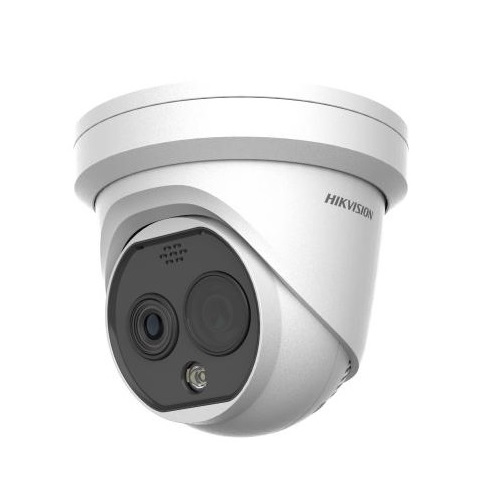
- DS-2TD1217-2/QA HeatPro turret - A thermal entry point for smaller thermal jobs.
- DS-2CD2387G3-LIS2UY/SL ColorVu 3.0 turret - A current Hikvision low-light visible-light example.
- DS-2CD3H66G3-LIZSUY/SL Smart Hybrid Light turret - Shows the flexibility of dual illumination.
Sources and Further Reading
Night technology decision examples
| Need | Technology to consider |
|---|---|
| Simple evidence in darkness | IR may be enough. |
| Colour context at a lit entry | ColorVu or Smart Hybrid Light. |
| Early detection on a dark boundary | Thermal plus visible confirmation. |
Frequently Asked Questions
-
Is thermal better than ColorVu at night?
Thermal is better for heat-based detection in difficult conditions. ColorVu is better when the site still needs ordinary visible colour detail at night.
-
Is IR night vision enough for most sites?
Yes, for many ordinary doors, walkways, and entries, standard IR night vision is still enough. Thermal is usually a specialist step-up, not the default.
-
When should I choose ColorVu instead of thermal?
Choose ColorVu when clothing colour, vehicle colour, and normal visible scene detail matter more than long-range or difficult-condition detection.
-
Can thermal and ColorVu be used on the same site?
Yes. A site may use thermal on a rear boundary or risk area and ColorVu on front entries, gates, or customer-facing scenes.
-
Does thermal work through fog and smoke better than normal cameras?
Thermal is often more dependable in those kinds of conditions because it is reading heat differences rather than relying only on visible light.
-
Will thermal replace a normal evidence camera?
Usually no. It is usually paired with ordinary CCTV rather than replacing every visible-light scene.
Related Pages
Hikvision Thermal Cameras Buying Guide
The main Hikvision thermal guide for perimeter, fire, and bi-spectrum buying decisions.
Hikvision ColorVu vs Smart Hybrid Light
Compare Hikvision ColorVu and Smart Hybrid Light in practical site terms.
What Is a Hikvision Thermal Camera?
A plain-language thermal explainer for Hikvision buyers.
How to Choose a Hikvision Camera
Work out which Hikvision camera type fits the job, the lighting, and the installation.