












Commercial
Best Hikvision Cameras and NVRs for 2026
2026 Buying Guide
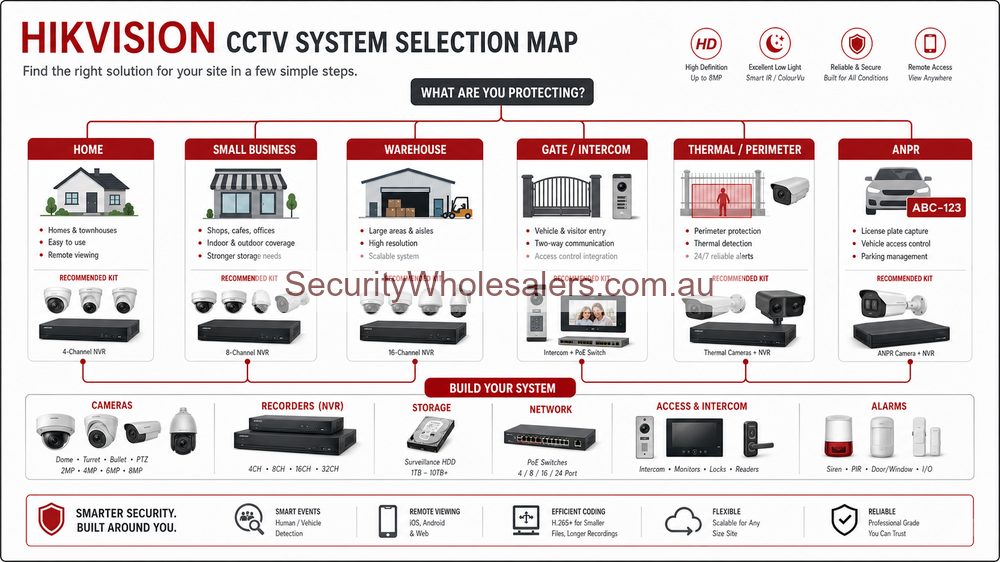
Start with the job, not the model number
There is no single Hikvision camera that is best everywhere. An 8MP ColorVu turret with a flashing light and speaker can be excellent at a front door, side passage or shopfront. Put the same camera high above a long driveway, however, and a motorised zoom camera may give you a far more useful view. At a quiet residential property, a loud warning message may be more nuisance than benefit.
The recorder needs the same care. A four-channel NVR is neat and affordable when four cameras really are enough. If you may add a gate, shed, car park or second entrance later, buying an eight-channel recorder now is usually cheaper than replacing the whole recorder later. Think about camera count, video storage and future additions together.
Hikvision technologies explained in plain English
Several Hikvision features can appear in the same camera, so the names are not always competing alternatives. For example, one camera may combine ColorVu for colour at night, AcuSense for human and vehicle filtering, Smart Hybrid Light for flexible illumination, and Live Guard features for active warning.
| Technology | What it does | Best suited to | What to know before choosing it |
|---|---|---|---|
| ColorVu | Uses a very light-sensitive lens and sensor to produce colour footage in low light. | Entries, driveways, shopfronts and yards where the colour of clothing, vehicles or objects could matter. | It still needs some available light. In complete darkness, the camera may use its built-in white light or switch illumination mode, depending on the model. |
| Smart Hybrid Light | Combines discreet infrared with white light. It can stay in infrared mode and turn on white light when a person or vehicle is detected. | Homes and businesses that want unobtrusive night monitoring most of the time, with colour detail when an event happens. | Check whether visible light is acceptable near bedrooms, neighbours, roads and customer areas. |
| AcuSense | Helps distinguish people and vehicles from movement caused by rain, leaves, insects and similar activity. | Almost any site that wants more useful alerts and quicker event searching. | It reduces nuisance alerts; it does not guarantee perfect detection. Camera height, angle and scene setup still matter. |
| Live Guard | Adds active deterrence such as a flashing strobe, speaker, siren or two-way audio on supported models. | Side gates, yards, loading areas, closed shopfronts and other places where a warning may stop an incident. | Use it selectively. Frequent lights or messages can annoy staff, customers and neighbours. |
| DarkFighter | Prioritises image quality in very low light, especially on higher-grade commercial cameras. | Large outdoor areas, car parks, warehouses and difficult low-light scenes. | DarkFighter describes low-light performance; it does not automatically mean full-colour video in total darkness. |
| Motorised varifocal | Lets the installer adjust the lens remotely, moving from a wide view to a tighter view without physically changing the lens. | Long driveways, gates, loading docks, car parks and any position where the correct framing is hard to judge in advance. | It is normally set during installation; it does not follow people around like a PTZ camera. |
| PTZ and TandemVu | PTZ cameras can pan, tilt and zoom. TandemVu models combine a wide overview with a movable close-up view. | Large yards, campuses, car parks and sites with a guard or operator actively monitoring cameras. | A PTZ can be looking the wrong way when an incident happens, so fixed cameras are still important for continuous evidence. |
| ANPR | Captures and reads number plates when the camera, lens and lighting are set up for a controlled vehicle approach. | Gates, private roads, car parks and access-control points. | Do not expect a normal wide-angle overview camera to read plates reliably. Vehicle speed, angle, distance and lighting are critical. |
| Thermal and bi-spectrum | Thermal cameras detect heat. Bi-spectrum models pair thermal detection with a normal optical image. | Long perimeters, darkness, smoke, heat monitoring and selected fire-detection applications. | Thermal is specialist equipment, not a sharper version of a normal CCTV camera. Most sites still need optical cameras for identification. |
| AcuSearch and AcuSeek | Recorder-based tools that make it faster to find people, vehicles or described events in recorded footage. | Retail, schools, warehouses and other sites where staff regularly investigate incidents. | They add the most value when footage is searched often. A simple home that rarely reviews video may be better served by a standard NVR. |
Three current Hikvision cameras worth comparing
The DS-2CD2387G3-LIS2UY/SL brings several useful features into one fixed-lens turret: 8MP resolution, ColorVu 3.0, Smart Hybrid Light, built-in audio, a strobe and speaker, person and vehicle classification, and an anti-corrosion IP67 housing.
If the view needs to be adjusted more precisely, compare it with the motorised DS-2CD3H66G3-LIZSUY/SL and DS-2CD3H86G3-LIZSU(Y)/SL. Both provide a 2.7-13.5 mm motorised lens plus active warning features; the main choice is whether the position genuinely benefits from 8MP or whether 6MP is already enough.
| Current model | What you get | Where it works well | Before you buy |
|---|---|---|---|
| DS-2CD2387G3-LIS2UY/SL | Current fixed 8MP ColorVu 3.0 deterrence turret | Front entries, external side paths, vulnerable retail frontages, and other fixed scenes where 4K detail, low-light colour, and optional warning response are genuinely useful. | Still fixed-lens. Awkward depth or long approach scenes may need motorised tuning instead, and 8MP plus audio has real storage consequences. |
| DS-2CD3H66G3-LIZSUY/SL | 6MP motorised deterrence turret with a 2.7-13.5 mm varifocal lens | Driveways, forecourts, loading approaches, school edges, business frontages, and other scenes where the installer needs one camera to cover either wide or tighter framing. | Do not buy it just because motorised sounds better. It should be used where the scene is genuinely awkward enough to justify the extra flexibility. |
| DS-2CD3H86G3-LIZSU(Y)/SL | 8MP motorised deterrence turret with a 2.7-13.5 mm varifocal lens | Higher-value commercial scenes where the site wants 4K detail, motorised zoom, active warning, two-way audio, face capture support, and a more serious fixed-position commercial camera. | Easy to overspec. It should be used where the extra detail and adjustability will actually be used, not simply because it is newer. |
Official Hikvision DORI figures are useful planning checks rather than guarantees. On the DS-2CD2387G3-LIS2UY/SL, the published recognition distance sits around 17 m on the 2.8 mm version and around 21 m on the 4 mm version. On the motorised DS-2CD3H86G3-LIZSU(Y)/SL, the published recognition distance moves from roughly 17.8 m at the wide end to around 44 m at the tele end. That is useful because it shows what zoom flexibility can change. It is still not a promise of identification quality if mounting height, angle, or lighting is poor.
Should you choose the 6MP or 8MP motorised model?
Both motorised models let the installer start with a broad view and zoom in until the important area fills more of the image. That makes them useful for car parks, building fronts and forecourts, as well as narrower targets such as gates, driveways and access lanes. Choose the 8MP model when the extra 4K detail will genuinely help with review or digital cropping. For many everyday commercial positions, the 6MP model offers ample detail while using less storage and bandwidth.
| Model | When set to a wide view | When zoomed in | Best choice for |
|---|---|---|---|
| DS-2CD3H66G3-LIZSUY/SL | Open areas, car parks, building fronts, and broad external approaches | Gates, driveways, longer corridors, and tighter human or vehicle analytics zones | Buyers who need one adjustable commercial camera without forcing 8MP into every position |
| DS-2CD3H86G3-LIZSU(Y)/SL | Wider 4K overview with stronger detail margin for later crop and review | Longer vehicle approaches, higher-value entries, or scenes where the extra 8MP detail and tele-end framing are both useful | Sites that genuinely need both motorised flexibility and the stronger 8MP tier, especially on commercial fronts, yards, and sensitive perimeter approaches |
Which Hikvision NVR size do you need?
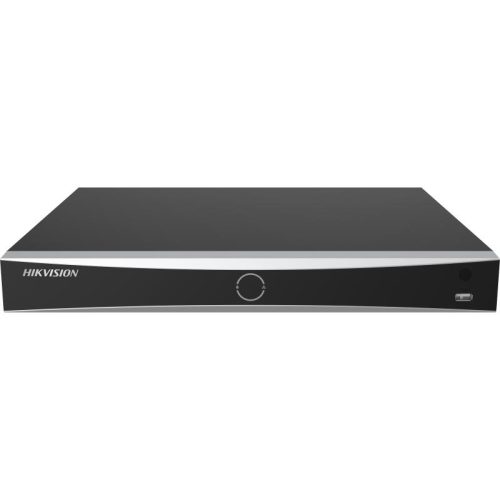
For most systems, the practical decision is between a compact four-channel recorder, an eight-channel model with better storage capacity, and a 16-channel recorder that leaves room to expand. VPro models add another option for businesses that spend a lot of time searching and investigating footage.
| Model | What it is | Usually strongest for | Why choose it | What to watch for |
|---|---|---|---|---|
| DS-7604NI-M1/4P | 4-channel PoE NVR with 40 Mbps incoming bandwidth, 4 PoE ports, 1 SATA bay, and support for current Hikvision smart camera families | Compact homes, small offices, or small shops with four cameras and no serious staged growth plan | It is tidy, direct and easy to set up, with no need to buy a larger recorder for a genuinely small system. | There is almost no room to grow. Four 4K cameras, audio or long retention can also fill a single hard drive quickly. If you may need six or eight cameras, choose the larger recorder now. |
| DS-7608NI-M2/8P | 8-channel PoE NVR with 128 Mbps incoming bandwidth, 8 PoE ports and space for 2 hard drives | Better homes, small commercial, medical, retail, and light industrial jobs running around six to eight cameras | It is often the sensible middle ground for 8MP cameras and longer recording times without moving straight to a 16-channel recorder. | Can still become tight if the site is already talking about ten or twelve cameras, distributed switching, or specialty cameras beyond the initial phase. |
| DS-7616NI-M2/16P | 16-channel PoE Ultra Series NVR with 256 Mbps incoming bandwidth, 16 PoE ports, 2 SATA bays, and 4/1 alarm I/O | Medium commercial, staged multi-zone systems, warehouses, schools, larger retail, and any site that already knows growth is part of the design | The extra bandwidth and spare channels make it a better fit for a growing or multi-area commercial system. | Plan the cabinet, ventilation, backup power and network layout properly. Larger sites may connect some cameras through separate PoE switches rather than directly to the NVR. |
When a VPro AcuSeek recorder is worth it
The DS-7608NXI-I2/8P/VPRO and DS-7616NXI-I2/16P/VPRO are more than standard 8- and 16-channel recorders. Their AcuSeek and AcuSearch tools are designed to shorten the time it takes to find an incident, person or vehicle in recorded footage.
| VPro model | What makes it different | Usually strongest for | When it is probably overkill |
|---|---|---|---|
| DS-7608NXI-I2/8P/VPRO | 8-channel PoE VPro NVR with AcuSeek, AcuSearch, dual AI engines, face library support, and a stronger review workflow than a standard 8-channel recorder | Retail loss prevention, campus or office review workflows, investigation-led small commercial, and any site where operators will search footage regularly rather than only record it | Simple homes, basic four-camera or six-camera jobs, or sites that will never use advanced search, face library, or smarter event review. |
| DS-7616NXI-I2/16P/VPRO | 16-channel PoE VPro NVR with AcuSeek, AcuSearch, dual AI engines, up to 16-channel search coverage, and a more serious commercial analytics posture | Larger retail, schools, campuses, transport-style sites, warehouses with frequent review work, and businesses that genuinely investigate incidents rather than just archive footage | Sites where the CCTV outcome is basically "record and only look at footage once in a while." In those jobs, the standard M-series path is usually enough. |
The practical difference is not just AI in the abstract. AcuSeek changes how someone searches footage. Instead of only relying on time, motion, or area, the platform is built to support more natural text-led and attribute-led retrieval. That is much more relevant to loss prevention, public-facing commercial, campus security, and investigation-heavy environments than to simple domestic installs.
Putting the camera and recorder together
The camera determines what you can see; the recorder determines how long you can keep it and how easily you can find it again. A four-camera system with modest storage needs may be perfectly comfortable on the DS-7604NI-M1/4P. A system with six to eight cameras, several 4K streams or longer retention is better matched to the DS-7608NI-M2/8P. For a larger commercial site or a project likely to expand beyond eight cameras, the DS-7616NI-M2/16P usually makes more sense even if a few channels are empty at first.
If staff regularly investigate theft, safety events or vehicle movements, recorder search tools may matter as much as channel count. That is where the VPro AcuSeek models become attractive. For a home where footage is reviewed only occasionally, a standard NVR will usually do the job at lower cost.
Sample 2026 system examples
Harbour Allied Health
A small allied-health clinic may pair four standard fixed cameras with a DS-7604NI-M1/4P when the camera count is unlikely to change. It is a straightforward way to cover the entry, reception, corridor and rear exit without paying for unused capacity.
Olivia's Professional Office
A better suburban home or a professional office may pair several fixed cameras with one DS-2CD2387G3-LIS2UY/SL on the most important external side path or front entry and run them into a DS-7608NI-M2/8P. That combination makes sense when the site wants stronger 4K low-light coverage on one or two key scenes but still needs a recorder with sensible headroom for retention and possible extra cameras.
Grant's Trade Showroom
A trade showroom with a customer car park, front glazing, warehouse door and side gate may use one or two motorised DS-2CD3H66G3-LIZSUY/SL or DS-2CD3H86G3-LIZSU(Y)/SL cameras for the longer, harder views. Standard fixed cameras can cover the simpler areas, while a DS-7616NI-M2/16P leaves room for the planned second stage. This keeps premium cameras where they add value instead of overspecifying every position.
Metro Retail Group
A retail store or campus reception may be a good fit for a VPro recorder. If staff regularly need to find people, vehicles or specific incidents, the faster search tools in a DS-7608NXI-I2/8P/VPRO or DS-7616NXI-I2/16P/VPRO can save meaningful review time compared with a basic recorder.
Do not overlook the installation
A premium camera cannot fix a poor mounting position. Before ordering, confirm the lens and viewing distance, camera height, night lighting, cable routes, recorder location, backup power and required recording time. On a larger site, also decide whether cameras will connect directly to the NVR or through separate PoE network switches. The most common problems are still simple ones: a view that is too wide, a camera mounted too high, no spare recorder channels and not enough hard-drive space.
Quick shortlist: which model suits which job?
- DS-2CD2387G3-LIS2UY/SL - Choose it for a fixed, high-detail view where colour at night and an optional strobe or speaker are useful.
- DS-2CD3H66G3-LIZSUY/SL - Choose it when the installer needs to fine-tune a longer or awkward view and 6MP provides enough detail.
- DS-2CD3H86G3-LIZSU(Y)/SL - Choose it when you need both motorised lens adjustment and 8MP detail at an important commercial position.
- DS-7604NI-M1/4P - Best for a simple four-camera system that is not expected to grow.
- DS-7608NI-M2/8P - A strong all-round choice for better homes and small businesses with up to eight cameras.
- DS-7616NI-M2/16P - Better for growing businesses, multi-area sites and systems likely to exceed eight cameras.
- DS-7608NXI-I2/8P/VPRO - Choose it when an eight-camera site will benefit from faster AI-assisted footage searches.
- DS-7616NXI-I2/16P/VPRO - Choose it for a larger commercial system where frequent incident investigation is part of the day-to-day work.
Recommended next pages
If you are still deciding between a fixed camera, motorised lens, PTZ or active deterrence model, read How to Choose a Hikvision Camera. Once the camera plan is clear, use How to Choose a Hikvision NVR to confirm channel count, hard-drive capacity and room for future expansion.
Sources and Further Reading
- Hikvision Australia: DS-2CD2387G3-LIS2UY/SL
- Hikvision: DS-2CD3H86G3-LIZSU(Y)/SL
- Hikvision Global: DS-7604NI-M1/4P
- Hikvision Global: DS-7608NI-M2/8P
- Hikvision: DS-7616NI-M2/16P
- Hikvision: DS-7608NXI-I2/8P/VPro
- Hikvision Australia: DS-7616NXI-I2/16P/VPro
- Hikvision: AcuSeek launch background
- SecurityWholesalers: DS-2CD2387G3-LIS2UY/SL
- SecurityWholesalers: DS-2CD3H66G3-LIZSUY/SL
- SecurityWholesalers: DS-2CD3H86G3-LIZSU(Y)/SL
- SecurityWholesalers: DS-7604NI-M1/4P
- SecurityWholesalers: DS-7608NI-M2/8P
- SecurityWholesalers: DS-7616NI-M2/16P
- SecurityWholesalers: DS-7608NXI-I2/8P/VPRO
- SecurityWholesalers: DS-7616NXI-I2/16P/VPRO
Frequently Asked Questions
-
Is the DS-2CD2387G3-LIS2UY/SL the right default Hikvision camera for every site?
No. It is a strong higher-end fixed 8MP turret with colour low-light footage and deterrence features, but it is not automatically right for every position. A simpler entry may not need all of those features, while a long driveway may be better served by a motorised lens.
-
When is the DS-7604NI-M1/4P a good Hikvision NVR choice?
It suits a straightforward four-camera system where the owner wants direct plug-and-play PoE and does not expect to add more cameras. If six or eight cameras are a real possibility, choose a larger recorder from the start.
-
Why does the DS-7608NI-M2/8P often make more sense than a cheaper 8-channel recorder?
Its stronger bandwidth and two hard-drive bays make it easier to support 8MP cameras, audio and longer recording times. It also leaves spare channels when a four-camera system is likely to grow.
-
When should you step straight to the DS-7616NI-M2/16P?
Choose it when the finished system is likely to exceed eight cameras, or when a commercial site needs more bandwidth and room to grow. Buying the 16-channel model early can avoid a costly recorder replacement later.
-
Where do the new Hikvision VPro AcuSeek NVRs fit in 2026?
They fit when the site cares about investigation workflow, faster search, and smarter review rather than only basic recording. They are more relevant to commercial users, campuses, retail loss prevention, and sites with heavier incident review demands than to simple camera-only jobs.
-
Do these current Hikvision picks remove the need for storage and UPS planning?
No. Better hardware only helps if retention, hard-drive sizing, and power-backup planning are done properly. Higher-resolution ColorVu cameras and audio-enabled deterrence models can put real pressure on storage if the assumptions are weak.
-
Should a buyer choose the NVR first or the cameras first?
Start by deciding what each camera position needs, then choose the recorder before ordering. The NVR must have enough channels, bandwidth, hard-drive capacity and compatible smart features for the full camera plan.
Related Pages
How to Choose a Hikvision Camera
Work out whether each position needs a fixed camera, an adjustable motorised lens, a PTZ or active deterrence.
How to Choose a Hikvision NVR
Use the NVR guide to confirm channel count, bandwidth, storage, UPS, and topology.
Hikvision ColorVu Cameras Buying Guide
Read this when colour footage after dark is one of the main reasons for upgrading the cameras.
Hikvision Live Guard Cameras Buying Guide
Use this when the shortlist is really being driven by speaker, strobe, and after-hours deterrence rather than only image quality.
Best Hikvision CCTV System for Small Business
See how current Hikvision camera and NVR choices land in smaller commercial jobs.