








Informational
What Is Access Control?

Explainer Guide
What It Means
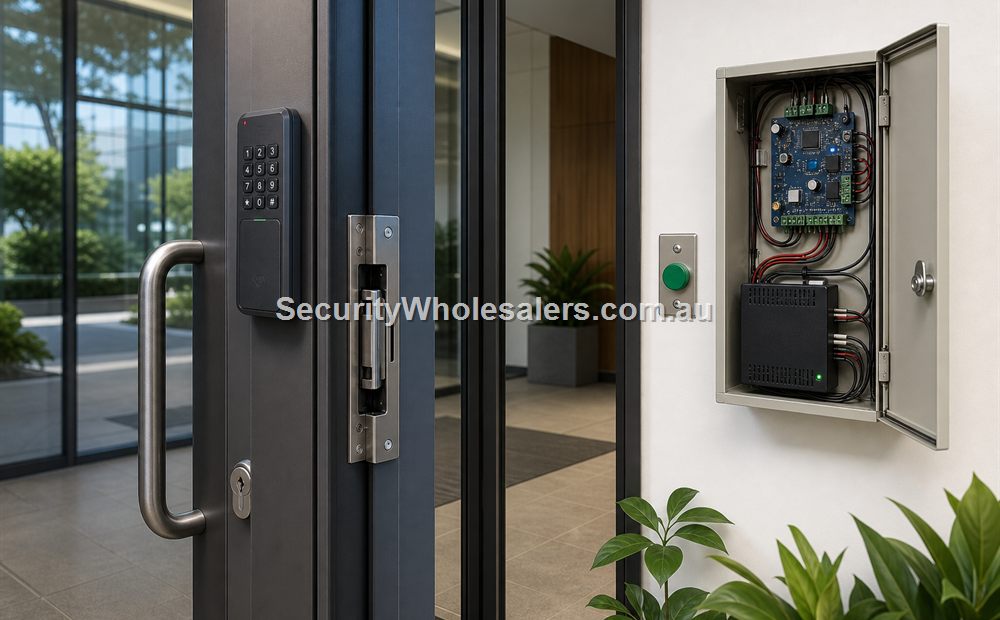
In practical terms, access control is the combination of credential, reader, decision logic, lock release, and exit path that controls movement through a door or gate. It might be as simple as one standalone card-and-PIN device on a storeroom door, or as complex as a multi-building controller system with lifts, visitor intercom, and central software.
Text Diagram: Basic Access Control Flow
[Card / PIN / Face / App]
|
v
[Reader or terminal]
|
v
[Decision logic / controller]
|
v
[Lock release on the door]
|
+--> [Exit button / REX / egress path]
|
+--> [Logs / schedules / software if used]How It Fits in a Real Installation
A real installation usually includes more than the reader. It also includes the lock hardware, a safe egress method, power, and whatever administration layer is needed to add or remove users later. That is why experienced installers start with the door and the workflow, not just the terminal model.
Why It Matters
Good access control gives a site a cleaner way to manage access than physical keys alone. It can remove old users without rekeying, separate user groups, and create searchable event history if the system tier supports logs.
Common Misunderstandings
The most common misunderstanding is thinking access control means only a keypad or only a card reader. The actual system is the full entry workflow from the credential through to the door release and exit hardware.
Where to Go Next
If you are still deciding which tier is right, read the buying guide and the comparison between standalone and networked access control next.
Relevant SecurityWholesalers Product Areas
- Access Control - The main category for controllers, readers, credentials, locks, and supporting hardware.
- Hikvision Access Control - A strong ecosystem when you want one family spanning standalone devices, controllers, lift hardware, and software growth.
- Door Strikes - Often the cleanest answer for hinged commercial doors when the latch and frame suit the hardware.
- Hikvision Access Control Base License Package - Useful when the site needs a proper software layer for users, schedules, event review, and central administration.
Related Guides in This Series
Source References
Frequently Asked Questions
-
What does access control mean in plain English?
Access control is the system that decides whether a person or credential is allowed to open a door or gate.
-
Where does access control fit in a real installation?
In a real job, access control includes the lock, the exit path, the power, and the user-management workflow, not just the badge reader.
-
Why does access control matter to a buyer or installer?
It matters because it gives sites cleaner user control, easier credential removal, and often a much better audit trail than keys.
-
What do people usually get wrong about access control?
People often reduce access control to the reader, when the real system is the whole door workflow.
-
When should a site move beyond the basic version of this?
A site moves beyond the basic version once it needs logs, schedules, several doors, or central administration.
-
Which related guide should someone read next?
Read the standalone-versus-networked comparison next if you are choosing a system tier.
Quote checklist for What Is Access Control?
Before ordering, ask for a short answer to these questions. They make the quote easier to compare and reduce the chance of buying hardware that does not match the site.
- What exact problem is being solved: access control planning, deterrence, evidence, access control, safety, compliance or convenience?
- What happens during poor light, bad weather, busy periods, after-hours events or staff changes?
- Who will administer users, review events, export evidence and test the system?
- Which part of the design is allowed to be basic, and which part must be strong because it proves the incident?
If those answers are vague, the buyer should pause before purchasing. Good security equipment becomes much more useful when the operating plan is written down before installation.
Final field note for What Is Access Control?
For What Is Access Control?, the final buying decision should be easy to explain to the person who will live with the system. The quote should identify the must-have outcome, the acceptable compromises, and the support path if users, doors, cameras, sensors or site conditions change later.
This is the difference between a list of products and a security design. The products matter, but the design is what makes them useful.
Final field note for What Is Access Control?
For What Is Access Control?, the final buying decision should be easy to explain to the person who will live with the system. The quote should identify the must-have outcome, the acceptable compromises, and the support path if users, doors, cameras, sensors or site conditions change later.
This is the difference between a list of products and a security design. The products matter, but the design is what makes them useful.
Final field note for What Is Access Control?
For What Is Access Control?, the final buying decision should be easy to explain to the person who will live with the system. The quote should identify the must-have outcome, the acceptable compromises, and the support path if users, doors, cameras, sensors or site conditions change later.
This is the difference between a list of products and a security design. The products matter, but the design is what makes them useful.
Final field note for What Is Access Control?
For What Is Access Control?, the final buying decision should be easy to explain to the person who will live with the system. The quote should identify the must-have outcome, the acceptable compromises, and the support path if users, doors, cameras, sensors or site conditions change later.
This is the difference between a list of products and a security design. The products matter, but the design is what makes them useful.
Real quote scenario for What Is Access Control?
When quoting What Is Access Control?, the useful starting point is door-by-door access planning. The buyer should be able to record the door type, lock type, reader position, exit method, power supply, fire requirement and daily user group. Without those details, two quotes can look similar while solving very different problems.
For What Is Access Control?, a shopfront door, warehouse staff door, server-room door and shared tenancy door can all need different hardware even when the software is the same. This is why a strong SecurityWholesalers guide should talk about the site, the workflow and the equipment together rather than treating the product category as a simple shopping list.
Budget-conscious path
Use the simplest reliable hardware that solves the main risk. Keep administration simple and avoid specialist features unless they change the outcome.
Balanced path
Add better management, verification or expansion headroom where the site is likely to grow. This is usually the best path for small businesses and shared buildings.
Higher-risk path
Document response, audit trail, permissions and fallback procedures. Higher-risk sites need clearer operating rules, not just stronger hardware.
The final What Is Access Control? quote should make the weak points visible. If cabling, power, monitoring, mobile app access, fire release, user management or future expansion are assumed rather than written down, the buyer is carrying risk that should have been solved during design.
Questions to ask before approving What Is Access Control?
- What does the system need to prove or control on an ordinary day?
- What is different after hours, on weekends, during staff changes or during an emergency?
- Who will administer users, review events, export evidence or test the system?
- What happens if the internet is unavailable, a user loses a credential, a sensor triggers falsely or a door does not release?
- Which part of the system is easy to expand later, and which part would be expensive to change?
These questions are deliberately practical. They help separate a polished product list from a design that will remain useful after installation.
Extra buying notes for What Is Access Control?
The What Is Access Control? buying decision should be tested against normal use, after-hours use and failure conditions. If the quote cannot explain those three moments, it needs more design work before the customer commits. This is the kind of detail that helps a buyer compare quotes properly, because it turns the conversation from ?which model is cheapest?? into ?which design will still be useful after installation??
For What Is Access Control?, the best final check is to ask what would make the system fail in practice. Common answers include poor cabling, weak power planning, missed user permissions, unclear response duties, too little storage, unsuitable mounting positions, or a handover that nobody can follow. A strong quote names those risks and deals with them before hardware is ordered.
For What Is Access Control?, SecurityWholesalers should help buyers feel more confident, not more overwhelmed. The ideal outcome is a quote that is technically sound, easy to explain, and honest about where a simpler option is enough.
Extra buying notes for What Is Access Control?
The What Is Access Control? buying decision should be tested against normal use, after-hours use and failure conditions. If the quote cannot explain those three moments, it needs more design work before the customer commits. This is the kind of detail that helps a buyer compare quotes properly, because it turns the conversation from ?which model is cheapest?? into ?which design will still be useful after installation??
For What Is Access Control?, the best final check is to ask what would make the system fail in practice. Common answers include poor cabling, weak power planning, missed user permissions, unclear response duties, too little storage, unsuitable mounting positions, or a handover that nobody can follow. A strong quote names those risks and deals with them before hardware is ordered.
For What Is Access Control?, SecurityWholesalers should help buyers feel more confident, not more overwhelmed. The ideal outcome is a quote that is technically sound, easy to explain, and honest about where a simpler option is enough.