












Informational
Card Reader vs PIN vs Face Recognition
Decision Guide
Credential choice changes how the building is actually managed. A reader is not just a piece of hardware. It defines whether users share codes, carry tags, use phones, or present their face. The better method is normally the one the site can administer cleanly rather than the one that sounds the most advanced.
Main differences
| Method | Usually strongest for | Main watch-out |
|---|---|---|
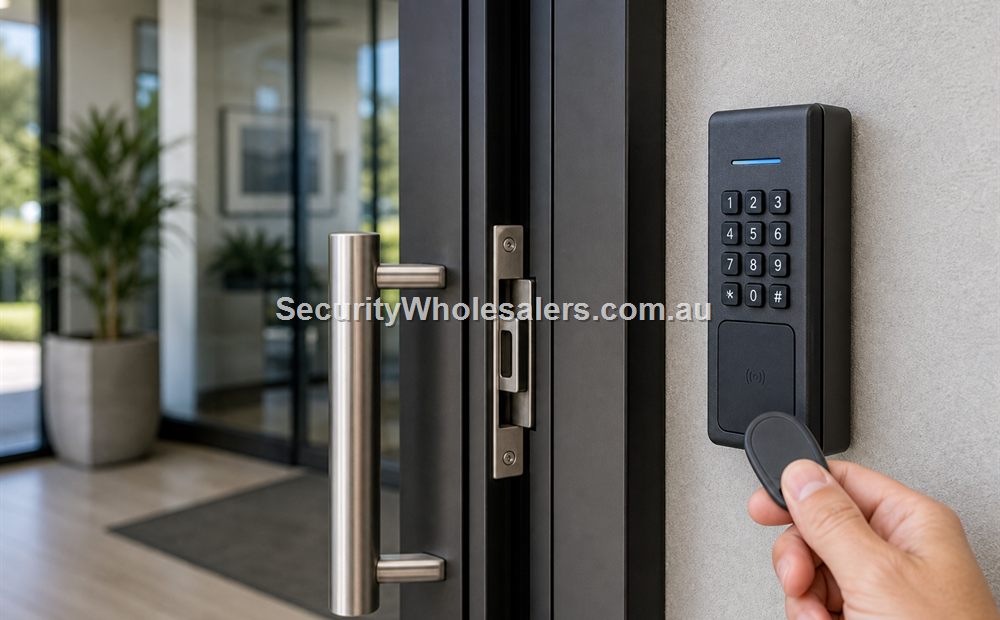
| Card or fob reader | Named users, quick revoke and replace workflow, cleaner day-to-day administration | Cards and fobs still need issuing, tracking, and replacement discipline. |
| PIN entry | Lower-complexity openings and simple convenience access | Shared codes drift quickly if the site has staff turnover or wider user groups. |
| Face recognition | Selected sites wanting faster or lower-touch entry with stronger automation logic | Needs privacy, governance, fallback credential planning, and realistic software expectations. |
Small office with recurring staff changes
A small office that regularly hires casual staff or contractors is often better on cards or fobs than shared PINs because each person can be issued and revoked cleanly without changing the door for everyone else.
Premium staff-only entry with low-touch requirement
A higher-end staff entry may justify face recognition if the business has a genuine reason for faster lower-touch access and is willing to manage the privacy and fallback credential questions properly. The reader only makes sense if the governance layer is equally mature.
Questions that normally decide the credential method
- How often users change and how quickly the site needs to disable a departed or lost credential.
- Whether the building can tolerate shared knowledge such as one common code.
- Whether the site wants the cheapest usable method or the cleanest long-term administration path.
- Whether privacy, consent, or software management makes face recognition a practical option or an unnecessary complication.
- Whether the opening is staff-only, visitor-facing, or part of a broader controlled workflow.
Relevant SecurityWholesalers product paths
- DS-K1107AM and DS-K1107AMK for card and card-plus-PIN reader paths.
- HA-AC-S1 for simple card and PIN entry.
- Hikvision Face Recognition for sites seriously evaluating face-based entry.
Related guides
Frequently Asked Questions
- When is a card reader usually the better choice?
A card reader is often the cleaner choice where named users need to be issued and revoked quickly without relying on shared codes.
- When does PIN still make sense?
PIN still makes sense on some lower-complexity openings or where the site deliberately wants keypad access, but shared or unmanaged codes can become difficult quickly.
- When is face recognition worth serious consideration?
Face recognition is worth serious consideration when the site has a genuine reason for faster user flow or lower-touch credential use and is prepared to manage privacy, fallback credentials, and software properly.
- Is face recognition always the most advanced answer?
No. It is only the right answer where the building and its governance can genuinely support it.
- What is the biggest credential mistake?
Choosing by novelty rather than by how users are issued, replaced, revoked, and reviewed over time.
- Which page should someone read next?
If the site is thinking about face entry seriously, the face-recognition buying pages are the next useful read.
Review information
Content owner: SecurityWholesalers access control guide team. Revision: 17 July 2026. Use these examples as a starting point, then confirm the details against current product manuals, approved drawings and relevant authority requirements.
NCC access and egress | ACMA cabling requirements | OAIC biometric guidance | Access control definitions