













Commercial
Best Access Control System for Multi-Tenant Buildings
Buying Guide
Multi-tenant buildings usually have shared common entry points, tenant-specific rights, and often some combination of intercom, after-hours access, and lift or parking logic. That is why they usually need more than standalone door products.
What Usually Fits Best
A controller-based system with software is usually the strongest fit because the site needs common-area control, tenant separation, and cleaner management of different user groups over time.
| Situation | Usually The Better Path | Why |
|---|---|---|
| Shared lobby only | Still usually controller-based | Tenant separation starts at the common entry. |
| Shared lobby plus tenant and service doors | Controller plus software | Several permission sets need one management layer. |
| Building with lifts or mixed-use floors | Controller plus lift integration | Movement through the building has to follow tenancy rules. |
Implementation Direction
A multi-tenant job should define common entries, tenant-specific entries, any lift or parking integration, and how visitors are routed. The installer should also decide whether the site needs separate user groups by tenancy, how cleaners or service contractors are handled, and whether the main entry is intercom-led, credential-led, or both.
What the Installer Needs to Confirm on Site
Multi-tenant buildings should be surveyed as a layered permissions job. Shared entries, tenant-specific rights, visitors, and sometimes lifts or parking all have to be designed together or the system will become difficult to administer very quickly.
- Confirm the shared lobby or common entry, any service doors, any tenant-specific access boundaries, and whether lifts or parking are part of the scope.
- Ask how visitors reach tenants and whether the main entry is intercom-led, credential-led, or a mix of both.
- Check where the building can securely house controllers, switchgear, lock supplies, and UPS hardware.
- Define user groups by tenancy, cleaners, contractors, and building-management staff before selecting the software tier.
- Coordinate with lift and gate contractors early where those systems need to follow tenant permissions.
What This Job Normally Requires
Multi-tenant sites almost always justify controller architecture plus software. The install has to support common-area control and tenant separation at the same time, which is hard to do cleanly with device-by-device programming.
- Controller path sized for shared entries plus any tenant or service openings that need coordinated permissions.
- Intercom at the main entry where visitors need to reach different tenants, with proper strike or maglock and safe egress hardware.
- Lift or parking integration where tenant permissions should follow through the rest of the building.
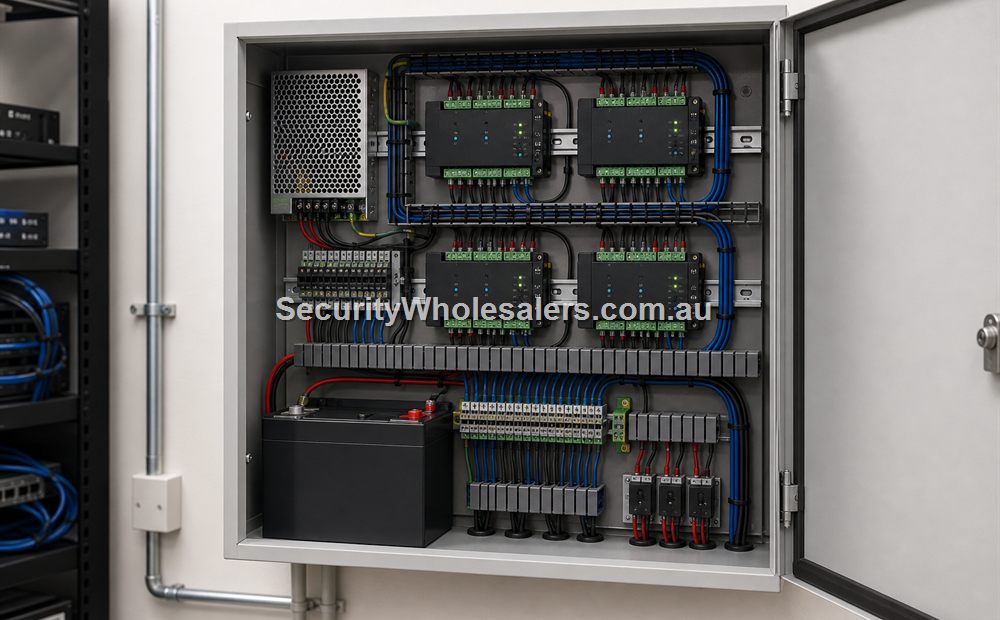
- Central cabinet and UPS so the building core is serviceable and not scattered across tenancies.
- Software layer that can manage tenancy groups, common areas, and event history from one administrative view.
Programming, Testing, and Handover
The building should be handed over with tenant separation already proven, not as a future programming idea. Management needs to see that a shared building can still have clean boundaries.
- Create separate admin structure for building management versus tenancy-level users where the project calls for it.
- Test shared-lobby release, tenant-specific credentials, contractor schedules, and any lift or parking permissions with live examples.
- Show management how to add or remove a tenant user without disturbing other tenancies in the same building.
- Verify event logs clearly identify which door, tenant group, or common area was involved in an incident.
- Leave a clear system map showing the boundary between shared building infrastructure and any tenant-specific equipment.
Software, Credentials, and Growth
A real multi-tenant building almost always benefits from software-backed access management because the building needs one place to administer shared areas and also keep tenant permissions separate. Browser-only device setup is rarely the right long-term operating model here.
Common Mistakes to Avoid
- Separate common-area rules from tenant-specific rights.
- Treat the main entry as a visitor and credential workflow, not just a lock.
- Use software if the site has several user groups or tenancies.
- Plan lift or parking permissions early.
- Do not assume all tenants need the same access model.
Recommended Direction
For multi-tenant buildings, choose a controller-based system with software and design around tenant separation from the beginning.
Relevant SecurityWholesalers Product Areas
- Hikvision DS-K2704X - A four-door controller with web-based setup and room to grow into a much larger system.
- Hikvision DS-K2210 - A practical elevator controller option when floor permissions need to follow the access rules.
- Intercoms - Useful where visitor verification and door release need to sit in the same workflow.
- Hikvision Access Control Base License Package - Useful when the site needs a proper software layer for users, schedules, event review, and central administration.
- Hikvision DS-K2M002X - A two-door control module used to extend larger controller-based systems.
Related Guides in This Series
Source References
Frequently Asked Questions
-
What usually works best for multi-tenant-building access control?
Multi-tenant buildings usually need controller-based access plus software because shared entry and tenant separation have to be managed together.
-
Is a simple standalone system enough for multi-tenant-building access control?
Standalone rarely suits the core of a multi-tenant building because separate tenant rights and common-area administration are the whole challenge.
-
When do logs really matter on multi-tenant-building access control?
Logs matter because shared lobbies, after-hours access, and tenant-specific issues all create management questions.
-
When does intercom or visitor verification matter here?
Intercom is usually very relevant at the common entry where visitors need to reach different tenants.
-
What software usually makes sense?
Software is usually central because tenant permissions, building management, and common-area auditing all need one management layer.
-
What is the most common buying mistake?
A common issue is trying to manage a multi-tenant building as if every door belongs to one business.
Plan this site door by door
Download the editable workbook, list every controlled opening, then email it with matching door photos to sales@securitywholesalers.com.au. Include the site suburb, installation requirement and target timing.
Review information
Content owner: SecurityWholesalers access control guide team. Revision: 17 July 2026. Use these examples as a starting point, then confirm the details against current product manuals, approved drawings and relevant authority requirements.
NCC access and egress | ACMA cabling requirements | OAIC biometric guidance | Access control definitions