













Informational
How Does Door Access Control Work?
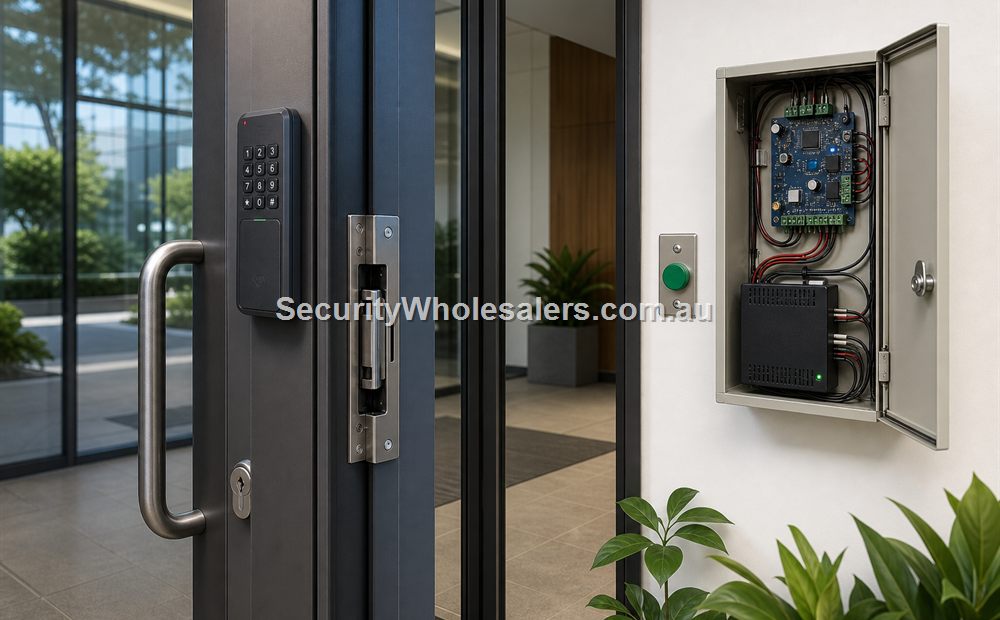
Explainer Guide
What It Means
At the simplest level, a user presents a credential such as a card, PIN, face template, mobile app, or intercom-triggered release. The system checks whether that credential is valid for that door and that time. If the rule matches, the lock is released for a defined period and the user can enter.
Text Diagram: What Happens When a Credential Is Presented
[User presents card / PIN / face / app]
                   |
                   v
          [Reader or terminal]
                   |
                   v
     [Rule check: allowed door? allowed time?]
                   |
        +----------+----------+
        |                     |
        v                     v
    [Allowed]             [Denied]
        |                     |
        v                     v
[Lock release for set time] [Event can be logged]
        |
        v
[User enters]
        |
        +--> [Exit button / REX for leaving]
        |
        +--> [Door contact confirms closed state]
How It Fits in a Real Installation
In a real installation, that process sits on top of a full hardware path: reader, controller or onboard decision logic, lock hardware, exit device, and often a door contact so the system can tell whether the door actually closed again.
Why It Matters
Understanding the sequence matters because many site problems are not actually "reader problems". They are door, lock, egress, or administration problems that only show up when the whole workflow is tested.
Common Misunderstandings
A common misunderstanding is assuming that the reader "opens the door" by itself. Usually the reader is only one part of the decision path. The actual opening still depends on the lock release, the door hardware, and the safe exit arrangement working properly.
Where to Go Next
Read the door-controller explainer and the strike-versus-maglock comparison if you want to understand where most installation decisions really sit.
Relevant SecurityWholesalers Product Areas
- Access Control - The main category for controllers, readers, credentials, locks, and supporting hardware.
- Door Strikes - Often the cleanest answer for hinged commercial doors when the latch and frame suit the hardware.
- Door Locks - Helpful when comparing maglocks, monitored locks, and other locking paths.
- Hikvision DS-K2702X-P - A strong fit when one or two doors need proper logs, schedules, and a real controller architecture.
Related Guides in This Series
Source References
Frequently Asked Questions
-
What does door access control mean in plain English?
Door access control works by checking a credential against a rule, then releasing the lock if the rule passes.
-
Where does door access control fit in a real installation?
In practice, the reader, controller, lock, exit device, and door contact all work together.
-
Why does door access control matter to a buyer or installer?
It matters because many access faults come from the door workflow, not the badge itself.
-
What is useful to understand about door access control?
People often assume the reader alone opens the door, when the real result depends on the full lock and egress path.
-
When should a site move beyond the basic version of this?
A site moves beyond the basic version when the door needs logs, software, extra readers, or coordination with other doors.
-
Which related guide should someone read next?
Read the door-controller and strike-versus-maglock guides next.
Review information
Content owner: SecurityWholesalers access control guide team. Revision: 17 July 2026. Use these examples as a starting point, then confirm the details against current product manuals, approved drawings and relevant authority requirements.
NCC access and egress | ACMA cabling requirements | OAIC biometric guidance | Access control definitions