

















Dahua Full-color vs Smart Dual Light
Low Light
The real decision is not marketing language
The site should first decide what it needs to see after dark. If the job really wants colour on a key gate, walkway, or external frontage all night, Full-color can make sense. If the site wants a more flexible approach that behaves one way until an event matters, Smart Dual Light can be the better fit.
In both cases, the right answer depends on scene lighting, mounting distance, the operator's tolerance for visible light, and whether the night scene has to identify people and vehicles clearly or simply confirm activity.
Installation insight
Low-light camera choice is often won or lost by placement. A camera that is too high, too far back, or aimed into a difficult lighting angle may underperform no matter how strong the spec sheet looks. Installers normally check spill light, reflective surfaces, likely shadows, and what the scene looks like when the site is truly dark rather than vaguely dim.
That is why Smart Dual Light and Full-color should be chosen as scene tools, not just as buzzwords. If the site wants strong night detail at one gate, that does not mean every camera on the property needs the same low-light behaviour.
How to choose in practice
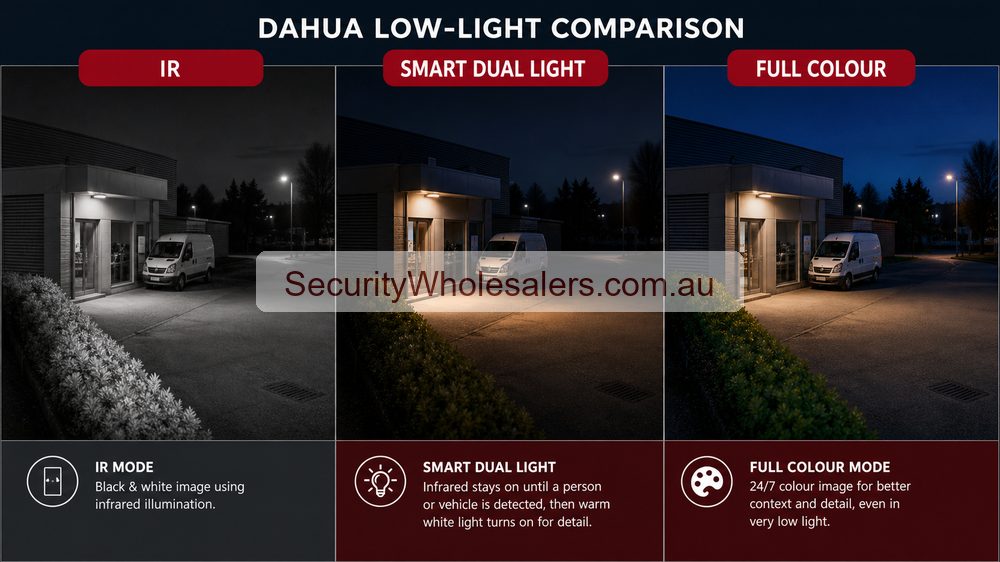
- Choose Full-color where the site consistently wants colour on the scene and is comfortable with the lighting behaviour needed to support it.
- Choose Smart Dual Light where the site wants a more selective response and does not need full visible-light behaviour on every quiet night-time minute.
- Use ordinary IR paths where the scene does not justify a stronger low-light premium and black-and-white review is still operationally enough.
Night-scene examples
| Scene | Better starting point | Why |
|---|---|---|
| Quiet side path beside a neighbour | IR or carefully tuned Smart Dual Light | Constant white light may create nuisance without improving the result enough. |
| Driveway with occasional movement | Smart Dual Light | Can stay discreet until an event needs colour detail. |
| Shopfront with street lighting | Full-colour or WizColor-style path | Existing light can help colour footage stay useful without harsh event lighting. |
| Rear stock entry | Smart Dual Light or active deterrence depending on risk | The site may benefit from visible response after hours. |
The wrong low-light choice usually comes from chasing colour at night without asking where the light comes from. If the scene is genuinely dark, even colour-capable cameras need some usable light. If white light will annoy neighbours or customers, a calmer IR design may be better.
Choosing by neighbour and customer impact
Low-light cameras do not exist in isolation. A driveway camera can affect a neighbour's bedroom. A shopfront camera can affect diners, staff or people walking past. A rear-lane camera may justify a stronger response because the risk is after hours and away from customers.
- Choose calmer IR where the site only needs reliable evidence and light spill would be a problem.
- Choose Smart Dual Light where occasional colour footage is valuable during events.
- Choose full-colour style cameras where the scene has useful ambient light and colour detail matters often.
- Do not promise colour-at-night miracles in a completely dark scene without planning the light source.
Relevant SecurityWholesalers Categories and Products
These Dahua examples and categories are useful because they represent the main low-light decisions buyers make on real sites.
- DH-IPC-HDW3667EM-S-IL-ANZ - A useful Smart Dual Light 6MP reference point.
- Dahua 8MP TiOC PRO vari-focal eyeball - A useful example of a stronger deterrence and low-light path where speaker, lights, and AI all matter.
- Dahua 6MP and 8MP camera categories - The broadest place to compare Dahua low-light-capable network cameras on the site.
Sources and Further Reading
Good better best low-light path
| Level | Path | Best fit |
|---|---|---|
| Good | Quality IR camera with correct placement. | Quiet homes, side paths and areas where white light is not wanted. |
| Better | Smart Dual Light. | Driveways, rear paths and business entries where colour during events is useful. |
| Best | Full-colour/WizColor-style path where ambient light supports it. | Shopfronts, lit approaches and scenes where colour detail is often valuable. |
The best low-light path is the one the site can live with every night. A technically stronger light system is not better if it creates nuisance or gets turned off.
Full-color vs Smart Dual Light: buyer decision table
| Choose this | When it makes sense | Watch out for |
|---|---|---|
| Full-color | Colour detail is needed all night and the scene has enough usable light. | White light, glare and neighbour impact. |
| Smart Dual Light | The site wants discreet IR most of the time, with white light only when needed. | Detection zones and schedules must be commissioned properly. |
| Normal IR | Quiet evidence is more important than colour. | Less colour context after dark. |
Useful product paths include DH-IPC-HDW3667EM-S-IL-ANZ for Smart Dual Light style buying and the Dahua 6MP/8MP IP camera categories for comparing the broader low-light range.
Frequently Asked Questions
-
What is the basic difference between Dahua Full-color and Smart Dual Light?
Full-color is more about maintaining colour at night, while Smart Dual Light is a more selective low-light path that can suit sites wanting a different balance between quiet scenes and event-driven response.
-
Is Full-color always better at night?
Not automatically. It is better when the site truly benefits from constant colour and the lighting behaviour suits the scene. Some sites are better served by a more selective low-light approach.
-
What installation factor matters most on low-light Dahua cameras?
Placement. Mounting height, distance to target, shadows, reflective surfaces, and actual site darkness matter hugely.
-
Should every Dahua camera on a site use the same low-light strategy?
Usually not. The stronger design is often a mix, with only the views that truly matter after dark getting the higher low-light treatment.
-
When does Smart Dual Light make more sense than a standard IR camera?
When black-and-white IR review is not enough and the site wants more useful night-time identification without assuming every scene needs a full-time colour-first behaviour.
-
Which related guide helps with the next decision?
Usually the camera-selection guide or the small-business / warehouse Dahua guide, depending on whether the low-light decision is tied to a broader site type.
Related Pages
Dahua WizColor Cameras Buying Guide
Use this if the site is seriously considering Dahua's current colour-first low-light branch.
How to Choose a Dahua Camera
Work through the real camera-selection questions rather than chasing Dahua model numbers too early.
Best Dahua CCTV System for Small Business
Use Dahua in a small-business context, with practical camera, recorder, and installation logic.
Dahua for Warehouses
Use Dahua in a warehouse context, especially where NVR scale, motorised lenses, and PTZ are real considerations.
Dahua Network Cameras Buying Guide
Map the Dahua network-camera range before you dive into individual models.