












Informational
Hikvision Thermal Resolution Explained: 160 x 120 vs 256 x 192 vs 384 x 288
Explainer
What the three resolutions mean in practice
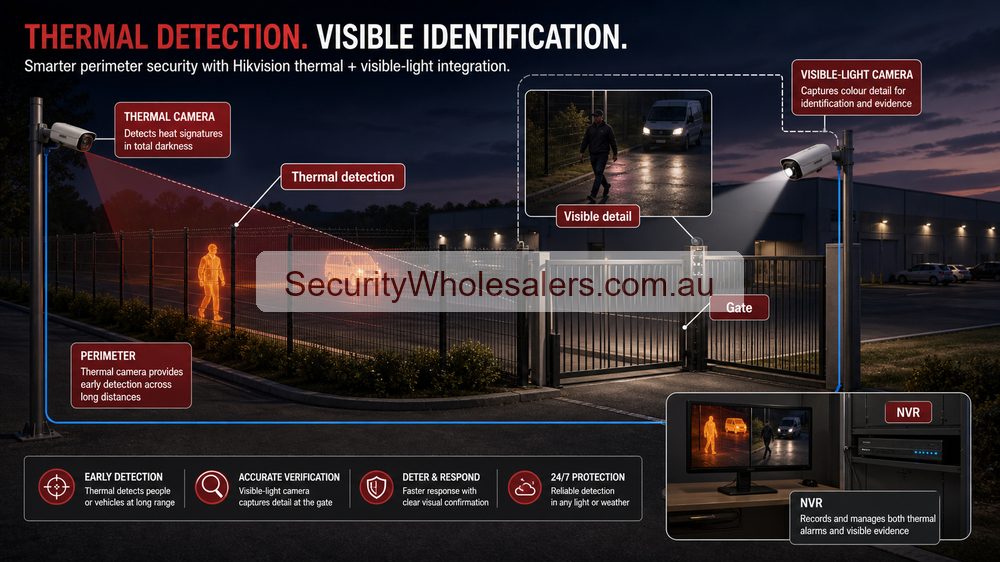
A 160 x 120 sensor contains 19,200 thermal pixels, 256 x 192 contains 49,152, and 384 x 288 contains 110,592. More pixels let the camera describe smaller temperature differences across a wider or more distant scene. They do not create visible-light detail such as a face, clothing colour or number plate, so important events may still need an optical camera for identification.
Direct resolution comparison
| Thermal resolution | Usually best for | What to keep in mind |
|---|---|---|
| 160 x 120 | Shorter-range fire-risk awareness, tighter outdoor scenes, smaller budget thermal jobs | Best when the target is relatively large in the frame. It has limited room for cropping or very wide scenes. |
| 256 x 192 | Mixed perimeter and fire-detection jobs, practical bi-spectrum middle ground | A useful middle ground, but the lens and required detection distance still need to be checked. |
| 384 x 288 | Higher-end perimeter and thermographic jobs on larger or more demanding scenes | Provides more scene detail and design flexibility, but should not be used to compensate for the wrong lens or mounting position. |
Example: small plant room versus large stockpile edge
Situation: One site wants thermal over a compact plant room. Another wants it over a larger waste or stockpile edge outdoors.
Solution used: The plant room may be fine with a 160 x 120 thermal camera if the scene is compact. The stockpile edge may justify 256 x 192 or 384 x 288 depending on scene size and the level of early warning needed.
Why this was chosen: The bigger scene spreads the same thermal pixels across more area, so it usually benefits from more thermal detail.
Installation notes: The installer should still confirm lens and field of view. A higher-resolution camera can still be a poor fit if the scene is framed badly.
Example: narrow perimeter gate versus wide remote boundary
Situation: A narrow gate or side access line needs thermal awareness, and another site wants coverage over a much broader remote boundary.
Solution used: The narrow access line may work with a 160 x 120 or 256 x 192 unit, while the broad boundary is more likely to need 256 x 192 at minimum and sometimes 384 x 288 or a thermal PTZ.
Why this was chosen: Thermal resolution matters more as the scene widens and the target occupies less of the frame.
Installation notes: This is where buyers often oversimplify thermal into one generic product class. In reality, a narrow crossing line and a wide paddock edge are very different thermal jobs.
Relevant SecurityWholesalers Categories and Products
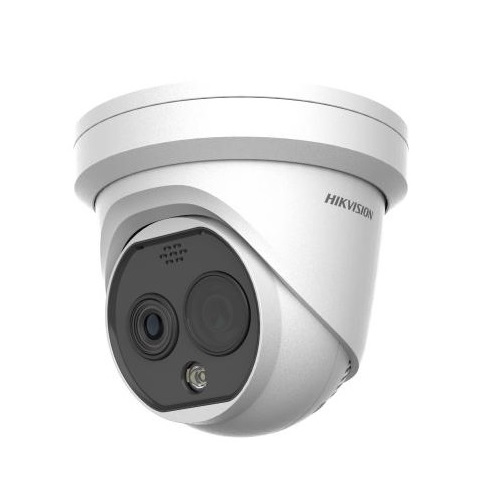
These product examples show the three practical resolution tiers currently visible in the Hikvision thermal range on SecurityWholesalers.
- DS-2TD1217-2/QA - A 160 x 120 entry-level example.
- DS-2TD1228T-2/QA - A practical 256 x 192 middle-ground example.
- DS-2TD2637T-10/QY - A 384 x 288 higher-end example.
Sources and Further Reading
How to choose without overbuying
Lower thermal resolution may be enough for shorter detection tasks where the target is large and close. Higher thermal resolution becomes easier to justify when the target is smaller, further away, or when the scene has more background complexity. The right answer depends on distance and lens as much as the headline resolution.
- Use distance and target size before choosing resolution.
- Do not expect thermal resolution to behave like visible-light megapixels.
- Use visible cameras where identification detail is required.
Frequently Asked Questions
-
Is 160 x 120 enough for thermal cameras?
It can be enough for smaller scenes, shorter distances, and more modest fire-risk or thermal-awareness jobs.
-
Is 256 x 192 the best middle ground?
For many real jobs, yes. It is often the practical step-up once you want more useful thermal detail without jumping straight to the highest-cost tier.
-
When does 384 x 288 become worth it?
It becomes more worthwhile when the scene is larger, the distance is greater, or the job is more demanding from a perimeter or thermographic perspective.
-
Does higher thermal resolution mean longer distance by itself?
Not by itself. Lens choice, field of view, mounting height, scene width, and the actual detection objective still matter.
-
Should I buy the highest thermal resolution available?
Not automatically. The site should buy enough thermal detail to solve the job properly, but not overspend on resolution the scene does not need.
-
Do all Hikvision thermal jobs need bi-spectrum?
No, but bi-spectrum is often the more practical choice where the operator also needs visible context.
Related Pages
Hikvision Thermal Cameras Buying Guide
The main Hikvision thermal guide for perimeter, fire, and bi-spectrum buying decisions.
Best Hikvision Thermal Cameras for Perimeter Protection
Perimeter-focused Hikvision thermal buying guidance.
Best Hikvision Thermal Cameras for Fire Detection
Fire-detection buying guidance for Hikvision thermal cameras.
When to Use Bi-Spectrum Hikvision Thermal Cameras
A practical guide to choosing Hikvision bi-spectrum thermal cameras.