












Dahua for Warehouses
Warehouse Fit
Where Dahua usually fits well
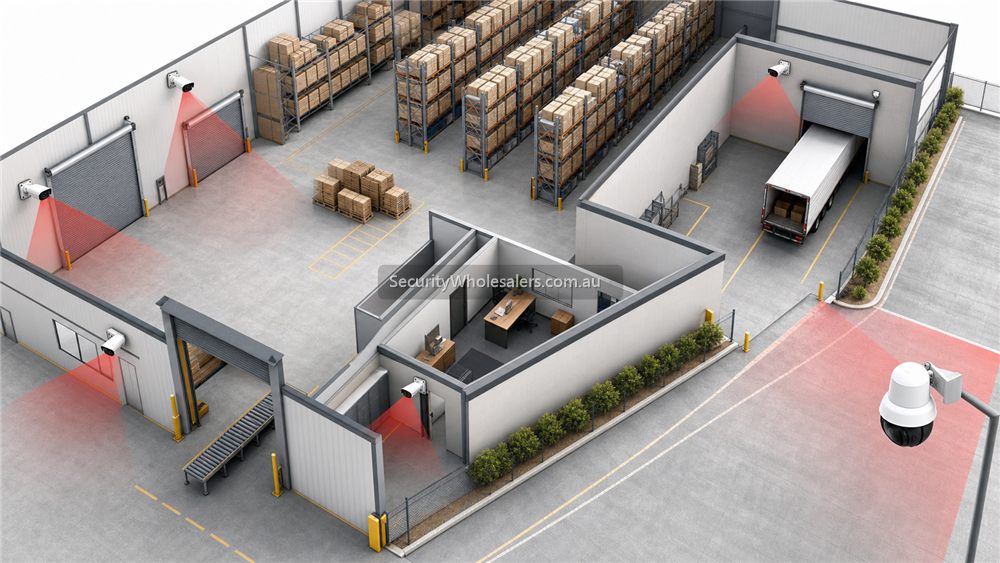
- Dock doors and dispatch areas where a fixed or motorised camera can be set for repeatable operational views.
- Longer aisles and internal traffic lanes where motorised varifocal cameras are more useful than guessing a fixed lens.
- Yards and broader external apron areas where one PTZ may support fixed cameras.
- After-hours perimeter points where Smart Dual Light or TiOC-style deterrence is justified on selected scenes.
How this page differs from the warehouse system guide
This page is about whether Dahua is a suitable brand fit for a warehouse-style project. The separate warehouse system page goes deeper into the full camera and recorder layout. Buyers who are still comparing Dahua with other brands usually start here, then move into the system-design page once Dahua is still in contention.
In practice, Dahua tends to suit warehouses that want a broad choice of fixed cameras, motorised views, PTZ options, and a sensible recorder ladder without forcing the project into a very high-end enterprise platform from the start.
Sample scenarios
Example: a medium wholesale warehouse with two loading docks, a front office entry, four long racking aisles, and a rear bin cage can suit Dahua well if the design uses fixed cameras on the repeating evidence points, motorised views on the aisles, and one stronger low-light exterior camera at the rear gate.
Example: a larger transport depot with multiple detached buildings, remote gates, and a demand for deeper search across many cameras may still use Dahua, but that is the point where the NVR tier, local switching, and PTZ design start to matter as much as the camera brand itself.
What decides whether Dahua is the right warehouse path
- How large the warehouse estate really is.
- Whether one or two PTZs are expected or the job is mostly fixed evidence cameras.
- Whether the recorder needs to stay mainstream or move toward a heavier search and review workflow.
- Whether the site already has Dahua elsewhere and wants to keep one app and one recorder ecosystem.
Warehouse camera zoning by area
| Zone | Best evidence target | Dahua design note |
|---|---|---|
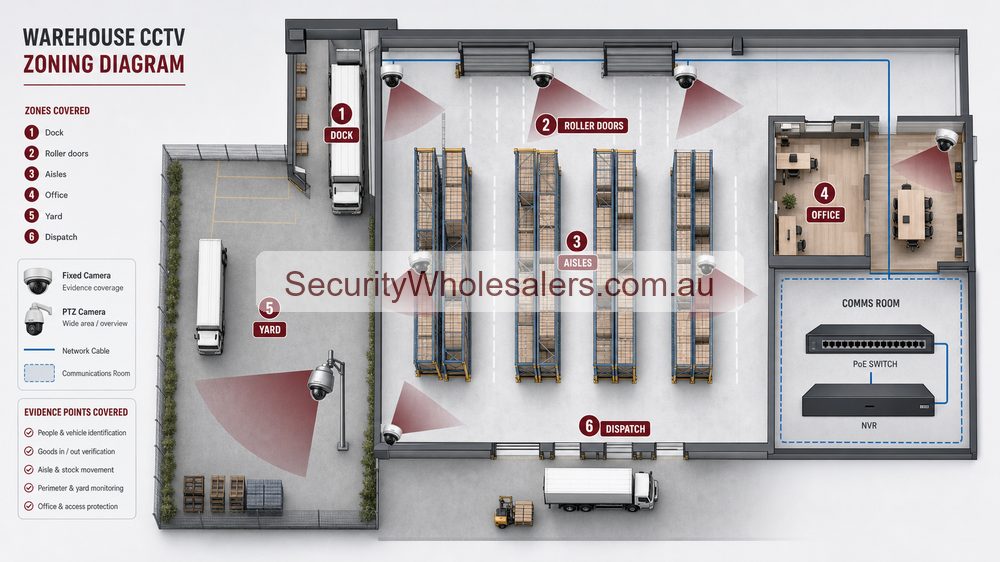
| Roller doors | Vehicles, pallets, people entering and leaving. | Use fixed or motorised cameras with repeatable views. Do not rely on a distant PTZ only. |
| Dispatch and loading dock | Proof of dispatch, damage disputes and timing. | Multiple fixed views often beat one wide overview. |
| Racking aisles | Movement through aisles, forklift incidents and stock access. | Motorised varifocal can help tune aisle views during commissioning. |
| Office and reception entry | Face detail and staff/customer entry records. | Use a calmer evidence camera rather than active deterrence. |
| External yard | Vehicles, gates, containers, after-hours activity. | PTZ can support yard overview, but fixed cameras should still cover gates and choke points. |
Small, medium and complex warehouse examples
Small warehouse: 6 to 8 cameras can cover front office, roller door, dispatch, internal aisle, rear exit and yard. An 8-channel NVR may work if the layout is stable, but a 16-channel recorder is usually smarter where growth is likely.
Medium warehouse: 10 to 16 cameras are common once there are multiple roller doors, racking aisles, dispatch benches, an office entry and an external yard. This is where recorder storage, PoE planning and review workflow start to matter more than one individual camera model.
Complex site: multiple buildings, detached yards, gates and high-value stock should be scoped as a system. Dahua can still be a strong path, but the design should include switches, fibre or wireless links, surge protection, NVR placement, user permissions and retention goals.
Warehouse mistakes to avoid
- Expecting a PTZ to replace fixed evidence cameras at doors and docks.
- Mounting cameras too high and losing face, vehicle or pallet detail.
- Ignoring storage until after the camera count has been chosen.
- Putting every camera on a filled 8-channel recorder when the site clearly needs headroom.
- Using deterrence in staff-facing areas where it creates nuisance instead of value.
Relevant SecurityWholesalers Categories and Products
These Dahua categories are relevant because they match the warehouse zones buyers usually need to cover.
- Dahua 6MP IP cameras - Useful fixed and motorised starting points for many warehouse zones.
- Dahua 8MP IP cameras - Useful where wider warehouse scenes need more detail margin.
- Dahua NVRs - Recorder choice often decides whether the warehouse system stays usable later.
- Dahua PTZ guide - Useful if the warehouse really needs a PTZ rather than just more fixed cameras.
Sources and Further Reading
Warehouse recorder and retention planning
Warehouses often underestimate the recorder. The first conversation tends to be about cameras, but the later frustration is usually storage, search speed, export workflow or not having enough channels when the site grows. A warehouse that starts with 10 cameras should usually be thinking in 16-channel terms, and a larger site may need a more careful network and storage design from the beginning.
| Warehouse size | Likely recorder path | Planning note |
|---|---|---|
| Small unit | 8-channel if final, 16-channel if growth likely. | Do not fill every channel if the business may add yard or stock views. |
| Medium warehouse | 16-channel with storage sized to retention needs. | Balance fixed cameras, motorised aisle views and exterior coverage. |
| Larger site | Higher-channel planning, switches and storage scoped as a system. | Network topology and review workflow become central. |
What to ask before quoting a warehouse
- How many roller doors, docks and vehicle entries need clear evidence?
- Are there high-value stock cages, dangerous goods, fuel or equipment zones?
- Does the warehouse need footage mainly for theft, OH&S, dispatch disputes or all three?
- Who reviews footage and how quickly do they need to find an incident?
- Is night lighting consistent across the yard and rear approaches?
- Will the site expand into more aisles, offices, external buildings or yard cameras?
Useful Dahua product paths for warehouses
Use Dahua 6MP IP cameras for roller doors, dispatch desks, pedestrian entries and stock movement. Use the Dahua NVR category to choose 16-channel or 32-channel headroom where the system may grow. Consider Dahua PTZ only for yard overview or live patrol, not as a replacement for fixed evidence cameras.
Frequently Asked Questions
-
Is Dahua a good fit for warehouses?
Often yes, especially where the site wants a broad range of fixed, motorised, low-light, PTZ, and recorder options without immediately stepping into a much heavier platform.
-
Does a warehouse usually need Dahua PTZ?
Usually only on broader yards, dock aprons, or larger external zones. Most warehouse evidence points are still better served by fixed or motorised cameras.
-
What matters more in a warehouse, the camera or the recorder?
Both matter, but the recorder often becomes critical once channel count, retention, and remote review expectations rise.
-
Can Dahua suit small and large warehouses?
Yes, but the design logic changes. A small warehouse can stay fairly simple. A larger estate needs more careful recorder, switch, PTZ, and storage planning.
-
Which related page helps after this one?
Usually the full warehouse system guide, because that page goes deeper into actual zone layout and camera mix.
-
When is Dahua not the whole answer on a warehouse job?
When the site also needs a more complex network, remote buildings, power planning, or higher-end review workflow that has to be scoped as part of the total system rather than just the camera brand.
Related Pages
Dahua for Warehouses
Use Dahua in a warehouse context, especially where NVR scale, motorised lenses, and PTZ are real considerations.
How to Choose a Dahua NVR
Choose the Dahua recorder path properly before locking in the camera mix.
Dahua PTZ Buying Guide
Understand where Dahua PTZ helps, where it does not, and how to choose the right zoom and power path.
Dahua CCTV Buying Guide
Start here to decide which Dahua branch matters before diving into camera, PTZ, NVR, or use-case pages.