













Commercial
Best Hikvision Thermal Cameras for Perimeter Protection
Use Case Guide
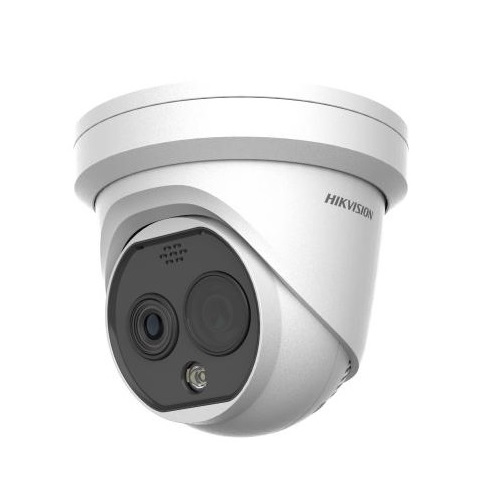
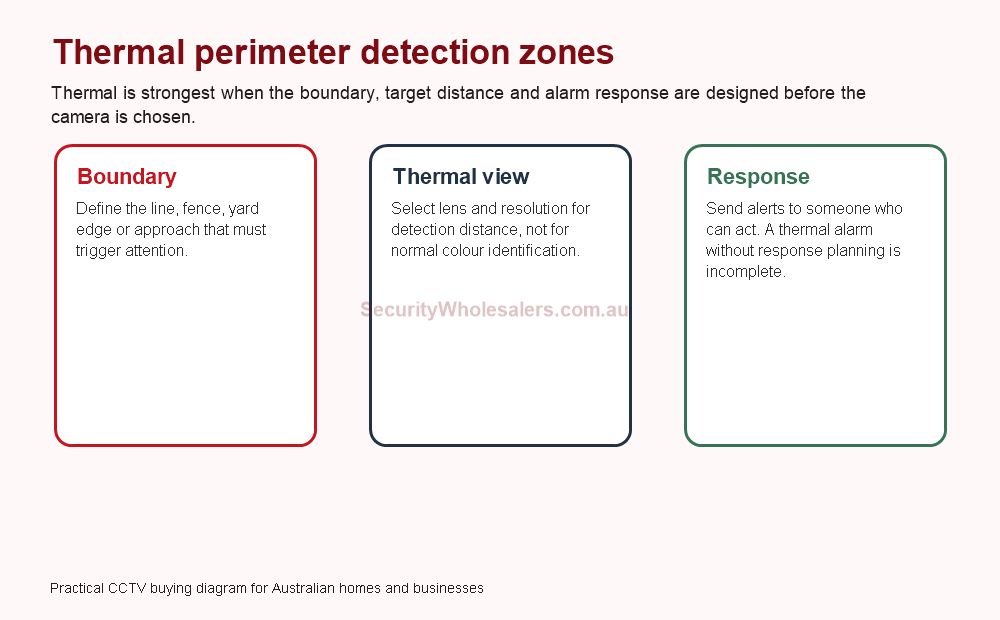
Perimeter thermal should start with the crossing line, not the camera name
The first step is to decide where the site actually wants to detect movement. That might be a rear fence line, a driveway mouth, a stockyard edge, or a broad external approach. If the detection line is not clear, the thermal camera shortlist is guesswork.
A practical perimeter ladder
| Model option | Best fit | Why it fits |
|---|---|---|
| DS-2TD1217-2/QA | Shorter-range perimeter edges, tighter yards, modest budgets | Simple entry point into thermal and optical coverage where the scene is not very large |
| DS-2TD2617-6/QA | Directional outdoor views that need a bullet form factor | Gives the installer a more directional 160 x 120 outdoor option |
| DS-2TD2628T-7/QA | Serious fixed perimeter jobs that still want visible context | 256 x 192 plus bi-spectrum is a practical middle ground for many real sites |
| DS-2TD2637T-10/QY | Larger or more demanding perimeter scenes | 384 x 288 gives stronger thermal detail for harder scenes |
| DS-2TD4228T-10/S2 | Large sites needing patrol and smart tracking | Thermal PTZ belongs where the site genuinely needs active wide-area coverage |
Example: farm rear boundary
Situation: A farm has a rear tree line and a remote service track where occasional vehicle movement and trespass occur after dark.
Solution used: A fixed thermal bullet or a stronger bi-spectrum bullet was used to watch the actual approach rather than trying to illuminate a huge area with visible-light cameras.
Why this was chosen: The job was early detection across darkness and distance, not fine facial detail at a doorway.
Installation notes: The thermal line was tied back into the broader recorder and alert process, and ordinary visible CCTV stayed closer to sheds and gates where identification mattered.
Example: larger quarry or industrial perimeter
Situation: A larger site needs broader outdoor patrol and wants to follow events across more than one approach line.
Solution used: A thermal PTZ was chosen because one fixed camera would not cover the operational brief well enough.
Why this was chosen: The site needed patrol behaviour and tracking, not just one static detection angle.
Installation notes: PTZ only makes sense if presets, patrol logic, and operator or alarm workflow are planned properly. A thermal PTZ should support a broader perimeter design, not replace every fixed evidence camera on the site.
What usually goes wrong
- Using a short-range thermal model on a scene that is too wide.
- Expecting thermal to provide ordinary evidence footage by itself.
- Skipping the alarm workflow and assuming the detection will look after itself.
- Using PTZ where a fixed crossing line would have solved the real problem more cleanly.
Relevant SecurityWholesalers Categories and Products
These are the Hikvision thermal products on SecurityWholesalers that most clearly show the perimeter-protection ladder.
- DS-2TD1217-2/QA HeatPro turret - Useful for shorter-range or tighter perimeter scenes where entry cost matters.
- DS-2TD2617-6/QA HeatPro bullet - A more directional 160 x 120 outdoor bullet option.
- HeatPro DS-2TD2628T-7/QA - A stronger 256 x 192 bullet for perimeter plus visible context.
- DS-2TD2637T-10/QY - A higher-end 384 x 288 option for more demanding perimeter jobs.
- DS-2TD4228T-10/S2 thermal PTZ - For larger outdoor sites that need patrol, tracking, and dual-spectrum review.
Sources and Further Reading
Frequently Asked Questions
-
What is the best Hikvision thermal camera for a small perimeter job?
A smaller HeatPro turret or bullet can suit shorter-range jobs, provided the scene width and target distance are modest.
-
When is 256 x 192 better than 160 x 120 for perimeter work?
It is often better once the outdoor scene gets larger or you want a more dependable middle-ground thermal image with bi-spectrum context.
-
When do I need a thermal PTZ?
Usually only on larger sites where one fixed camera is not enough and patrol, tracking, or broader outdoor coverage are part of the brief.
-
Is thermal enough on its own for perimeter protection?
Sometimes, but many jobs still use visible-light cameras elsewhere for identification, gate review, or close-up scene context.
-
Can Hikvision thermal detect vehicles and people at night?
Yes, thermal is often chosen precisely because it can detect those targets more reliably in difficult darkness and broad outdoor scenes.
-
What should I check before buying a perimeter thermal camera?
Check the actual detection line, target distance, scene width, mount position, alarm workflow, and whether a fixed or PTZ approach makes more sense.
Related Pages
Hikvision Thermal Cameras Buying Guide
The main Hikvision thermal guide for perimeter, fire, and bi-spectrum buying decisions.
Hikvision Thermal Resolution Explained: 160 x 120 vs 256 x 192 vs 384 x 288
A practical explanation of Hikvision thermal resolution tiers.
When to Use Bi-Spectrum Hikvision Thermal Cameras
A practical guide to choosing Hikvision bi-spectrum thermal cameras.
How to Choose a Hikvision Camera
Work out which Hikvision camera type fits the job, the lighting, and the installation.