HiLook can be a very strong small-business answer when the site is honest about what it needs: dependable cameras, a clean NVR path, and a realistic approach to night performance and alerts.
Buying Guide
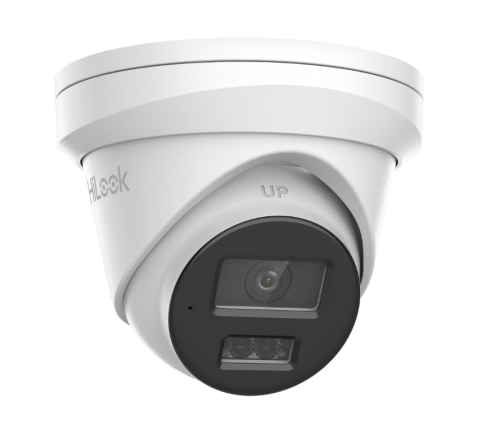
A HiLook fixed-lens turret is usually the right starting point for straightforward homes, small offices, counters, and everyday perimeter points.
Use HiLook where the business wants strong basics done well
Many small businesses do not need a more complicated CCTV ecosystem than the site can actually manage. They need good entry coverage, clean counter views, useful after-hours external scenes, and a recorder that does not become a headache. That is where HiLook often performs very well.
Stay honest about complexity
If the site is already asking for several specialised lenses, deeper analytics, broad multi-building growth, or tighter system crossover, that is the moment to consider whether the job is stepping out of HiLook territory. There is no value in pretending otherwise.
Installation insight: one small-business mistake can ruin the whole job
The mistake is usually not the camera brand. It is a badly chosen view, a cramped NVR, or failing to treat the real after-hours risk point as a separate design question. A clean small-business system still needs proper scene planning, recorder sizing, and if relevant, UPS planning for the core path.
Use HiLook as a good-value lane, not a fake enterprise lane
HiLook is strongest when it is allowed to be what it is: a dependable, Hikvision-backed value option that covers many small commercial needs very well. That honest positioning usually helps the customer trust the recommendation more, not less.
Relevant SecurityWholesalers Categories and Products
These HiLook products suit the kind of small-business projects where the range normally shines: simple entry views, counter areas, small warehouses, and straightforward after-hours external coverage.
HiLook IP cameras - A practical starting point for office entries, shop fronts, counters, and smaller work areas.
Use 4 to 6 cameras only when the property is genuinely simple. If side access, garage or rear yard matter, plan around an 8-channel NVR even if not every channel is used on day one.
Serious home
Use 6 to 8 cameras, choose Hi-Color or deterrence only where the scene needs it, and make sure playback is tested through HiLookVision.
Small business
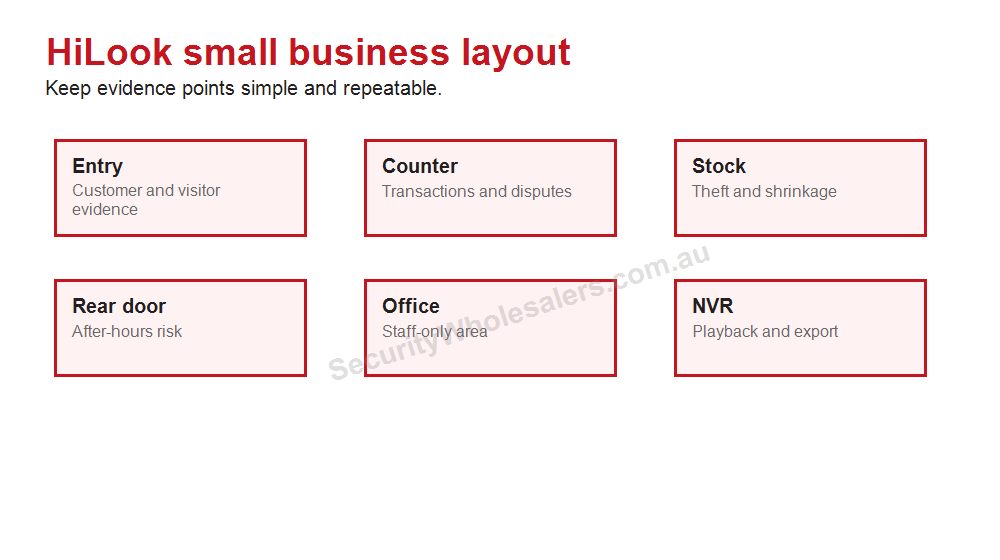
Start with entry, counter, stock, rear door and office evidence. Step up to Hikvision if analytics, access control, ANPR or a larger commercial design is needed.
Buyer checklist
Count coverage points before choosing a kit.
Leave recorder headroom where the site may grow.
Check night lighting before choosing Hi-Color or deterrence cameras.
Confirm account ownership and app handover.
Choose Hikvision instead when the job becomes specialist or complex.
Small-business camera count examples
HiLook is a strong value choice when the business needs clear evidence views rather than advanced commercial analytics.
Four to six cameras: small office, entry, reception, rear door and one external approach. Use this when the site is genuinely simple.
Eight cameras: shop, cafe or workshop with entry, counter, customer area, stock, office, rear door, driveway and bin or loading area. This is often the practical small-business sweet spot.
When to step up: if the business expects regular investigations, access control, ANPR, PTZ, thermal or multi-site management, the better buying advice is to review Hikvision rather than stretching HiLook.
Small business mistakes to avoid
Do not use one wide camera to cover a counter, entry and stock area if each view needs detail.
Do not fill every NVR channel on day one unless the site is truly finished.
Do not skip night testing on rear doors, laneways and external approaches.
Do not leave the app controlled by the installer account only.
Do not force HiLook if the business already needs Hikvision-level features.
The right small-business system should make common incidents easy to review: who entered, what happened at the counter, whether stock moved, and how someone left the site.
What I would quote first
Small office: 5 to 6 cameras, 8-channel NVR, entry, reception, corridor, rear door and carpark approach. Keep the system simple and make the app handover clean.
Retail shop: 8 cameras is usually more realistic: entry, counter, public floor, stock room, rear door, office and external approach. The quote should explain which views are identification views and which are overview views.
Trade workshop: use cameras for office entry, roller door, tool area, driveway and rear access. If the yard becomes large or the owner wants PTZ/ANPR, move the discussion to Hikvision rather than pretending HiLook is the perfect fit.
A strong small-business HiLook quote should be easy to understand: camera count, recorder size, hard drive target, app ownership and what each camera is meant to prove.
Handover for business owners
Small businesses need a slightly different handover from homes. The owner or manager should know how to find counter footage, export a clip, check after-hours motion and share access without giving away the admin password. Camera names should match the business language: Front Entry, Counter, Rear Door, Stock Room, Office and Car Park.
If staff may request footage, decide the process before an incident. If the business has privacy obligations, keep cameras away from inappropriate areas and document why each camera exists. A simple HiLook system can still be professional if the handover is clean.
The system should also leave a clear upgrade path. If the business is likely to add cameras, choose recorder headroom. If it is likely to add access control or advanced analytics, consider Hikvision earlier.
Final business buying rule
The best HiLook small-business system is the one that makes common incidents easy to prove without turning the job into a complex commercial project. If the owner needs entry, counter, stock and rear-door review, HiLook is often a strong fit. If the owner needs analytics, access control or multi-site management, step up early.
Frequently Asked Questions
What kinds of small businesses suit HiLook best?
HiLook suits many shops, offices, cafes, service businesses, and light-commercial sites where fixed-lens coverage and simple recorder design solve most of the brief well.
When is HiLook enough for a business?
It is enough when the site mainly needs predictable entry, counter, internal circulation, and selected after-hours external views without heavier enterprise demands.
When should a business step up from HiLook to Hikvision?
It should step up when the project clearly needs more specialised cameras, broader analytics, deeper ecosystem crossover, or more complex long-term commercial growth.
Can a small business use deterrence cameras in a HiLook system?
Yes, selectively. They make the most sense on rear doors, side lanes, gates, or other after-hours vulnerable points rather than every view.
What does the installer need to confirm on a HiLook business job?
Camera count, coverage priorities, night-time risk points, recorder location, cable routes, and whether the business has realistic growth expectations or is likely to outgrow the simpler design quickly.
How should a business plan storage?
It should calculate storage based on the real retention window, recording mode, and camera count rather than guessing. Even small sites can underestimate storage once higher resolutions and audio are involved.
Make the practical call on whether the project belongs in HiLook or Hikvision.
HiLook practical buying worksheet
Best HiLook CCTV System for Small Business should keep HiLook practical: sensible camera count, clear recorder sizing and an app handover the owner can repeat later. The page should also be honest about when the site has grown into a Hikvision-style requirement.
Situation
Practical direction
Common mistake
Compact home
Front, driveway, side/rear path and back entry
Four cameras only works when those are truly the main views
Detached home
Often six to eight useful views
Plan an 8-channel NVR if expansion is likely
Small business
Entry, counter, rear door, stock and external approach
Staff access and playback matter as much as camera count
Value-system checks
Choose camera count from doors, paths, vehicles and business evidence points.
Size the NVR for the finished site, not just the first stage.
Test playback, export and mobile viewing before calling the job complete.
Document app ownership and user permissions.
Step up to Hikvision when the site needs specialist analytics, ANPR, thermal or larger commercial design.
Best HiLook CCTV System for Small Business: practical depth notes
Best HiLook CCTV System for Small Business should keep HiLook in its honest lane: straightforward value CCTV, clean recorder planning and a handover the owner can understand. If the job needs specialist analytics or a larger commercial ecosystem, the guide should say so clearly.
For this page, the useful buying question is where the scene, lens, lighting, mounting height and recorder path decide the right model. That question is more important than choosing the most impressive specification. A cheaper camera in the right place can beat a premium model mounted too high, pointed too wide or paired with the wrong recorder.
Real-world camera selection examples
Site type
Practical recommendation
Why it helps
Simple site
Protect the main evidence point first, then add only the views that answer a likely incident question.
The buyer avoids paying for coverage that looks broad but proves little.
Typical Australian small business
Plan the camera, NVR, storage and app users together before model selection.
The system is easier to review after theft, damage, staff disputes or after-hours movement.
More complex site
Document zones, permissions, alert rules, cable paths and expansion before ordering.
The install remains supportable when the site changes or another technician takes over.
Good example scenes for this decision include entries, driveways, stock areas, offices and external approaches. In each case, the final choice should explain what the view must prove, what happens at night, how footage will be found, and what the buyer should not expect the system to do.
Quote wording that is actually useful
A useful quote for Best HiLook CCTV System for Small Business should include a short reason for each camera or recorder choice. For example: this camera protects the rear door at face height, this recorder leaves four spare channels, this lens avoids wasting pixels on the sky, this alert is scheduled after hours only, or this user can view but not export footage. That sort of explanation gives the buyer confidence because it connects the hardware to the site.
The weak version of Best HiLook CCTV System for Small Business is a quote that sounds impressive but does not name the job. The strong version explains the exact view, the evidence standard, the recorder assumption and the handover test. For HiLook buyers, that plain explanation is often more valuable than another feature label because it shows how the system will actually be used after an incident.
Best HiLook CCTV System for Small Business: final practical example
For Best HiLook CCTV System for Small Business, imagine the buyer asking what they will actually see after something happens at a townhouse, small shop, rental property or budget home. The answer should be specific: which camera proves the approach, which camera proves the person or vehicle, how many days the recorder keeps, and who can open the app to export footage.
If the recommendation for Best HiLook CCTV System for Small Business cannot answer those questions, the buyer is still shopping by product name rather than buying a security outcome. The better recommendation keeps the design simple where the site is simple and adds stronger features only where they solve a named weakness.
Your Shopping Cart will be saved and you'll be given a link. You, or anyone with the link, can use it to retrieve your Cart at any time.
Back
Save & Share Cart
Your Shopping Cart will be saved with Product pictures and information, and Cart Totals. Then send it to yourself, or a friend, with a link to retrieve it at any time.