














Commercial
Best HiLook CCTV System for Homes
Buying Guide
Start with the home scenes that actually matter later
A good home system should answer clear questions later. Who came to the front door. Which way did they approach. What happened at the driveway. Did someone use the side access path. Did a vehicle stop outside and leave. That is why the best HiLook home systems usually start with the front door, driveway, side path, backyard gate, and any vulnerable rear entry rather than trying to cover everything evenly.
How to think about the current HiLook kit paths
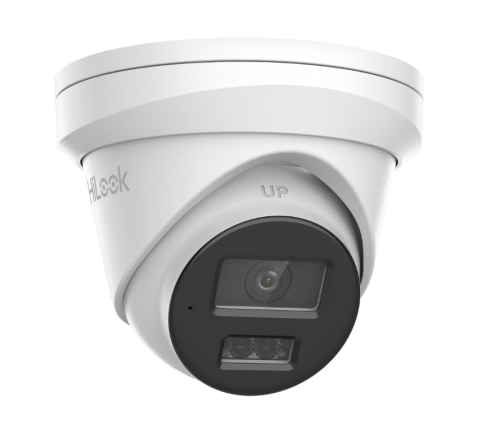
The live HiLook category is useful because it is sorted by popularity, so it gives a practical picture of the products and kit families buyers are actually looking at most often. That does not mean the most popular kit is always the right one. It does mean the category is a useful starting point for understanding the normal fixed-lens kits, the flashing-light deterrence kits, and the stronger colour-at-night options.
| Home situation | More suitable HiLook path | Why it fits |
|---|---|---|
| Normal residential coverage where the owner mainly wants dependable front, side and rear views | HiLook 8MP T381H-MU kits | A normal fixed-lens path is usually the cleanest answer when the scene does not need a visible warning response. It suits front doors, driveways, side access paths, and backyard entries where the owner mainly wants clear evidence and simple app viewing. |
| After-hours problem points such as side gates, rear laneways, workshop aprons or repeated trespass paths | HiLook 6MP T269MU/SL kits | These are more suitable where a flashing light and active warning can add value. They are not the default answer for every house. They are better used selectively on the view where the owner actually wants a stronger visible response. |
| Scenes where the owner cares about colour detail at night, such as clothing, vehicle colour or driveway activity under low light | HiLook full-colour or Hi-Color style paths, such as the IPC-T561H-MU Hi-Color turret and related colour-at-night kit paths | These are more suitable when the question later is not just whether someone was there, but what colour clothing they wore, what vehicle was involved, or what happened across a darker residential frontage. |
Typical home where a normal fixed-lens kit is the right answer
Situation: A suburban brick home has one front door, a two-car driveway, a narrow side path on the left, and a rear sliding door under a covered patio. The owner wants a system that is easy to use and mainly wants to know who arrived, which way they moved, and what vehicle was involved.
Solution used: A normal fixed-lens HiLook kit path, such as the T381H-MU family, with cameras focused on the front door, driveway, side path, and rear yard entry.
Why this was chosen: The home needs clear, dependable coverage rather than a stronger warning response on every view. A normal fixed-lens kit keeps the system simpler and usually gives better value when the owner mainly wants reviewable footage.
Installation notes: This kind of job is won or lost by camera position. One camera should cover the driveway entry properly, not just the middle of the driveway, and the front-door camera should favour approach and interaction rather than a high wide shot that misses detail.
Home where a flashing-light deterrence camera should be used selectively
Situation: A corner-block home has repeated late-night loitering and attempted gate access along a dark side return. The front of the house is quiet, but the side gate and rear lane approach have become the real problem.
Solution used: A normal fixed-lens HiLook path on the general views, with a T269MU/SL flashing-light kit path or camera used specifically on the side gate and rear approach.
Why this was chosen: The owner does not need flashing lights on every camera. They need a stronger active response on the one scene where after-hours behaviour keeps recurring. That is a better use of the deterrence model than upgrading every view unnecessarily.
Installation notes: Deterrence works best when the camera sees the approach clearly and the owner is comfortable with a more visible response. It is less suitable on scenes where neighbours would be affected or where the warning adds no practical value.
Home where colour at night matters more than a flashing light
Situation: A wide shallow driveway and street frontage stay dim at night, but the owner mainly wants clearer colour detail of visitors, parked vehicles, and any vehicle that stops briefly outside.
Solution used: A HiLook colour-at-night path on the frontage view, using a Hi-Color style camera rather than a flashing deterrence model.
Why this was chosen: The owner cares more about colour detail after dark than about a visible warning response. A colour-at-night camera is more suitable when later review depends on seeing vehicle colour, clothing tone, or broader driveway activity in a darker scene.
Installation notes: This type of camera still needs a realistic low-light scene. It is best used where the environment already has some ambient light or where the owner understands what the night result should look like.
Recorder and storage still matter on a home job
Even on a house, recorder choice affects how usable the system feels six months later. A 4-channel recorder may be enough on a compact home, but many homes end up being more comfortable on 8 channels once the owner realises they also want the garage, backyard, or second side path covered. The CCTV Storage Calculator helps size storage properly, and the UPS Backup Time Calculator helps estimate how long the recorder path can stay live if the power drops.
Do not make every camera the same by default
The best HiLook home systems are usually mixed sensibly. Use normal fixed-lens cameras on the ordinary views. Use a deterrence path only where the owner really wants a stronger after-hours response. Use a colour-at-night path where the owner cares about seeing more useful night detail. That is usually a better home design than forcing one camera type onto every position.
Relevant SecurityWholesalers Categories and Products
These HiLook categories and examples are useful for home buyers because they line up with the three residential questions that matter most: ordinary fixed-lens coverage, stronger deterrence at selected problem points, and colour-at-night detail where the scene justifies it.
- HiLook overview category - A useful starting point because the category is sorted by popularity and shows the current kit families buyers most often compare.
- HiLook 8MP T381H-MU kits - A normal fixed-lens kit path for straightforward home coverage where the owner mainly wants clear reviewable footage.
- HiLook 6MP T269MU/SL kits - A stronger active-deterrence path for homes with a recurring side gate, rear lane, or after-hours entry problem.
- IPC-T561H-MU Hi-Color turret - A useful colour-at-night example when the owner cares more about vehicle and clothing detail after dark than about a visible warning response.
- 4-channel HiLook PoE NVR - A good example of the kind of simple recorder path that suits smaller homes, while larger homes may be more comfortable on 8 channels.
Sources and Further Reading
Home layout that avoids regret
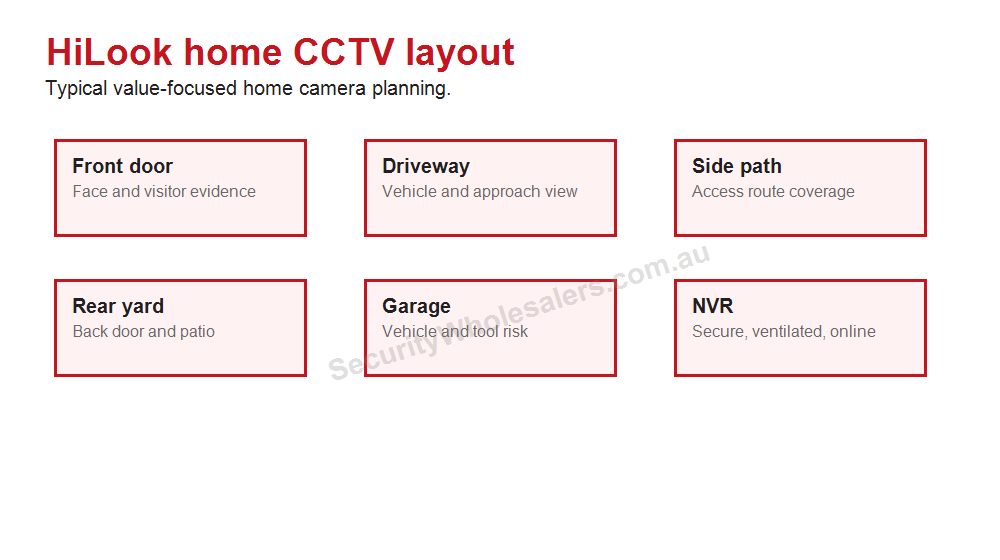
Four cameras: front door, driveway, side path and rear entry can work on a compact home. It is lean, but honest if the owner accepts the blind spots.
Six to eight cameras: this is the safer path for larger homes because garage, second side access, rear alfresco and shed approaches often matter after the first incident. An 8-channel NVR keeps the system tidy.
Privacy note: if internal cameras are used for family support, pets or vulnerable residents, place them only in agreed areas and make sure everyone understands who can view them.
Frequently Asked Questions
-
Why is HiLook a strong home option?
Because many home jobs mainly need dependable fixed-lens cameras, sensible NVR sizing, and easy remote viewing rather than a much more complex commercial security stack.
-
What home areas should be covered first?
Most homes should start with the front door, driveway, side access, backyard gate or path, and any vulnerable rear entry before worrying about every possible angle.
-
Does a home need Hi-Color or active deterrence everywhere?
Usually not. Those features are most useful on the views that genuinely matter after dark, not every camera position.
-
How should the installer decide on camera placement?
They should prioritise the path people actually take, the height that still gives useful review, and the night-time scene the owner really cares about. The Camera Planner can help before cable routes are finalised.
-
What recorder usually suits a HiLook home system?
Many homes are well served by a 4-channel or 8-channel PoE NVR, depending on camera count and how much future growth the owner expects.
-
When should a home owner step up beyond HiLook?
If the project starts demanding many specialised cameras, more complicated analytics, or wider system integration, it may be worth reviewing whether the job belongs in fuller Hikvision territory.
Related Pages
How to Choose a HiLook Camera
Choose the right HiLook camera for fixed-lens coverage, low light, and deterrence.
How to Choose a HiLook NVR
Choose the right HiLook NVR for channel count, storage, and simple expansion.
HiLook vs Hikvision
Compare HiLook and Hikvision in a practical, non-salesy way.
When HiLook Is Enough and When to Step Up to Hikvision
Make the practical call on whether the project belongs in HiLook or Hikvision.