Comparison

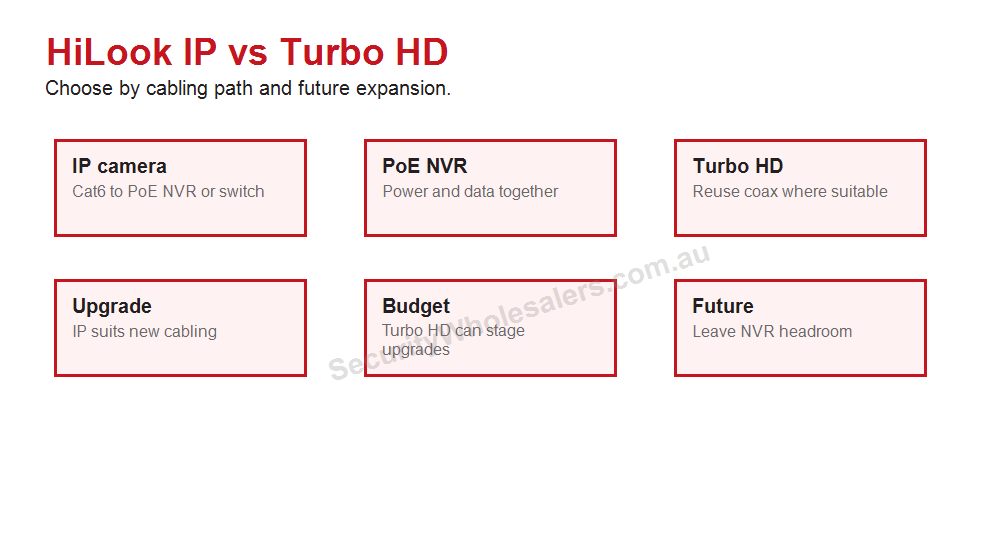
HiLook IP vs Turbo HD

The HiLook version of this choice usually comes down to value and cabling honesty: are you building cleanly from scratch, or making the best use of existing coax?

Comparison Guide

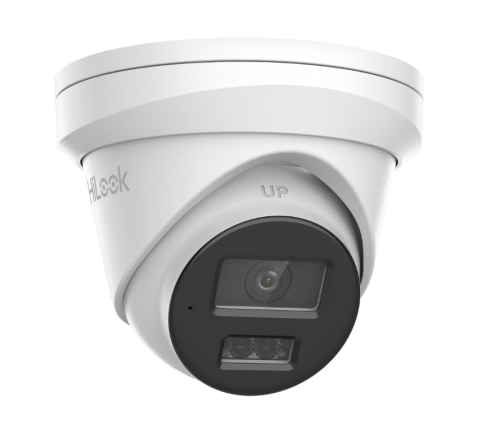
HiLook turret CCTV camera
A HiLook fixed-lens turret is usually the right starting point for straightforward homes, small offices, counters, and everyday perimeter points.

The decision is still about the cabling path

HiLook IP and HiLook Turbo HD are different technical paths, but the commercial decision is the same one buyers face on higher-end brands: is the best move to cable cleanly for IP, or to preserve value from existing coax?

Where HiLook IP usually wins

HiLook IP usually wins on homes and small businesses that are starting fresh, adding new cable, or wanting a clean PoE system with an easy NVR handover. It is especially attractive where the project wants to stay simple but still feel modern and tidy.

Where HiLook Turbo HD can still be a smart decision

If the site already has usable coax and the real goal is to improve image quality and reliability without recabling everything, Turbo HD still deserves serious consideration. The gain is not the spec sheet alone. It is the installation efficiency and the staged-upgrade logic.

Installation insight: do not guess about old cable

Many upgrade decisions fail because the customer assumes the old cable is automatically worth keeping. The installer should still check the route, cable quality, power layout, and the way the head end will be organised before promising a simple Turbo HD path.

Relevant SecurityWholesalers Categories and Products

These categories help show the real choice: a straightforward PoE camera and NVR build, or a coax reuse path where the customer wants a practical upgrade without tearing everything out.

  • HiLook overview - A good starting point for both IP and analogue-style HiLook research.
  • HiLook IP cameras - Usually the cleanest path on new or re-cabled jobs.
  • HiLook NVRs - Relevant when the project is leaning toward simple PoE installation and modern IP remote viewing.

Sources and Further Reading

Practical buying scenarios

Budget home

Use 4 to 6 cameras only when the property is genuinely simple. If side access, garage or rear yard matter, plan around an 8-channel NVR even if not every channel is used on day one.

Serious home

Use 6 to 8 cameras, choose Hi-Color or deterrence only where the scene needs it, and make sure playback is tested through HiLookVision.

Small business

Start with entry, counter, stock, rear door and office evidence. Step up to Hikvision if analytics, access control, ANPR or a larger commercial design is needed.

Buyer checklist

  • Count coverage points before choosing a kit.
  • Leave recorder headroom where the site may grow.
  • Check night lighting before choosing Hi-Color or deterrence cameras.
  • Confirm account ownership and app handover.
  • Choose Hikvision instead when the job becomes specialist or complex.

IP vs Turbo HD quote examples

HiLook IP vs Turbo HD cabling comparison
New cabling usually favours IP. Existing coax can still make Turbo HD worth considering if the cable is usable.

New home or shop: choose IP unless there is a strong reason not to. PoE makes camera power, recorder connection and future troubleshooting cleaner.

Existing coax upgrade: inspect the cable before promising reuse. If the old cable is damaged, badly joined or poorly routed, forcing Turbo HD may save money on paper and cost more on site.

Mixed expectations: if the owner wants higher flexibility, better future camera choice or cleaner network expansion, IP is usually the safer long-term path.

How the cabling decision changes the quote

New build or renovation: IP should normally be the default because Cat6 and PoE make the job cleaner. Each camera has one cable back to the NVR or PoE switch, the recorder powers the cameras, and future troubleshooting is usually easier.

Old analogue system: Turbo HD can be a sensible upgrade if the coax is clean, accessible and already runs to useful camera positions. The risk is assuming the old cable path is still good. Water ingress, poor joins, hidden splitters and awkward camera locations can turn a cheap upgrade into a messy compromise.

Mixed site: if some cameras need to move, some cable is poor, or the owner wants better long-term flexibility, it may be better to recable the key views in IP rather than preserve every old cable run. The best quote should explain the labour difference, not just the hardware difference.

Buyer checks before choosing Turbo HD

  • Inspect cable condition before promising reuse.
  • Check whether old camera positions still make sense.
  • Confirm power and recorder location.
  • Compare the saving against future flexibility.
  • Choose IP for new cable paths unless there is a clear reason not to.

Installer field notes

When replacing an old analogue system, ask for photos of the existing recorder, cable terminations, power supplies and camera positions before quoting. If the old cameras were mounted in poor positions, reusing the cable may preserve the original mistake. A clean IP recable can sometimes produce a better result with fewer cameras because the views are finally placed correctly.

Turbo HD remains useful where the old coax is in good condition and the owner wants a cost-conscious refresh. It is less attractive when the site wants future IP camera choice, PoE simplicity or a cleaner network layout. New commercial jobs should generally be quoted as IP unless there is a practical site reason not to.

For buyers, the question is not "which technology is newer?" It is "which cable path gives the most reliable result for this building?" That keeps the decision grounded.

Final buyer rule

If the site has no useful existing cable, choose IP. If the site has good coax in the right locations and the owner wants a value upgrade, Turbo HD can still be sensible. If the old camera positions were poor, do not let existing cable make the decision for you. The right cable path is the one that gives the owner useful footage after an incident, not just the one that makes the first quote look cheaper.

Final practical note

When the quote is close, choose the path that makes future service easier. A slightly dearer IP recable can be better value if it removes old cable uncertainty and gives the owner cleaner expansion options.

Useful final check

Before committing, ask whether the page advice matches the finished site, the person who will use the system and the support path after installation.

Frequently Asked Questions

  • When is HiLook IP the better choice?

    HiLook IP is usually the better choice on new builds, recabled projects, and jobs where PoE simplicity and cleaner long-term flexibility matter more than reusing old coax.

  • When does Turbo HD still make sense on HiLook?

    Turbo HD still makes sense when the real advantage is using existing coax and the customer wants a staged, practical upgrade rather than a full recable.

  • Is HiLook IP harder to install?

    Not necessarily. On a fresh build it can be cleaner to install because the project is planned around Ethernet and PoE from the start.

  • Does the installer still need to survey existing cabling?

    Yes. The old cable quality, pathway, distance, and power arrangement should still be checked before a coax reuse plan is trusted.

  • Should storage planning change between the two?

    The same storage discipline still applies. Camera count, bitrate, and retention matter regardless of whether the signal path is IP or Turbo HD.

  • Can a site mix HiLook IP and Turbo HD during upgrades?

    Sometimes yes, especially on staged jobs. The key is being deliberate about which views are staying on coax and which are worth moving to IP now.

Related Pages

How to Choose a HiLook Camera

Choose the right HiLook camera for fixed-lens coverage, low light, and deterrence.

How to Choose a HiLook NVR

Choose the right HiLook NVR for channel count, storage, and simple expansion.

HiLook vs Hikvision

Compare HiLook and Hikvision in a practical, non-salesy way.

HiLook Buying Guide

The main HiLook guide for matching the range to real projects.

HiLook practical buying worksheet

HiLook IP vs Turbo HD should keep HiLook practical: sensible camera count, clear recorder sizing and an app handover the owner can repeat later. The page should also be honest about when the site has grown into a Hikvision-style requirement.

Situation Practical direction Common mistake
Compact home Front, driveway, side/rear path and back entry Four cameras only works when those are truly the main views
Detached home Often six to eight useful views Plan an 8-channel NVR if expansion is likely
Small business Entry, counter, rear door, stock and external approach Staff access and playback matter as much as camera count

Value-system checks

  • Choose camera count from doors, paths, vehicles and business evidence points.
  • Size the NVR for the finished site, not just the first stage.
  • Test playback, export and mobile viewing before calling the job complete.
  • Document app ownership and user permissions.
  • Step up to Hikvision when the site needs specialist analytics, ANPR, thermal or larger commercial design.

HiLook IP vs Turbo HD: practical depth notes

HiLook IP vs Turbo HD should keep HiLook in its honest lane: straightforward value CCTV, clean recorder planning and a handover the owner can understand. If the job needs specialist analytics or a larger commercial ecosystem, the guide should say so clearly.

For this page, the useful buying question is where the scene, lens, lighting, mounting height and recorder path decide the right model. That question is more important than choosing the most impressive specification. A cheaper camera in the right place can beat a premium model mounted too high, pointed too wide or paired with the wrong recorder.

Real-world camera selection examples

Site type Practical recommendation Why it helps
Simple site Protect the main evidence point first, then add only the views that answer a likely incident question. The buyer avoids paying for coverage that looks broad but proves little.
Typical Australian small business Plan the camera, NVR, storage and app users together before model selection. The system is easier to review after theft, damage, staff disputes or after-hours movement.
More complex site Document zones, permissions, alert rules, cable paths and expansion before ordering. The install remains supportable when the site changes or another technician takes over.

Good example scenes for this decision include entries, driveways, stock areas, offices and external approaches. In each case, the final choice should explain what the view must prove, what happens at night, how footage will be found, and what the buyer should not expect the system to do.

Quote wording that is actually useful

A useful quote for HiLook IP vs Turbo HD should include a short reason for each camera or recorder choice. For example: this camera protects the rear door at face height, this recorder leaves four spare channels, this lens avoids wasting pixels on the sky, this alert is scheduled after hours only, or this user can view but not export footage. That sort of explanation gives the buyer confidence because it connects the hardware to the site.

The weak version of HiLook IP vs Turbo HD is a quote that sounds impressive but does not name the job. The strong version explains the exact view, the evidence standard, the recorder assumption and the handover test. For HiLook buyers, that plain explanation is often more valuable than another feature label because it shows how the system will actually be used after an incident.

Browse product paths after the design is clear

HiLook IP vs Turbo HD: final practical example

For HiLook IP vs Turbo HD, imagine the buyer asking what they will actually see after something happens at a townhouse, small shop, rental property or budget home. The answer should be specific: which camera proves the approach, which camera proves the person or vehicle, how many days the recorder keeps, and who can open the app to export footage.

If the recommendation for HiLook IP vs Turbo HD cannot answer those questions, the buyer is still shopping by product name rather than buying a security outcome. The better recommendation keeps the design simple where the site is simple and adds stronger features only where they solve a named weakness.

We make product support and ordering easy! Reach out to our help team :)
Trade Customers: Log In or Register to Unlock Even Better Prices.

Save & Share Cart
Your Shopping Cart will be saved and you'll be given a link. You, or anyone with the link, can use it to retrieve your Cart at any time.
Back Save & Share Cart
Your Shopping Cart will be saved with Product pictures and information, and Cart Totals. Then send it to yourself, or a friend, with a link to retrieve it at any time.
Your cart email sent successfully :)