

















Commercial
Best CCTV System for Medical Centres in Australia
Return to CCTV Systems for Medical Centres hub
Commercial Buying Guide
Medical-centre buyers are rarely just asking which camera is best. They are usually asking a broader operational question: what CCTV system should we buy for this clinic, this reception workflow, this front door, these staff-only zones and this after-hours risk profile? The answer is normally a combination of fixed evidence views, a realistic recorder size, sensible storage, UPS backup and clear internal rules about who can view footage.
Quick answer
A small clinic may only need 4 to 6 cameras on an 8 channel PoE NVR. A typical GP, allied health or dental clinic should usually plan around 6 to 10 cameras. Larger clinics, multi-practitioner sites and centres with stronger after-hours or restricted-area requirements often need 10 to 16 cameras, better storage planning, UPS backup and more deliberate entry and reception coverage.
Glossary of what this guide covers
- Recommendation table by clinic type
- 4 vs 8 vs 16 camera medical-centre systems
- Coverage zones and camera placement logic
- Camera type recommendations
- NVR and recorder selection
- Storage and retention
- PoE, cabling and network planning
- Recommended buying paths
- Recommended packages and product paths
- Related buying categories
- Medical-centre CCTV FAQs
At-a-Glance Recommendation Table
| Site type | Typical camera count | Recommended system | Notes |
|---|---|---|---|
| Small allied health clinic | 4 to 6 cameras | 8 channel PoE NVR with fixed entry, reception and hallway coverage | Usually covers the main entry, reception counter, waiting-room circulation, rear door and one staff-only threshold. |
| GP clinic | 6 to 8 cameras | 8 or 16 channel NVR with spare room for after-hours and staff-only additions | Most clinics grow beyond a simple front-door and reception brief once staff areas and rear access are mapped properly. |
| Dental clinic | 6 to 10 cameras | 16 channel NVR with stronger reception, entry and restricted-boundary planning | Often needs cleaner front-desk evidence, hallway intersections and controlled storage or staff thresholds. |
| Medical centre with after-hours access | 8 to 12 cameras | 16 channel NVR, surveillance HDDs, UPS and better external entry coverage | Important where cleaners, contractors or approved after-hours access create a more complex event-review window. |
| Larger multi-practitioner healthcare site | 10 to 16 cameras | 16 channel NVR with deliberate recorder security, user permissions and expansion headroom | Better for multiple reception touchpoints, wider hallways, more staff-only doors and larger after-hours exposure. |
Do not choose only by square metres. Camera count depends on reception workflow, number of doors, waiting areas, staff-only boundaries, car-park exposure, after-hours access and how carefully the site wants to treat restricted spaces.
4 vs 8 vs 16 Camera Medical Centre CCTV Systems
4 camera clinic system
Suitable for: very small allied health or consulting suites with one entry, one reception point and very limited circulation.
Not enough when: the site has several staff-only doors, a rear access point, a car park or a real after-hours brief.
Recorder path: an 8 channel PoE NVR is still the safer fit, because most small clinics outgrow a strict 4-channel mindset quickly.
8 camera clinic system
Suitable for: many GP, dental and allied health sites that need reception, waiting room, entry, hallways, staff-only thresholds and one or two after-hours points treated properly.
Not enough when: the clinic has several practitioners, multiple public entries or more serious external exposure.
Recorder path: an 8 channel system can work, but a 16 channel NVR often gives the cleaner growth path.
16 camera clinic system
Suitable for: larger medical centres, multi-practitioner sites and clinics with more reception touchpoints, more staff-only doors and stronger after-hours review requirements.
Not enough when: the site spreads across multiple tenancies or buildings and starts to behave more like a campus.
Recorder path: use a 16 channel NVR with stronger storage planning, surveillance drives, UPS and careful user permissions.
Coverage Zones for Medical Centres
| Area | Recommended camera type | What to capture | Notes |
|---|---|---|---|
| Reception counter | Fixed turret or dome | Customer interaction, counter approach, staff-facing incident context | Usually one of the highest-value views on the site. |
| Waiting room | Wide fixed turret or dome | General circulation and incident context | Avoid turning it into casual blanket surveillance. |
| Front entry | Fixed or varifocal turret | Face capture, approach, entry timing | Important for intercom-controlled or after-hours front doors. |
| Rear or staff entry | Fixed bullet or turret | After-hours access and staff-only movement | Often matters more than buyers expect. |
| Hallways | Fixed turret | Movement between public and staff-only spaces | Useful at intersections rather than everywhere equally. |
| Medication or store-room boundary | Fixed threshold view | Who approached or entered the restricted threshold | Treat boundaries more carefully than internal room views. |
| Car park | Bullet or varifocal | Vehicle approach, staff arrival, after-hours movement | Useful where staff safety or after-hours exposure matters. |
| After-hours entry point | Bullet, deterrence or full-colour camera | Night-time face or movement evidence | Often pairs well with alarms or controlled door release. |
| Staff-only area threshold | Fixed turret | Boundary crossing into restricted back-of-house zones | Often more appropriate than watching treatment areas themselves. |
| External perimeter | Bullet or varifocal | Approach paths and after-hours activity | More useful on exposed sites than on tightly controlled tenancies. |
For deeper placement logic, read Medical Centre CCTV Coverage Zones and Camera Placement. For reception, intercom and restricted thresholds, continue with Reception, Front Door Intercoms and Staff-Only Zones.
Typical Clinic Layout Diagram
A practical clinic design usually starts at the front entry and reception, then follows movement into waiting and staff-only thresholds, instead of trying to watch every room equally.
Important privacy boundary
Avoid treatment rooms, bathrooms and obviously sensitive clinical spaces unless there is a very specific lawful and documented reason. This page is general buying guidance, not legal advice.
Camera Type Recommendations
Turret cameras
Often the best general-purpose option for medical centres. They suit front entries, reception, hallway intersections and staff-only thresholds without making the site feel over-engineered.
Dome cameras
Useful where lower-profile appearance or vandal resistance matters, especially around public-facing interiors. They need careful placement so reflections and maintenance do not reduce image quality.
Bullet cameras
Usually a better fit outdoors at rear doors, side approaches, small car parks and after-hours access points.
Varifocal or motorised zoom cameras
Worth using where a foyer, car park or external approach needs better framing than a standard wide lens can provide. See Fixed, Motorised, PTZ and Deterrence Cameras.
PTZ cameras
Usually selective rather than standard on medical jobs. They can supplement a larger external site, but they are not a replacement for stable reception and entry evidence views.
Active deterrence or full-colour cameras
Best kept for after-hours external entries or dark side approaches rather than normal indoor operation.
NVR / Recorder Selection
| Camera count needed | Recommended recorder | Why |
|---|---|---|
| 1 to 4 cameras | 8 channel NVR | Avoids buying a recorder with no practical room to grow. |
| 5 to 8 cameras | 8 or 16 channel NVR | 16 channel is often the smarter clinic buy if after-hours or back-door coverage may be added. |
| 9 to 16 cameras | 16 channel NVR | Common for larger clinics and multi-practitioner sites. |
| 16+ cameras | Larger NVR or staged design | Needs stronger bandwidth, storage and user-permission planning. |
The recorder should be chosen around channel count, incoming bandwidth, drive bays, user permissions, export workflow and physical security. For a deeper recorder and backup discussion, see Medical Centre CCTV Recording Time, Storage, UPS and Network Planning.
Storage and Retention
Medical-centre CCTV is often kept for reception incidents, after-hours access questions, aggressive behaviour review, staff-safety events and restricted-boundary questions. Many sites aim for a practical retention window such as around 30 days, but the right answer depends on risk, operations and insurer expectations.
| System size | Recording approach | Storage planning note |
|---|---|---|
| 4 to 6 cameras | Often continuous on key channels | Even smaller clinics should use surveillance-grade drives rather than assuming a bundled entry drive is enough. |
| 6 to 10 cameras | Continuous or mixed continuous and event-based | Reception and entries often justify continuous recording because disputes are not always movement-triggered neatly. |
| 10 to 16 cameras | Usually heavier continuous use | Resolution, FPS, codec and retention target matter more than camera count alone. |
Use the CCTV Storage Calculator if you want to estimate storage more realistically before committing to the recorder.
PoE, Cabling and Network Planning
Wired PoE is normally the preferred path for medical centres because it is stable, easier to manage and more suitable for secure recording than trying to build around Wi-Fi. Clean installation also matters in healthcare environments, so cable route quality, cabinet security and minimal disruption to operations are part of the buying decision, not just the install day.
- Cat6 Ethernet normally has a 100 metre limit.
- Reception, intercom, NVR, modem and switch paths should be considered as one system, not several unrelated purchases.
- Protect the recorder, switch and router in a secure cabinet or protected comms area.
- UPS backup is worth considering if the clinic cannot afford to lose entry or reception footage during a short outage.
- Remote viewing permissions should be restricted carefully rather than shared loosely between staff.
Recommended Buying Paths
Entry / small clinic
Best fit: HiLook or Uniarch small PoE systems where the brief is mainly entry, reception and hallway coverage.
Why: Good for value-led clinics that still want a proper NVR-based system rather than a consumer doorbell-style setup.
Standard / recommended clinic
Best fit: Hikvision, Dahua or Uniview on an 8 or 16 channel NVR with proper storage and UPS planning.
Why: Better where the clinic needs cleaner reception evidence, staff-only thresholds and after-hours entry protection.
Larger or higher-risk clinic
Best fit: 16 channel commercial build with a mix of turret, dome and outdoor bullet or varifocal cameras.
Why: More room for multi-practitioner layouts, several access points and stronger recorder discipline.
Premium pathway
Best fit: Higher-end Hikvision, Hanwha or Axis path where governance, analytics or corporate standards are more demanding.
Why: Better suited to larger healthcare sites or groups with stricter operational standards.
Recommended Packages and Product Paths
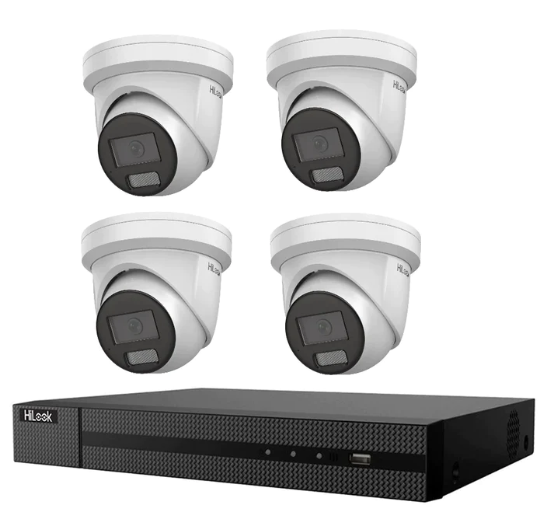
Small consulting-suite starter
Main pick: HiLook 6MP 4 camera turret kit
Best for: a compact allied health or consulting suite that mainly needs the front entry, reception, waiting-room circulation and one staff-only or rear threshold.
When to step up: move past this if the clinic has several consulting rooms, stronger after-hours access or a small car park that needs its own view.
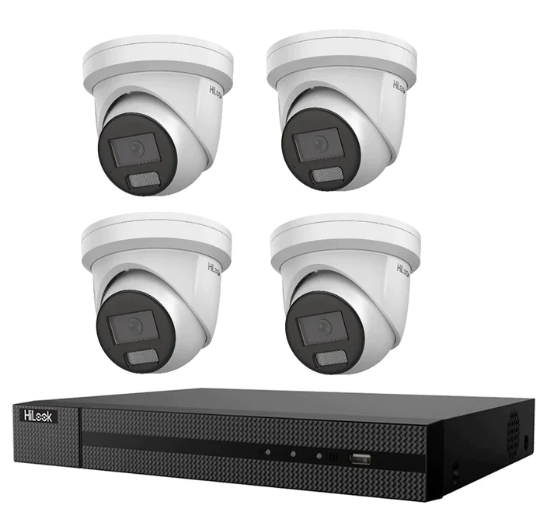
Sharper reception and entry starter
Main pick: HiLook 8MP 4 camera turret kit
Best for: smaller clinics that still want a packaged system but prefer stronger pixel density on the front door, reception desk and staff-only thresholds.
When to step up: step up once the site needs several hallways, after-hours entry coverage or more than one restricted boundary.
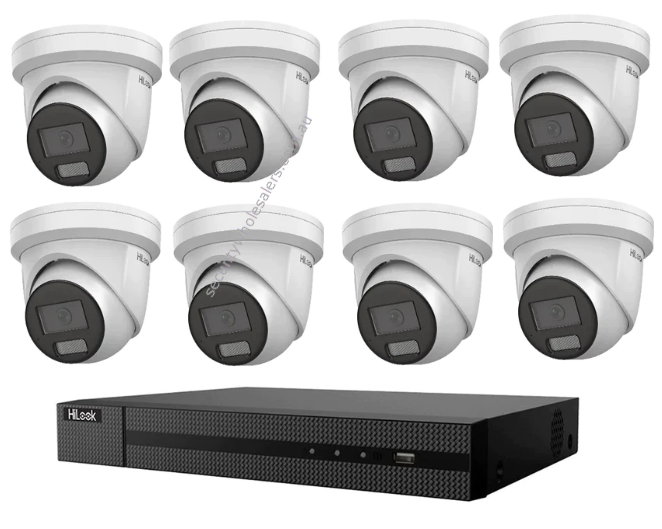
Typical GP, dental or allied-health clinic
Main picks: HiLook 8MP 8 camera turret kit or Hikvision 8MP ColorVu 3.0 hybrid 8 camera kit
How to choose: the HiLook path is the cleaner value-led fit for a normal clinic brief, while the Hikvision ColorVu path suits sites that want a more premium front-door and after-hours deterrence posture.
When to step up: move to a larger recorder path if the clinic has multiple practitioners, more staff-only zones or heavier after-hours access.
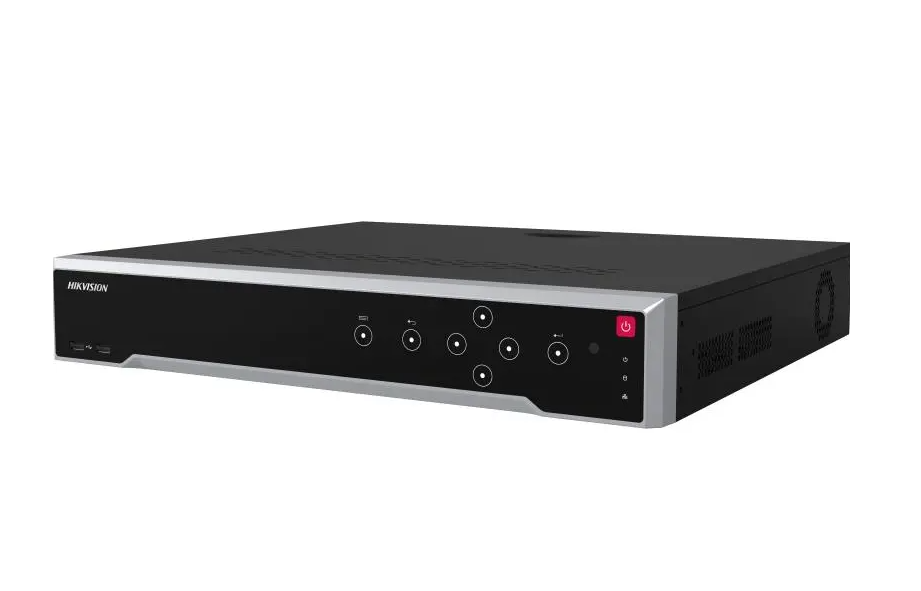
Multi-practitioner clinic build
Camera path: Hikvision ColorVu 3.0 smart hybrid turret cameras
Recorder path: Hikvision 16 channel Ultra Series NVR
Best for: clinics that have several reception touchpoints, multiple staff-only doors, after-hours access and a stronger need for controlled review and recorder headroom.
Related Buying Categories
CCTV Kits
Useful for smaller clinic starting points.
IP Cameras
Browse turrets, domes, bullets and varifocal cameras.
NVRs
Compare channel count, drive bays and remote viewing options.
Hikvision CCTV
Broader commercial camera and recorder range.
HiLook CCTV
Value-led path for smaller clinics.
Dahua CCTV
Commercial alternative for clinic CCTV builds.
Intercoms
Useful where front-door verification matters.
Access Control
Helps with staff-only doors and controlled entries.
Surveillance Hard Drives
Use surveillance-grade drives for reliable retention.
UPS Backup
Protects the recorder path during short outages.
Alarms and Panic Buttons
Often relevant on higher-risk medical jobs.
Suggested Next Reads
Compliance / Privacy Note
CCTV may capture staff, patients, visitors, contractors or members of the public. Clinics should consider signage, notice, camera purpose, footage access, retention and state or territory workplace or privacy requirements before installation. Avoid inappropriate areas such as toilets, change rooms and other sensitive spaces. This page is general buying guidance, not legal advice.
After You Buy: Useful Support Guides
Medical Centre CCTV FAQs
What is the best CCTV system for a medical centre?
For many medical centres, the best system is a wired IP CCTV system with fixed evidence cameras on the main entry, reception, waiting room circulation, staff-only doors and after-hours access points, backed by a correctly sized NVR and surveillance-grade hard drives.
How many cameras does a GP clinic usually need?
A small clinic may start with 4 to 6 cameras. A typical GP, dental or allied health clinic often lands around 6 to 10 once the entry, reception, waiting room, hallways and staff-only access points are treated properly.
Can CCTV be installed in treatment rooms?
That should be treated very cautiously. In most medical environments the stronger approach is to avoid treatment rooms, bathrooms and obviously sensitive clinical spaces unless there is a very specific lawful and documented reason.
Should medical centres use dome or turret cameras?
Turret and dome cameras can both suit medical centres. Turrets are often a practical general-purpose choice. Domes can suit reception and public-facing interiors where a lower-profile appearance matters, provided reflections and maintenance are considered.
How long should a medical centre keep CCTV footage?
The right answer depends on the centre's incident-review needs, insurer expectations and how long issues usually take to surface. Many sites work around a practical retention target such as 30 days, but some may want longer.
Should a medical centre record continuously?
Many centres record continuously on the key cameras because reception incidents, entry disputes and after-hours access events do not always line up neatly with motion-only triggers.
Do medical centres need panic buttons as well as CCTV?
Often yes. CCTV helps with evidence and review, while a panic or duress system gives staff a direct way to raise an alert during aggression or a serious incident.
What should a medical centre cover first?
Most sites should start with the main entry, reception counter, waiting-room circulation, staff-only thresholds, rear or side access and after-hours entry points before trying to cover every room equally.
Can a medical centre add more cameras later?
Usually yes, if the NVR, storage, switch capacity and cable paths were planned with spare room. That is why a 16 channel recorder can be the safer buy even on a mid-sized first stage.
What is the best CCTV brand for a clinic?
That depends on the clinic size, the budget and whether the site needs a broader commercial camera range. HiLook can suit simpler value-led clinics, while Hikvision, Dahua and Uniview often make more sense as the job becomes more specialised.