














Intercom with Door Strike or Maglock Release
Lock Release
What the intercom relay really does
In simple terms, the intercom usually provides a control signal. It tells the strike, maglock, gate input, or secure relay path to release. It does not automatically solve the lock power, the safe-side exit path, or the question of whether the door should be fail safe or fail secure.
Typical release wiring and installation flow
On a normal intercom release job, the installer first decides what the lock or gate actually is, then works backwards from there. A strike often means low-voltage wiring back to a lock power supply and the intercom relay. A maglock usually means a separate PSU, clear safe-side exit method, and careful attention to emergency release and egress. A gate usually means a dry-contact trigger back to the gate operator input.
That is why the intercom station cannot be chosen in isolation. The station relay, the lock power, the exit device, and the unlock timing all need to be designed as one path.
Strike versus maglock in an intercom job
| Lock path | Usually strongest for | What must be checked |
|---|---|---|
| Electric strike | Many standard hinged commercial doors where the frame and latch suit a strike | Door and frame type, latch hardware, lock power, safe exit |
| Maglock | Doors where strike hardware is awkward or where surface fixing is the more practical path | Safe exit, emergency release, door contact, power, and whether the door style really suits a maglock |
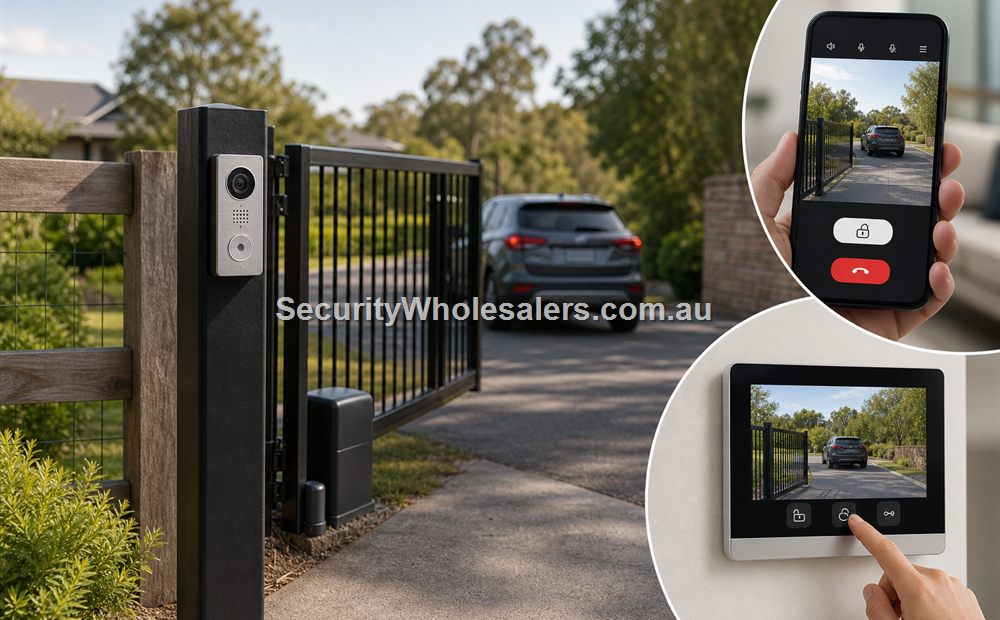
| Gate operator relay | Electric gates and some roller-door style entries | Dry-contact input, operator logic, and whether there is also a pedestrian release path |
Worked examples
An aluminium shopfront office door
Situation: An office has an aluminium shopfront door with a latch set and frame profile that already points naturally toward strike hardware.
Solution used: Confirm the strike path first, then choose the intercom station and relay arrangement around that hardware decision.
Why this was chosen: This kind of door usually becomes an electric-strike conversation before it becomes an intercom-brand conversation. The release hardware should lead the design, not follow it.
Installation notes: Door frame depth, latch compatibility, and where the exit button sits on the safe side all need to be checked early.
A glass door on a clinic entry
Situation: A clinic has a glazed entry where the buyer initially assumes a standard strike will be fine, but the glass-door hardware and mounting options do not suit that assumption.
Solution used: Reframe the job around the real door type and consider a maglock, drop bolt, or another specialist glass-door path before choosing the intercom release method.
Why this was chosen: Glass doors often change the hardware conversation quickly. Forcing a normal strike discussion onto the wrong door type usually wastes time and produces a poor result.
Installation notes: If the door is public-facing or part of an exit path, the release hardware and egress method should be assessed properly.
What to be careful with
- If the door is part of an exit path, do not guess the hardware.
- Do not assume the intercom itself is the lock power supply.
- Check the safe-side exit method, especially on maglocks and public-entry doors.
- Where required, have the full lock and egress path assessed by a suitably qualified installer, locksmith, electrician, builder, or fire professional.
Relevant SecurityWholesalers Categories and Products
These guides and product areas are the useful starting points when the intercom must actually release hardware.
- Access Control - Main product area for locks, power, exit devices, and supporting hardware.
- Guide: Electric Strike vs Magnetic Lock - Direct comparison guide for the lock hardware side.
- Guide: Fire and Egress Basics - Useful when the release path affects exit and emergency behaviour.
- Guide: Access Control with Intercoms - Useful when the intercom path overlaps with a broader door-control design.
Sources and Further Reading
Frequently Asked Questions
-
Can any intercom release any lock?
No. The release path depends on the actual door hardware, lock type, power path, and safe exit method.
-
What is the difference between using an intercom with a strike and with a maglock?
A strike usually works around the latch and frame. A maglock uses a different holding and release method and often needs more attention to egress and power.
-
Does the intercom power the lock?
Usually not in the full sense required. Many doors still need a separate low-voltage lock power supply and correct relay arrangement.
-
Can an intercom release a gate instead of a door lock?
Yes, often via a dry-contact input on the gate operator.
-
When should a professional check the release hardware?
If the door is public-facing, part of an exit path, a fire door, or simply not a basic straightforward hinged door, the hardware should be assessed properly.
Related Pages
Intercom for Electric Gates
Use this page when the visitor point is at a gate, boundary fence, or long driveway instead of a normal front door.
Intercom for Offices and Warehouses
Use this page when the intercom is for a business front door, warehouse gate, or managed staff entry.
Intercom with Mobile App
Use this page to decide whether app answering is a convenience feature or the main operating model.
SecurityWholesalers product paths for Intercom with Door Strike or Maglock Release
Use these product paths as a practical starting point after the buying logic is clear. The right product list should follow the site design, not replace it.
Quote checklist for Intercom with Door Strike or Maglock Release
Before ordering, ask for a short answer to these questions. They make the quote easier to compare and reduce the chance of buying hardware that does not match the site.
- What exact problem is being solved: door hardware and egress, deterrence, evidence, access control, safety, compliance or convenience?
- What happens during poor light, bad weather, busy periods, after-hours events or staff changes?
- Who will administer users, review events, export evidence and test the system?
- Which part of the design is allowed to be basic, and which part must be strong because it proves the incident?
If those answers are vague, the buyer should pause before purchasing. Good security equipment becomes much more useful when the operating plan is written down before installation.
Final field note for Intercom with Door Strike or Maglock Release
For Intercom with Door Strike or Maglock Release, the final buying decision should be easy to explain to the person who will live with the system. The quote should identify the must-have outcome, the acceptable compromises, and the support path if users, doors, cameras, sensors or site conditions change later.
This is the difference between a list of products and a security design. The products matter, but the design is what makes them useful.
Final field note for Intercom with Door Strike or Maglock Release
For Intercom with Door Strike or Maglock Release, the final buying decision should be easy to explain to the person who will live with the system. The quote should identify the must-have outcome, the acceptable compromises, and the support path if users, doors, cameras, sensors or site conditions change later.
This is the difference between a list of products and a security design. The products matter, but the design is what makes them useful.
Final field note for Intercom with Door Strike or Maglock Release
For Intercom with Door Strike or Maglock Release, the final buying decision should be easy to explain to the person who will live with the system. The quote should identify the must-have outcome, the acceptable compromises, and the support path if users, doors, cameras, sensors or site conditions change later.
This is the difference between a list of products and a security design. The products matter, but the design is what makes them useful.
Final field note for Intercom with Door Strike or Maglock Release
For Intercom with Door Strike or Maglock Release, the final buying decision should be easy to explain to the person who will live with the system. The quote should identify the must-have outcome, the acceptable compromises, and the support path if users, doors, cameras, sensors or site conditions change later.
This is the difference between a list of products and a security design. The products matter, but the design is what makes them useful.
Real quote scenario for Intercom with Door Strike or Maglock Release
When quoting Intercom with Door Strike or Maglock Release, the useful starting point is door release and safety logic. The buyer should be able to confirm door swing, lock power, exit hardware, emergency release and the authority or installer responsible for compliance. Without those details, two quotes can look similar while solving very different problems.
For example, a front entry may use a strike, a staff-only inward door may need a different lock body, and an emergency exit should never be treated as a normal locked door. This is why a strong SecurityWholesalers guide should talk about the site, the workflow and the equipment together rather than treating the product category as a simple shopping list.
Budget-conscious path
Use the simplest reliable hardware that solves the main risk. Keep administration simple and avoid specialist features unless they change the outcome.
Balanced path
Add better management, verification or expansion headroom where the site is likely to grow. This is usually the best path for small businesses and shared buildings.
Higher-risk path
Document response, audit trail, permissions and fallback procedures. Higher-risk sites need clearer operating rules, not just stronger hardware.
The final Intercom with Door Strike or Maglock Release quote should make the weak points visible. If cabling, power, monitoring, mobile app access, fire release, user management or future expansion are assumed rather than written down, the buyer is carrying risk that should have been solved during design.
Questions to ask before approving Intercom with Door Strike or Maglock Release
- What does the system need to prove or control on an ordinary day?
- What is different after hours, on weekends, during staff changes or during an emergency?
- Who will administer users, review events, export evidence or test the system?
- What happens if the internet is unavailable, a user loses a credential, a sensor triggers falsely or a door does not release?
- Which part of the system is easy to expand later, and which part would be expensive to change?
These questions are deliberately practical. They help separate a polished product list from a design that will remain useful after installation.