

















Intercom for Apartments and Units
Apartments
What changes on a shared residential entry
As soon as the site has several units, several users, or an owners corporation, the intercom stops being a simple house-door conversation. Directory logic, resident turnover, indoor station count, gate or lift crossover, and whether the site can reuse older cabling all become part of the decision.
How apartment and unit installation usually works
Apartment and unit jobs usually start with a building survey rather than a product choice. The installer needs to know how many units, where the riser or cable path runs, where the building can place the distribution hardware, and whether the project is a light retrofit or a more complete common-area upgrade.
Only after that does the door station, indoor monitor count, and release hardware become clear. Shared-entry jobs often fail when they are treated like a large house rather than a building with risers, directories, and tenant turnover.
Common apartment intercom directions
| Apartment intercom direction | Usually strongest for | Main question |
|---|---|---|
| Fresh IP apartment system | Newer apartment projects, smaller new builds, sites being fully upgraded | Can the building run new structured cabling cleanly? |
| 2-wire apartment upgrade | Older unit blocks with existing intercom routes | Is the old cable route still usable and worth preserving? |
| Compact SIP-style building entry | Mixed-use or smaller blocks where phone and app behaviour matter more | Does the building manager want a more communications-led workflow? |
Useful current reference points
| Reference point | Why it helps |
|---|---|
| Hikvision apartment intercoms | Good starting point when the building wants a mainstream apartment intercom path |
| Hikvision DS-KD3003-E6 | Useful apartment door-station reference point |
| Aiphone IXG family | Useful multi-tenant reference when Aiphone is the stronger brand fit |
| Akuvox 2-wire intercom | Useful retrofit-smart-entry reference point on older buildings |
Worked examples
A three-level strata block with tired old audio intercom
Situation: The owners want video, app answering, and less confusion when tenants change, but the building already has an older intercom riser in place.
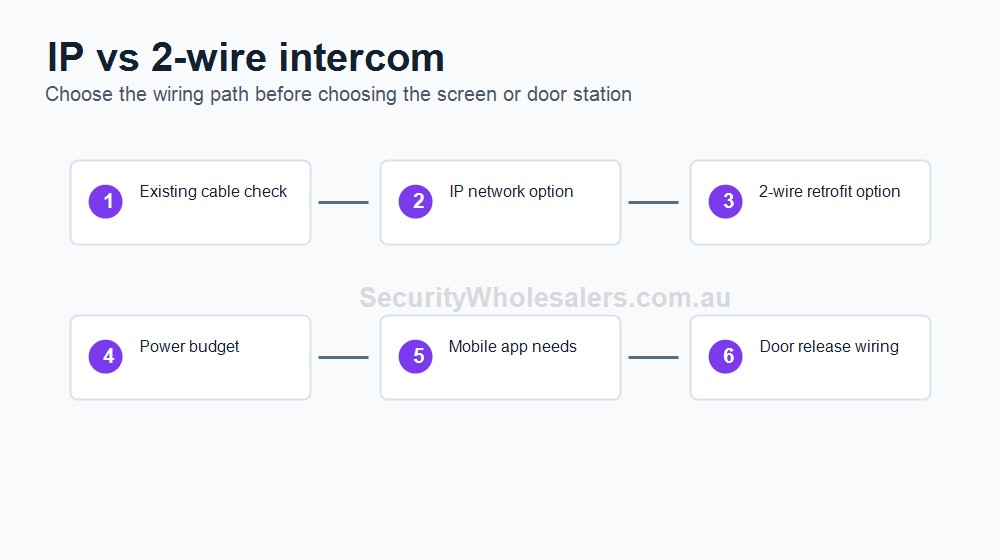
Solution used: Decide between 2-wire retrofit and a full IP apartment path before arguing about brands, then size the system around resident workflow, monitor count, and building hardware locations.
Why this was chosen: The main problem is not the badge on the door station. It is whether the building should preserve the old path or use the upgrade to move into a cleaner long-term IP structure.
Installation notes: Resident turnover, directory management, and who administers the building after handover are just as important as the station hardware.
A new mixed-use build with apartments over retail
Situation: A new mixed-use build has apartments above retail tenancies and the building is already being cabled from scratch.
Solution used: A structured IP apartment system with the right door-station family, monitor plan, and any gate or lift integration decided as part of the building design.
Why this was chosen: Because the building is already open for cabling, the case for a retrofit path is weak. A fresh IP apartment system is more attractive when the project already expects structured common-area infrastructure.
Installation notes: Mixed-use jobs should also decide early which doors are resident-only, which are retail-facing, and whether the lift workflow belongs in the same planning conversation.
What to be careful with
- Do not use a villa kit as a shortcut for a genuine multi-tenant building.
- Check who will administer resident changes, app access, monitors, and any directories.
- If the site has gates, lifts, or shared staff areas, ask early whether access control also belongs in the plan.
Relevant SecurityWholesalers Categories and Products
These categories and products are the main starting points when the job involves units, strata, or shared residential entry.
- Hikvision apartment intercoms - Main shared-entry apartment category.
- Hikvision DS-KD3003-E6 - Apartment door-station reference.
- Akuvox intercoms - Useful where SIP-style or app-led building entry is being considered.
- Akuvox 2-wire intercom - Useful retrofit path for older buildings.
- Aiphone intercoms - Useful Aiphone apartment and building-entry branch.
Sources and Further Reading
Frequently Asked Questions
-
What is the biggest difference between a house intercom and an apartment intercom?
The apartment system has to manage several users or units, resident turnover, and shared entry workflow, not just one front door.
-
Can a unit block upgrade to video intercom without rewiring everything?
Sometimes yes, which is why 2-wire retrofit options are often considered first on older buildings.
-
Do apartments still need indoor monitors if there is an app?
Often yes. Many buildings still want fixed indoor answer points even if app answering is also available.
-
When does apartment intercom start overlapping with access control?
That often happens when lifts, gates, or resident credential permissions become part of the project.
-
What should an owners corporation confirm early?
The likely cable path, resident administration method, number of stations, and whether the building wants a retrofit or a full new-system approach.
Related Pages
Intercom for Multi-Tenant Buildings
Use this page when several tenancies or unrelated occupiers share the entry.
IP Intercom vs 2-Wire Intercom
Choose between fresh IP and retrofit 2-wire based on the building, not just the brochure.
Best Intercom for Replacing an Old System
Use this page when the site already has an old intercom and the main question is upgrade strategy.
Quote checklist for Intercom for Apartments and Units
Before ordering, ask for a short answer to these questions. They make the quote easier to compare and reduce the chance of buying hardware that does not match the site.
- What exact problem is being solved: multi-tenant access, deterrence, evidence, access control, safety, compliance or convenience?
- What happens during poor light, bad weather, busy periods, after-hours events or staff changes?
- Who will administer users, review events, export evidence and test the system?
- Which part of the design is allowed to be basic, and which part must be strong because it proves the incident?
If those answers are vague, the buyer should pause before purchasing. Good security equipment becomes much more useful when the operating plan is written down before installation.
Final field note for Intercom for Apartments and Units
For Intercom for Apartments and Units, the final buying decision should be easy to explain to the person who will live with the system. The quote should identify the must-have outcome, the acceptable compromises, and the support path if users, doors, cameras, sensors or site conditions change later.
This is the difference between a list of products and a security design. The products matter, but the design is what makes them useful.
Final field note for Intercom for Apartments and Units
For Intercom for Apartments and Units, the final buying decision should be easy to explain to the person who will live with the system. The quote should identify the must-have outcome, the acceptable compromises, and the support path if users, doors, cameras, sensors or site conditions change later.
This is the difference between a list of products and a security design. The products matter, but the design is what makes them useful.
Final field note for Intercom for Apartments and Units
For Intercom for Apartments and Units, the final buying decision should be easy to explain to the person who will live with the system. The quote should identify the must-have outcome, the acceptable compromises, and the support path if users, doors, cameras, sensors or site conditions change later.
This is the difference between a list of products and a security design. The products matter, but the design is what makes them useful.
Final field note for Intercom for Apartments and Units
For Intercom for Apartments and Units, the final buying decision should be easy to explain to the person who will live with the system. The quote should identify the must-have outcome, the acceptable compromises, and the support path if users, doors, cameras, sensors or site conditions change later.
This is the difference between a list of products and a security design. The products matter, but the design is what makes them useful.
Real quote scenario for Intercom for Apartments and Units
When quoting Intercom for Apartments and Units, the useful starting point is visitor entry workflow. The buyer should be able to confirm cabling, power, call destination, mobile app needs, relay release, gate/door controller and backup process. Without those details, two quotes can look similar while solving very different problems.
For Intercom for Apartments and Units, a residential gate, apartment lobby, warehouse reception and old 2-wire retrofit may all need different wiring and release logic. This is why a strong SecurityWholesalers guide should talk about the site, the workflow and the equipment together rather than treating the product category as a simple shopping list.
Budget-conscious path
Use the simplest reliable hardware that solves the main risk. Keep administration simple and avoid specialist features unless they change the outcome.
Balanced path
Add better management, verification or expansion headroom where the site is likely to grow. This is usually the best path for small businesses and shared buildings.
Higher-risk path
Document response, audit trail, permissions and fallback procedures. Higher-risk sites need clearer operating rules, not just stronger hardware.
The final Intercom for Apartments and Units quote should make the weak points visible. If cabling, power, monitoring, mobile app access, fire release, user management or future expansion are assumed rather than written down, the buyer is carrying risk that should have been solved during design.
Questions to ask before approving Intercom for Apartments and Units
- What does the system need to prove or control on an ordinary day?
- What is different after hours, on weekends, during staff changes or during an emergency?
- Who will administer users, review events, export evidence or test the system?
- What happens if the internet is unavailable, a user loses a credential, a sensor triggers falsely or a door does not release?
- Which part of the system is easy to expand later, and which part would be expensive to change?
These questions are deliberately practical. They help separate a polished product list from a design that will remain useful after installation.
Extra buying notes for Intercom for Apartments and Units
The Intercom for Apartments and Units buying decision should be tested against normal use, after-hours use and failure conditions. If the quote cannot explain those three moments, it needs more design work before the customer commits. This is the kind of detail that helps a buyer compare quotes properly, because it turns the conversation from ?which model is cheapest?? into ?which design will still be useful after installation??
For Intercom for Apartments and Units, the best final check is to ask what would make the system fail in practice. Common answers include poor cabling, weak power planning, missed user permissions, unclear response duties, too little storage, unsuitable mounting positions, or a handover that nobody can follow. A strong quote names those risks and deals with them before hardware is ordered.
For Intercom for Apartments and Units, SecurityWholesalers should help buyers feel more confident, not more overwhelmed. The ideal outcome is a quote that is technically sound, easy to explain, and honest about where a simpler option is enough.