















IP Intercom vs 2-Wire Intercom
Comparison
Main technical difference
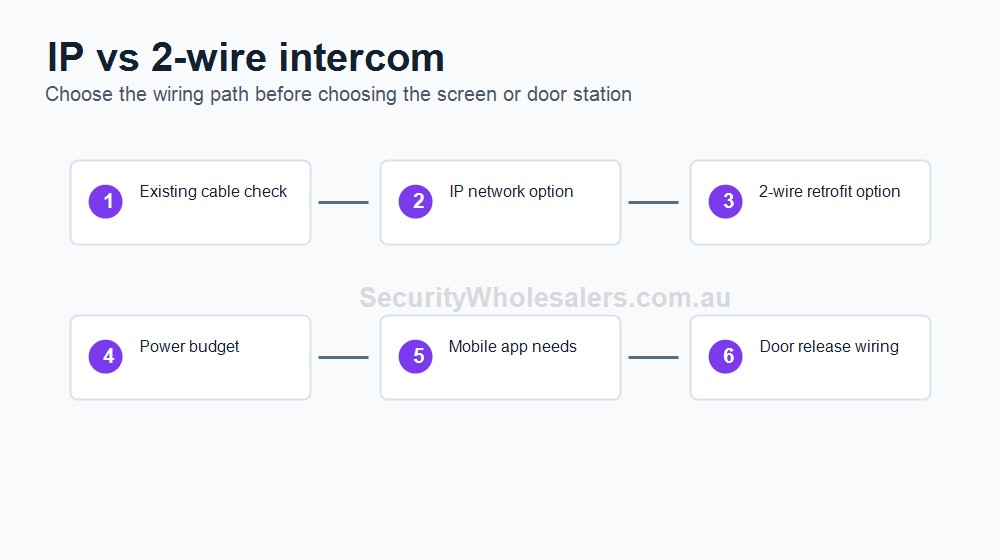
IP intercom usually assumes a cleaner network path with Cat6, PoE switches, and a more straightforward fit into the rest of the network. 2-wire usually exists to modernise a building over an existing cable route. In practical terms, IP is often the better long-term system architecture. 2-wire is often the better short-to-medium-term retrofit strategy when the building conditions make that worthwhile.
IP versus 2-wire in practical terms
| Question | IP intercom | 2-wire intercom |
|---|---|---|
| Best fit | New builds, re-cabled sites, modern offices, many simple front doors | Older buildings, retrofit apartments, sites avoiding wall work |
| Cabling | Cat6 and PoE are usually the normal expectation | Existing intercom cable may be reused if suitable |
| Expansion | Usually cleaner to expand later | Can be limited by the original building path and kit architecture |
| Why people choose it | Long-term cleanliness and easier system architecture | Lower disruption and better retrofit practicality |
| Main risk | Over-specifying a site that just needed a simple retrofit | Trying to force old cable into a job that would be better re-cabled |
Worked examples
A new childcare centre admin entry
Situation: The builder is already running new cable, the front entry needs an indoor answer point, and the site may later want stronger access-control overlap.
Solution used: An IP intercom from the start, with Cat6, PoE, one admin answer point, and a front-door path that can still make sense if access control later expands around the same entry.
Why this was chosen: When the building is already being cabled, IP gives the cleaner long-term system architecture and avoids preserving old-style compromises for no reason.
Installation notes: This is the kind of job where it helps to plan the intercom and future door control together, even if access control is not stage one.
An old eight-unit block replacing a failed panel
Situation: The owners do not want major cable work through existing common areas and units, and the building already has an older intercom path in place.
Solution used: A 2-wire or apartment-retrofit discussion first, provided the cable path is still viable.
Why this was chosen: The project goal is to restore and modernise the entry with low disruption. That usually makes 2-wire or a structured retrofit path more relevant than a fresh IP rewire.
Installation notes: The quality of the existing cable route is the deciding factor, so the survey matters more than the marketing language.
What usually works
- Choose IP when the site is already open, cabled, or expected to grow.
- Choose 2-wire when the real project goal is minimising wall work and preserving the old route.
- If the building is in between, ask whether the owner would rather pay more once for a cleaner long-term IP path or preserve the old route for speed and budget.
Relevant SecurityWholesalers Categories and Products
These categories and products are useful reference points when the cable path is the first big decision.
- IP Intercoms - Main IP intercom category.
- Hikvision Gen2 2-wire - Clear 2-wire retrofit reference point.
- Akuvox 2-wire - Alternative 2-wire upgrade path.
- Hikvision DS-KIS602 - Good simple IP reference.
- Hikvision DS-KIS702Y-P - Good simple 2-wire reference.
Sources and Further Reading
Frequently Asked Questions
-
Is IP intercom always better than 2-wire?
No. IP is often cleaner long term, but 2-wire can be the smarter choice on a real retrofit where cable reuse and low disruption matter.
-
What is the biggest mistake when comparing IP and 2-wire?
The biggest mistake is ignoring the building and choosing only on headline features.
-
Can 2-wire still support app-based intercom features?
Often yes, depending on the platform, but the building path and system architecture still matter.
-
When should an old building move straight to IP instead of 2-wire?
Usually when the building is already being opened up, renovated, or needs a cleaner long-term network path anyway.
-
What should I send before asking which path suits?
Photos of the door station location, monitor location, any old intercom gear, and any visible cable route or cupboard space are all helpful.
Related Pages
Hikvision IP Intercom Buying Guide
Use Hikvision IP where the job is wired cleanly and may need stronger CCTV or access-control crossover.
Hikvision 2-Wire Intercom Buying Guide
Use 2-wire when retrofit and cable reuse matter more than a fresh Cat6 start.
Best Intercom for Replacing an Old System
Use this page when the site already has an old intercom and the main question is upgrade strategy.
Quote checklist for IP Intercom vs 2-Wire Intercom
Before ordering, ask for a short answer to these questions. They make the quote easier to compare and reduce the chance of buying hardware that does not match the site.
- What exact problem is being solved: intercom planning, deterrence, evidence, access control, safety, compliance or convenience?
- What happens during poor light, bad weather, busy periods, after-hours events or staff changes?
- Who will administer users, review events, export evidence and test the system?
- Which part of the design is allowed to be basic, and which part must be strong because it proves the incident?
If those answers are vague, the buyer should pause before purchasing. Good security equipment becomes much more useful when the operating plan is written down before installation.
Final field note for IP Intercom vs 2-Wire Intercom
For IP Intercom vs 2-Wire Intercom, the final buying decision should be easy to explain to the person who will live with the system. The quote should identify the must-have outcome, the acceptable compromises, and the support path if users, doors, cameras, sensors or site conditions change later.
This is the difference between a list of products and a security design. The products matter, but the design is what makes them useful.
Final field note for IP Intercom vs 2-Wire Intercom
For IP Intercom vs 2-Wire Intercom, the final buying decision should be easy to explain to the person who will live with the system. The quote should identify the must-have outcome, the acceptable compromises, and the support path if users, doors, cameras, sensors or site conditions change later.
This is the difference between a list of products and a security design. The products matter, but the design is what makes them useful.
Final field note for IP Intercom vs 2-Wire Intercom
For IP Intercom vs 2-Wire Intercom, the final buying decision should be easy to explain to the person who will live with the system. The quote should identify the must-have outcome, the acceptable compromises, and the support path if users, doors, cameras, sensors or site conditions change later.
This is the difference between a list of products and a security design. The products matter, but the design is what makes them useful.
Final field note for IP Intercom vs 2-Wire Intercom
For IP Intercom vs 2-Wire Intercom, the final buying decision should be easy to explain to the person who will live with the system. The quote should identify the must-have outcome, the acceptable compromises, and the support path if users, doors, cameras, sensors or site conditions change later.
This is the difference between a list of products and a security design. The products matter, but the design is what makes them useful.
Real quote scenario for IP Intercom vs 2-Wire Intercom
When quoting IP Intercom vs 2-Wire Intercom, the useful starting point is visitor entry workflow. The buyer should be able to confirm cabling, power, call destination, mobile app needs, relay release, gate/door controller and backup process. Without those details, two quotes can look similar while solving very different problems.
For IP Intercom vs 2-Wire Intercom, a residential gate, apartment lobby, warehouse reception and old 2-wire retrofit may all need different wiring and release logic. This is why a strong SecurityWholesalers guide should talk about the site, the workflow and the equipment together rather than treating the product category as a simple shopping list.
Budget-conscious path
Use the simplest reliable hardware that solves the main risk. Keep administration simple and avoid specialist features unless they change the outcome.
Balanced path
Add better management, verification or expansion headroom where the site is likely to grow. This is usually the best path for small businesses and shared buildings.
Higher-risk path
Document response, audit trail, permissions and fallback procedures. Higher-risk sites need clearer operating rules, not just stronger hardware.
The final IP Intercom vs 2-Wire Intercom quote should make the weak points visible. If cabling, power, monitoring, mobile app access, fire release, user management or future expansion are assumed rather than written down, the buyer is carrying risk that should have been solved during design.
Questions to ask before approving IP Intercom vs 2-Wire Intercom
- What does the system need to prove or control on an ordinary day?
- What is different after hours, on weekends, during staff changes or during an emergency?
- Who will administer users, review events, export evidence or test the system?
- What happens if the internet is unavailable, a user loses a credential, a sensor triggers falsely or a door does not release?
- Which part of the system is easy to expand later, and which part would be expensive to change?
These questions are deliberately practical. They help separate a polished product list from a design that will remain useful after installation.
Extra buying notes for IP Intercom vs 2-Wire Intercom
The wiring decision often determines the whole intercom project. IP is cleaner for new work, while 2-wire can be excellent for retrofits where existing cable is usable and replacement wiring would be disruptive. This is the kind of detail that helps a buyer compare quotes properly, because it turns the conversation from ?which model is cheapest?? into ?which design will still be useful after installation??
For IP Intercom vs 2-Wire Intercom, the best final check is to ask what would make the system fail in practice. Common answers include poor cabling, weak power planning, missed user permissions, unclear response duties, too little storage, unsuitable mounting positions, or a handover that nobody can follow. A strong quote names those risks and deals with them before hardware is ordered.
For IP Intercom vs 2-Wire Intercom, SecurityWholesalers should help buyers feel more confident, not more overwhelmed. The ideal outcome is a quote that is technically sound, easy to explain, and honest about where a simpler option is enough.
Extra buying notes for IP Intercom vs 2-Wire Intercom
The wiring decision often determines the whole intercom project. IP is cleaner for new work, while 2-wire can be excellent for retrofits where existing cable is usable and replacement wiring would be disruptive. This is the kind of detail that helps a buyer compare quotes properly, because it turns the conversation from ?which model is cheapest?? into ?which design will still be useful after installation??
For IP Intercom vs 2-Wire Intercom, the best final check is to ask what would make the system fail in practice. Common answers include poor cabling, weak power planning, missed user permissions, unclear response duties, too little storage, unsuitable mounting positions, or a handover that nobody can follow. A strong quote names those risks and deals with them before hardware is ordered.
For IP Intercom vs 2-Wire Intercom, SecurityWholesalers should help buyers feel more confident, not more overwhelmed. The ideal outcome is a quote that is technically sound, easy to explain, and honest about where a simpler option is enough.