












Commercial
AXIS Thermal, Radar, and LPR Buying Guide
Specialist Guide
Quick answer
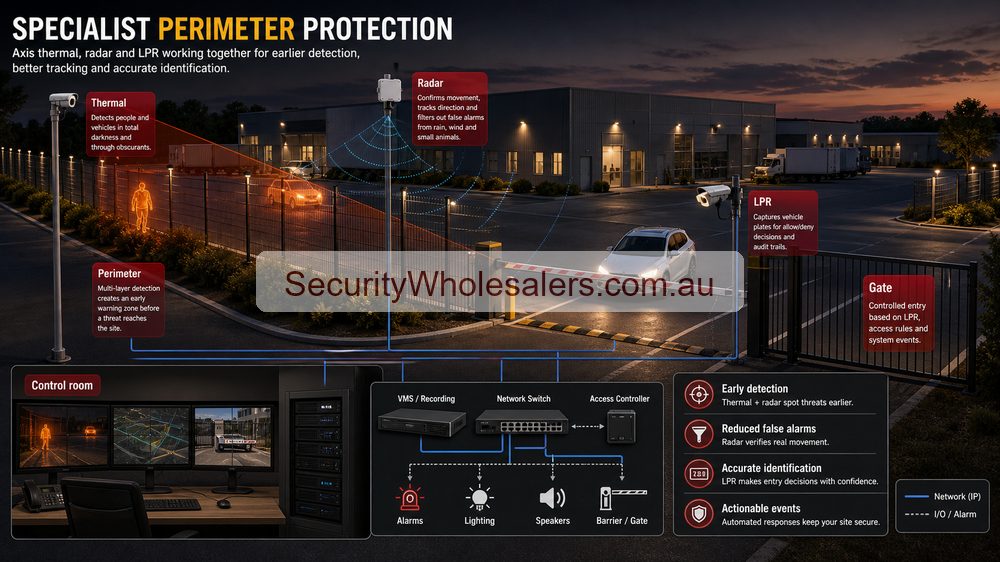
Use thermal when the site needs dependable perimeter or long-range detection in darkness or difficult conditions. Use radar when the site needs area movement awareness that is less dependent on clean video. Use LPR when the job really depends on vehicle and number-plate workflow. If the site only needs better ordinary evidence coverage, standard fixed AXIS cameras are usually still the right first move.
Specialist problem to specialist solution
Dark or difficult perimeter
Start with thermal if the site needs dependable detection before a normal visible-light camera would even have a clean picture.
Movement across a broad outdoor area
Start with radar or radar-video fusion if the site needs area awareness rather than only line-based analytics on a camera image.
Vehicle or gate workflow
Start with LPR or verifier kits if the site wants plate events, not just video of vehicles entering and leaving.
Hybrid premium perimeter
Combine these layers only when each one has a clear job, such as thermal for detection, radar for zone awareness, and visible-light cameras for verification.
How to separate thermal, radar, and LPR properly
Thermal is mainly about heat-based detection and privacy-aware perimeter awareness. Radar is mainly about movement detection across an area or boundary. Radar-video fusion combines those ideas into a tighter detection-and-visual workflow. LPR is about vehicle and plate workflow, not broad scene awareness. Many poor specialist designs happen because buyers collapse these into one premium-camera conversation when they are really different tools.
Where each specialist AXIS branch usually fits
| Specialist path | Usually strongest for | Weak point if used badly |
|---|---|---|
| Thermal | Perimeter detection in darkness, smoke, light fog, privacy-sensitive sites, and longer external boundaries | It does not replace the need for visual identification or colour evidence where that is still required. |
| Security radar | Area movement awareness, early intrusion detection, broader zone monitoring | Radar is a detection layer, not a visual evidence source by itself. |
| Radar-video fusion | Higher-confidence external detection where the site wants both radar and visual tracking in one branch | It is more complex and should be used where the environment actually justifies it. |
| LPR | Vehicle entry and exit control, parking, strata gates, logistics, industrial lanes | LPR fails if lane geometry, angle, speed, or lighting assumptions are poor. |
Recommended current AXIS product paths
Thermal reference path
Q1971-E is a useful thermal reference for perimeter awareness where the site needs dependable detection rather than ordinary colour footage alone.
Higher-end thermal path
Q2112-E is a stronger reference when privacy-aware and higher-performance thermal detection becomes central to the project.
Radar path
D2110-VE is the clearest AXIS radar reference when the job needs area or perimeter movement awareness more than another standard camera.
Plate-verifier path
P1465-LE-3 is a practical verifier-kit reference for sites that need a real lane-based vehicle workflow.
What usually works by specialist problem
| Problem on site | What usually works | Why |
|---|---|---|
| Long dark perimeter with poor ambient light | Thermal plus standard visual verification cameras | Thermal improves the first detection layer, while visible-light cameras still provide the scene evidence people review later. |
| Open external area where movement matters more than colour detail | Radar or radar-video fusion | The site needs dependable movement awareness over an area, not only tripwire logic on a normal image. |
| Vehicle gate where plate-based events matter | Dedicated verifier or LPR kit | The job is about plate workflow, lane discipline, and event accuracy. |
| Privacy-sensitive perimeter where people should be detected without conventional imaging everywhere | Thermal, sometimes combined with selective visual verification | This gives awareness without forcing every scene to rely on ordinary colour imagery. |
Outer-yard waste transfer site
A waste transfer site with long boundaries, poor ambient light, smoke, dust, and moving machinery is a stronger thermal and radar conversation than a normal fixed-camera conversation. The fixed cameras still matter, but they become the verification layer rather than the first detection layer.
Strata visitor gate
A strata visitor gate is usually not a thermal problem at all. It may be a straightforward LPR or verifier problem if the site wants to recognise authorised vehicles or log arrivals and departures more cleanly. In that case a purpose-built verifier kit is far more useful than trying to stretch a general overview bullet into a plate-recognition role.
Remote logistics approach road
A remote logistics approach road may justify a longer-range verifier path because vehicle speed, lane length, and reliable plate capture actually matter. The same product would be a poor fit on a simple suburban driveway where the buyer only wants a general external camera.
Where standard CCTV is still the better answer
A suburban trade yard wants better after-hours awareness, but the actual requirement is clearer gate coverage, staff-door coverage, and one wider yard overview. There is no long-distance perimeter issue, no plate workflow, and no real need for thermal or radar. In that case the smarter AXIS move is usually a stronger fixed-camera design first, not a specialist branch added too early.
Common specialist-design mistakes
- Choosing thermal because it sounds premium even though the site really needed better visible-light fixed cameras and stronger low-light planning.
- Using radar with no clear response workflow, so detections arrive but nobody has planned how they are reviewed or what they trigger.
- Trying to make a general bullet camera perform like a dedicated LPR lane camera.
- Expecting one specialist product to replace the rest of the surveillance design.
- Skipping lane geometry, angle, speed, and lighting checks on LPR jobs.
Relevant SecurityWholesalers categories and products
Specialist Axis quote scenarios
| Need | Technology | Design note |
|---|---|---|
| Dark perimeter detection | Thermal | Pair with visible cameras where identification matters. |
| Wide area movement tracking | Radar | Useful where direction, speed or movement pattern matters. |
| Vehicle entry records | LPR | Requires lane control, signage, retention policy and realistic plate angles. |
| High-risk yard | Thermal plus radar plus visible cameras. | Each technology should have a job, not just be added for effect. |
Specialist-camera mistakes
- Using thermal when the buyer really needs visual identification.
- Using LPR on an uncontrolled driveway with poor plate angles.
- Adding radar without a clear operator or alarm workflow.
- Forgetting privacy, signage and data-retention responsibilities.
Frequently Asked Questions
- When do AXIS thermal cameras make sense?
AXIS thermal cameras make sense when the site needs dependable detection in darkness, smoke, fog, or difficult weather, or when privacy-aware perimeter monitoring is more important than colour imagery.
- What is the point of AXIS security radar?
AXIS security radar is useful where the site needs area or perimeter movement detection that is less affected by darkness and visual-scene limitations. It works best as a detection layer that supports cameras rather than replacing them.
- What does radar-video fusion actually change?
Radar-video fusion combines visual evidence with radar-based movement detection, which can improve tracking and event confidence on harder external sites where one technology alone has more blind spots.
- When is AXIS LPR worth using?
AXIS LPR is worth using when the job genuinely depends on vehicle and plate workflow such as gated access, logistics, parking, strata entry, or controlled commercial arrivals and departures.
- Can one AXIS site combine thermal, radar, and LPR?
Yes, but only when each layer has a clear job. A stronger design may use thermal for long-range detection, radar for area movement awareness, standard cameras for visual verification, and LPR only on the vehicle lane where plate workflow matters.
-
Can Axis thermal identify people?
Thermal is mainly a detection tool, not a normal identification camera. Use visible-light cameras where faces, colours or detailed evidence are required.
-
Does Axis LPR work on every driveway?
No. LPR works best on controlled lanes with suitable angles, lighting and vehicle speed. Wide uncontrolled driveways can be poor candidates.