












Commercial
Best AXIS CCTV System in Australia
Return to AXIS Guides
Premium Commercial
Quick answer
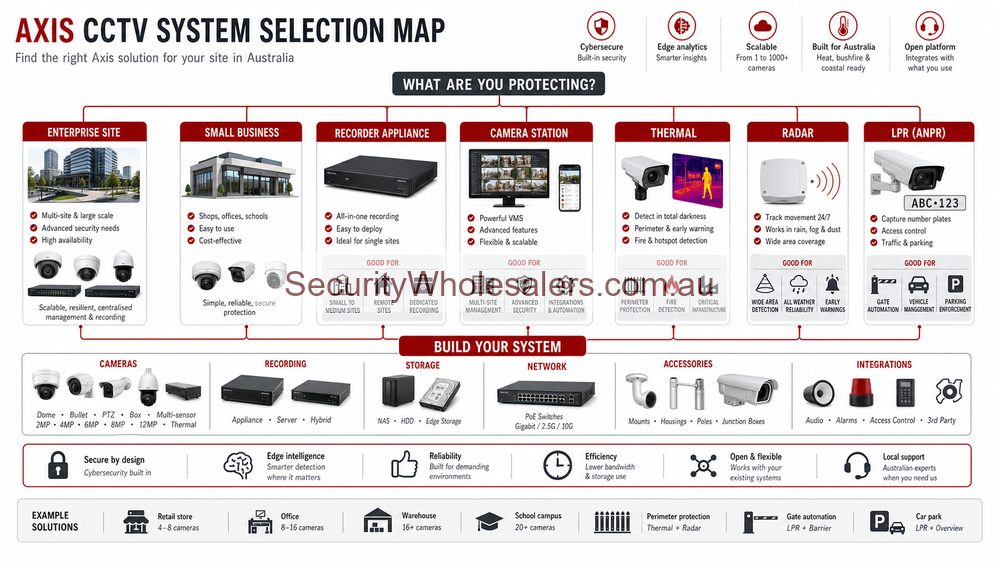
For many serious AXIS jobs, the best starting point is fixed dome and bullet cameras covering the evidence-critical scenes, paired with an AXIS appliance or Camera Station path sized for the likely final camera count. Add PTZ only for broader grounds, car parks or yards. Add thermal, radar or LPR only where the site genuinely has a specialist perimeter, detection or vehicle-entry problem.
What this page helps with
- Deciding whether AXIS is really the right brand fit
- Choosing between a tidy appliance-led path and a broader Camera Station rollout
- Separating normal fixed-camera jobs from PTZ, thermal, radar and LPR jobs
- Understanding when AXIS is worth the premium and when it is not
At-a-glance recommendation table
| Project type | Typical camera count | Recommended AXIS path | Notes |
|---|---|---|---|
| Premium office or clinic | 4 to 8 cameras | Fixed domes with a compact recorder or small appliance | Best where presentation, low light and review quality matter more than raw camera count. |
| Warehouse or trade site | 8 to 16 cameras | Fixed evidence cameras plus appliance-led recording | AXIS makes more sense when the scenes are harder and review value is higher. |
| School, campus or multi-building site | 16 to 48 cameras | Structured fixed cameras plus Camera Station planning | Software and permissions start to matter as much as camera specs. |
| Higher-risk perimeter job | 8 to 32 cameras plus specialist devices | Fixed cameras plus thermal, radar or LPR where justified | Use specialist AXIS branches only where the problem is real. |
| Very price-led small business | 4 to 8 cameras | Often not an AXIS job | If the site will not use the premium capabilities, a mainstream brand can be the more honest answer. |
Best AXIS paths by buyer type
Premium small-site path
Best for buyers who want a polished office, clinic, boutique retail or reception system that still feels commercial. Start with AXIS domes and a clean recorder path.
Commercial growth path
Best for warehouses, logistics spaces and multi-zone buildings where the camera roles are varied and the recorder workflow matters. This is where AXIS Camera Station and appliance thinking starts to pay off.
Specialist perimeter path
Best for sites where the real problem is broad perimeter detection, heat-risk detection or controlled vehicle entry. That is where thermal, radar and LPR belong.
Worked examples
Small premium office: six fixed cameras, tidy low-light entry views, one stronger external bullet, and a compact appliance path. This is where AXIS makes sense because the footage quality and operator experience matter every day.
Warehouse with loading and staff parking: fixed evidence cameras do the hard work on loading docks, roller doors and internal walk paths, while a PTZ is only added for yard overview once the fixed views are already right.
Campus or school: the right answer usually becomes a structured multi-zone design with permissions and grouped review workflow, not just better cameras on the same old recorder logic.
What to buy first
AXIS Dome Cameras
The cleanest starting point for many premium internal and external fixed-camera roles.
AXIS Bullet Cameras
Useful where longer external approaches or visible perimeter presence matter.
AXIS PTZ Cameras
Use as a support layer on bigger grounds, not a replacement for fixed evidence.
AXIS Recorders and Appliances
Where the recorder path, licences and long-term operator workflow start to matter.
Related AXIS guides
AXIS 2026 Reference Points
Useful when you want a tighter shortlist of current product directions.
AXIS Dome vs Bullet vs PTZ vs Panoramic
Useful when the camera role is still the main unresolved question.
AXIS Camera Station and Appliance Systems
Useful when the recorder and software path matters just as much as the cameras.
AXIS Thermal, Radar, and LPR
Useful for specialist perimeter, thermal and vehicle-entry jobs.
Quote-ready Axis system scenarios
| Site | Practical Axis path | Why Axis may be worth it |
|---|---|---|
| Premium home or estate | High-quality fixed cameras, controlled recording path and careful app/user handover. | The buyer values image quality, reliability and long-term support more than a basic kit. |
| Small business with high-value stock | Entry, POS/counter, stock, rear door and exterior views with recorder headroom. | Evidence quality and investigation workflow matter when incidents cost money. |
| Warehouse or yard | Fixed evidence cameras plus panoramic, PTZ or specialist analytics where justified. | Axis can suit sites that need better system management and specialist camera roles. |
| Campus, school or public facility | Camera Station/appliance planning, user roles, privacy-aware coverage and scalable storage. | Operational management and governance are often as important as cameras. |
| Perimeter or vehicle entry | Thermal, radar or LPR only where the site has a defined detection or vehicle workflow. | Specialist Axis tools are strongest when the design problem is clearly scoped. |
When Axis is the right choice
Axis is rarely the cheapest way to put cameras on a wall. It is usually chosen when the buyer wants a better-managed system, stronger camera hardware, credible analytics, longer-term supportability or an open-platform approach. That makes it attractive for commercial, government, education, premium residential and specialist perimeter projects.
- Choose Axis when the system will be managed, reviewed and expanded over time.
- Use Axis Camera Station or appliances where the site wants a more structured recording platform.
- Use panoramic, PTZ, thermal, radar or LPR only where they solve a defined site problem.
- Do not sell Axis only as a like-for-like replacement for a budget camera kit.
Axis buyer decision checklist
- Is the site likely to expand or need long-term support?
- Does the buyer need premium image quality, analytics or platform management?
- Will staff regularly search footage, export clips or manage users?
- Does the site need specialist perimeter, thermal, radar or LPR functions?
- Would a simpler Hikvision, Dahua or Uniview path solve the job well enough?
This is the honest Axis conversation. Axis is often excellent, but it should be chosen for a clear operational reason: management, evidence quality, integration, cybersecurity posture or specialist capability.
Frequently Asked Questions
What is the best AXIS CCTV system?
Usually the best AXIS system is a structured fixed-camera design with AXIS Camera Station or the right appliance path, then specialist layers only where they are genuinely useful.
When is AXIS worth the extra spend?
AXIS usually becomes easier to justify when the site values long service life, stronger analytics, cybersecurity, operator workflow, or difficult scenes where poor footage would be costly.
Should I use PTZ as the main AXIS camera on a site?
Usually no. Fixed evidence cameras should still do the core work. PTZ is better as a support layer on broader grounds, car parks, campuses or yards.
Do small sites ever make sense on AXIS?
Yes, but usually only where the buyer wants a premium small system rather than the cheapest possible answer.
Should AXIS buyers think about Camera Station early?
Yes. On AXIS, the appliance and software path often matters almost as much as the camera choice.
Frequently Asked Questions
-
Is Axis CCTV worth the extra cost?
Axis can be worth it where reliability, image quality, system management, analytics, cybersecurity posture and long-term support matter more than the lowest upfront price.
-
Who should choose Axis over Hikvision or Dahua?
Axis often suits commercial, education, government, premium residential, enterprise and specialist sites that need stronger management, open architecture or specialist detection.
-
Is Axis overkill for a small site?
Sometimes. A simple low-risk site may not need Axis. A small site with high-value stock, strict management expectations or premium evidence requirements may still justify it.