












Informational
AXIS FAQs
Detailed FAQs
Why are AXIS cameras more expensive than many other CCTV brands?
AXIS usually costs more because the proposition is wider than camera image quality alone. The buyer is generally paying for stronger device build quality, better-supported analytics, a more mature appliance and software path, long-term support expectations, and a stronger cybersecurity story. That does not automatically make AXIS the right answer, but it is why price comparisons can look uneven if they focus only on sensor size and resolution.
When is AXIS usually worth the extra spend?
AXIS usually makes the strongest commercial sense where the system is expected to remain useful for years, where operators genuinely use search, analytics, and playback, where the deployment sits on a serious network, or where the environment is demanding enough that failure and poor footage would be costly. It tends to suit education, healthcare, logistics, industrial, premium retail, and better office or mixed-use commercial projects more naturally than purely price-led small installs.
When is AXIS usually not worth the extra spend?
It is often not worth the premium on jobs where the client mainly wants basic overview footage, does not intend to use analytics or a stronger software path, and sees little value in longer lifecycle, device hardening, or appliance structure. In that case the budget may be better spent on improving the placement or number of cameras rather than moving the whole brand decision upward.
What is the difference between AXIS dome, bullet, PTZ, and panoramic cameras?
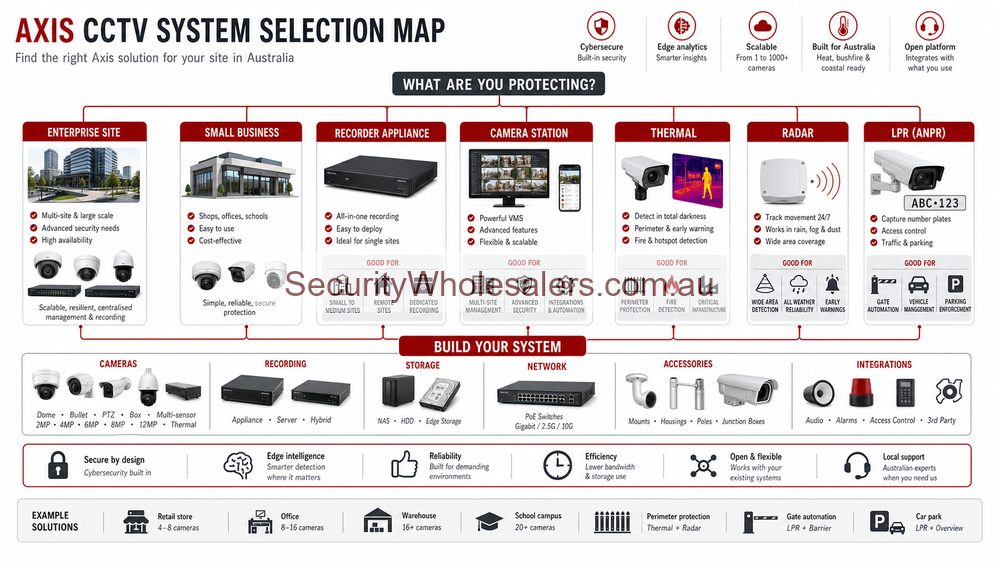
Domes are the standard fixed all-rounder. Bullets are more directional and often more natural on external walls, lanes, and perimeters. PTZ is for live overview and zooming, not for replacing fixed evidence views. Panoramic is for broad context coverage across several directions or a large open zone. A lot of poor shortlists happen because buyers treat these as cosmetic variations when they are really different surveillance tools.
Which AXIS models are currently popular on SecurityWholesalers?
Because the SecurityWholesalers AXIS category is ordered by popularity, models such as M2036-LE, P3268-LVE, M3085-V, M5526-E, and S3008 Mk II are useful practical references. They show what buyers keep returning to as everyday AXIS starting points, even while newer models continue to arrive.
Which newer AXIS cameras currently stand out?
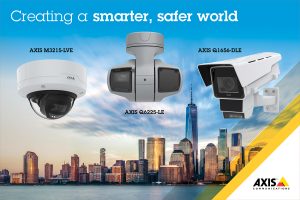
Current standouts include P3287-LVE, Q3628-VE, Q3556-LVE, Q1656-LE, and Q6300-E. They are important because they show the current direction of the AXIS range: more AI-enabled domes, stronger outdoor hardening, more specialist perimeter imaging, and a clearer overview-plus-detail design philosophy on bigger sites.
What is AXIS Camera Station and why does it matter?
AXIS Camera Station matters because on AXIS the software environment often influences the value of the whole deployment. It is not just about saving clips. It affects how users log in, review footage, search events, manage devices, and scale the system. That is one reason the recorder discussion on AXIS can become an appliance discussion quite quickly.
What is the difference between AXIS S3008 Mk II and the S2208 or S2212 appliance path?
S3008 Mk II is the simple compact recorder path. It is appropriate where the site is staying small and local. S2208 and S2212 are more complete standalone appliances with AXIS Camera Station Pro licences included. That means they are not just about more storage or channels. They represent a more structured software and management path from the start.
Does AXIS offer good low-light performance?
Yes, particularly on the better Lightfinder 2.0 branches. The practical question is whether the site will actually benefit from it. On a difficult external scene, a stronger low-light branch can materially improve night-time review. On a brightly lit indoor corridor, the difference may be far less meaningful than the sales description implies.
What does AXIS Object Analytics actually help with?
It helps most when the site is using alerts and event review seriously. Human and vehicle classification can make the event stream more useful than pure motion-only detection on busy commercial scenes. The value is operational. It is about reducing wasted review time and making the event list more manageable, not just adding a smart feature to the brochure.
What is Axis Edge Vault and why should a buyer care?
Axis Edge Vault is part of AXIS device identity and security architecture. Buyers should care when the system is going onto a serious commercial or institutional network, when device trust is part of procurement, or when the client is specifically asking about cybersecurity and lifecycle management rather than only asking about image quality.
What kind of site usually suits AXIS best?
AXIS is most naturally suited to sites where the system matters operationally. That includes schools, clinics, specialist medical spaces, transport, larger offices, logistics, higher-end retail, industrial sites, and mixed-use commercial buildings. In these environments the long-term value of analytics, appliance structure, support maturity, and harder device roles is easier to justify.
Is AXIS a good fit for small business?
It can be, but it depends on why the small business is buying. AXIS is usually strongest where the owner values image consistency, analytics, device quality, software maturity, and a longer service life. If the job is simply a four-camera overview install with no meaningful interest in lifecycle, analytics, or structured management, the AXIS premium may be difficult to justify. If the site is a clinic, specialist office, premium retail store, or compact commercial site that wants a stronger long-term system path, AXIS can make much more sense.
Is AXIS mainly for larger commercial projects?
No. Larger projects often make the value easier to see, but AXIS is not only for large deployments. Smaller professional environments can also suit AXIS if the buying priority is quality and structure rather than the lowest possible upfront price. The key is that the site should benefit from the stronger ecosystem rather than simply admiring it.
Which AXIS camera is the usual starting point for a general commercial entry or frontage?
On SecurityWholesalers, P3268-LVE and the newer P3287-LVE are practical starting points for many general commercial entry or frontage jobs. They are useful not because they solve every site, but because they represent the all-round outdoor AXIS dome path clearly. Buyers can then decide whether they actually need to move up to a tougher Q-series branch, down to a simpler M-series branch, or sideways to a bullet or panoramic design.
How should a buyer think about AXIS M-series, P-series, and Q-series?
A practical way to think about the AXIS hierarchy is that M-series is the more accessible entry path, P-series is the stronger everyday commercial branch, and Q-series is where the range becomes more specialised, more rugged, or more demanding in terms of scene quality and environment. That is not an absolute rule, but it is a useful commercial shorthand when the range starts to look too broad.
Are panoramic AXIS cameras better than several fixed cameras?
Not automatically. Panoramic cameras are strong when the site needs broad situational coverage from one position. They are weaker when the buyer quietly expects them to replace the tighter face, plate, or point-of-interaction views that still need fixed cameras. The better design often combines panoramic for context and fixed cameras for evidence rather than forcing one camera to do both jobs badly.
When is a PTZ actually justified on an AXIS project?
A PTZ is justified when the site has a real live-review role for it. That might be a larger car yard, public space, transport location, logistics site, or hospitality environment where staff actively use presets, tours, or zoom control. A PTZ is not justified merely because zoom sounds impressive. If nobody will operate it and there are not enough fixed evidence cameras, the PTZ often becomes an expensive distraction.
Does AXIS require AXIS Camera Station?
No. Some smaller AXIS sites can stay on a simpler recorder path. AXIS Camera Station becomes more important when the system wants a stronger appliance and software workflow, several users, clearer device management, and a more disciplined long-term structure. It is best seen as a system path, not a compulsory tax on every AXIS project.
Can AXIS cameras work with third-party VMS platforms?
Yes, they often can. The more useful question is whether a third-party VMS helps or weakens the design. On some jobs a mixed-platform environment is appropriate. On others, especially where the client is already paying for the AXIS ecosystem, the buyer should think carefully before giving away the advantages of a more integrated appliance and software workflow.
Do AXIS appliances include licences?
Some of the AXIS appliance products on SecurityWholesalers include AXIS Camera Station Pro licences. That matters because it changes the real value calculation. The buyer is not only getting hardware and storage. They are also getting a more complete software and deployment path. That is one reason those products should be compared as appliances, not as generic NVR boxes.
What should buyers compare besides storage on an AXIS recorder or appliance?
They should compare PoE budget, included licences, user workflow, device-management expectations, cabinet format, growth room, and how many people will actually review or administer the system. A recorder decision that looks right on raw storage numbers can still be wrong if the appliance structure or workflow is a poor fit for the site.
What does AV1 mean on newer AXIS cameras?
AV1 is part of the newer compression and efficiency discussion on some newer AXIS models. For many buyers it will not be the first reason to purchase, but it is a useful signal that the model belongs to a newer generation with broader long-term efficiency and software considerations than a simple megapixel comparison would suggest.
When do AXIS thermal cameras make sense?
AXIS thermal cameras make sense when the site needs dependable detection in darkness, smoke, fog, or difficult weather, or when the project wants privacy-aware perimeter awareness rather than detailed visible-light imagery. Thermal is a specialist branch and should be chosen because the site has that problem, not because it sounds like the premium version of a normal camera.
What is the role of AXIS radar on a real project?
AXIS radar is usually a detection layer for external zones and boundaries. It helps the site understand movement across larger outdoor areas and supports cameras rather than replacing visual evidence. The value appears when the buyer wants more dependable movement detection across open space than pure visual rules are likely to provide.
When is AXIS licence plate recognition worth using?
AXIS LPR is worth using when the site genuinely needs vehicle and number-plate workflow, such as gated access, commercial parking, logistics lanes, strata entry, or controlled arrival and departure records. It is not a general exterior camera feature. It is a specialist lane and workflow decision.
What is the biggest mistake people make when evaluating AXIS?
The biggest mistake is treating AXIS as a premium badge decision rather than a system-design decision. Buyers should evaluate whether they will actually use the stronger analytics, software, appliance, and lifecycle advantages rather than assuming the brand alone creates value. A weaker but correctly scoped system is still better than an expensive brand choice that never gets used properly.
Professional-services office
A professional-services office with one reception desk, two meeting-room corridors, and a basement entry may not need the most advanced AXIS branch, but it may still justify AXIS if the owner values a cleaner long-term software path, discreet fixed domes, and stronger network-security confidence over a purely price-led alternative.
Distribution and transport site
A transport or distribution site is where AXIS becomes easier to defend commercially. The site may need stronger external devices, PTZ support, panoramic context, better event handling, and a more disciplined appliance path. On that kind of system the brand premium is tied to the operational role of the cameras rather than to marketing language.
FAQ buying shortcuts
If you are choosing quickly, decide whether the job is a simple camera system, a managed Camera Station system, or a specialist perimeter/vehicle workflow. That one choice usually decides whether the buyer should focus on standard cameras, appliances, server planning, thermal, radar or LPR.
Frequently Asked Questions
- Why are AXIS cameras more expensive than many other CCTV brands?
AXIS generally costs more because the proposition is broader than image capture alone. Buyers are usually paying for stronger device quality, analytics maturity, lifecycle support, cybersecurity, and a more structured software and appliance ecosystem.
- When is AXIS usually worth the extra spend?
AXIS is usually worth the extra spend when the site is difficult, the system is expected to remain in service for years, analytics and review quality matter, cybersecurity is part of the brief, or the project benefits from a more mature appliance and software path.
- When is AXIS usually not worth the extra spend?
It is often not worth the premium on heavily price-led jobs where the buyer only wants simple overview footage, will never use the analytics or software properly, and has no requirement for a stronger long-term ecosystem.
- What is the difference between AXIS dome, bullet, PTZ, and panoramic cameras?
Domes are the main all-round fixed camera path, bullets are more directional and perimeter-friendly, PTZs are for live steering and zoom, and panoramic cameras are for wide context coverage. They are not interchangeable and usually solve different site problems.
- Which AXIS models are currently popular on SecurityWholesalers?
The popularity-ordered category currently makes models such as M2036-LE, P3268-LVE, M3085-V, M5526-E, and S3008 Mk II particularly useful as practical reference points.
- Which newer AXIS cameras currently stand out?
Current newer standouts include P3287-LVE, Q3628-VE, Q3556-LVE, Q1656-LE, and Q6300-E because they show where AXIS is pushing AI-enabled domes, stronger outdoor hardening, specialist outdoor imaging, and overview-plus-detail system design.
- What is AXIS Camera Station and why does it matter?
AXIS Camera Station is the software and appliance environment that increasingly shapes the AXIS recorder decision. It matters because it affects how users review footage, manage devices, structure permissions, and scale the system over time.
- What is the difference between AXIS S3008 Mk II and the S2208 or S2212 appliance path?
S3008 Mk II is the simple compact recorder path. S2208 and S2212 are more complete standalone appliances with AXIS Camera Station Pro licences included, which makes them better suited to structured commercial systems that want a fuller AXIS workflow from day one.
- Does AXIS offer good low-light performance?
Yes, especially on the better Lightfinder 2.0 branches. The real question is whether the site is difficult enough that the low-light advantages will be noticed in day-to-day review or incident handling.
- What does AXIS Object Analytics actually help with?
It helps by improving human and vehicle event handling on supported devices, which can make the event stream more useful than a simple motion-only approach on busy commercial scenes.
- What is Axis Edge Vault and why should a buyer care?
Axis Edge Vault is part of AXIS device identity and cybersecurity architecture. Buyers should care if the system sits on a serious commercial network, if the client has stronger cyber expectations, or if device trust and secure lifecycle management are part of the brief.
- What kind of site usually suits AXIS best?
AXIS is usually strongest on better commercial, education, healthcare, logistics, industrial, government-adjacent, transport, and premium retail sites where the system is expected to stay useful for a long time and the footage or event workflow genuinely matters.
- Is AXIS a good fit for small business?
It can be, but not automatically. AXIS usually makes more sense for small business when the owner values longer service life, stronger analytics, better cybersecurity, or a more structured software path rather than simply wanting the cheapest acceptable camera package.
- Is AXIS mainly for larger commercial projects?
No. AXIS can fit smaller professional offices, clinics, and specialist retail as well. The difference is that the buyer is usually paying for quality, lifecycle, analytics, and software maturity rather than only camera count.
- Which AXIS camera is the usual starting point for a general commercial entry or frontage?
On SecurityWholesalers, P3268-LVE and the newer P3287-LVE are practical starting points for many general commercial fixed-camera jobs because they represent the all-round outdoor dome path clearly.
- How should a buyer think about AXIS M-series, P-series, and Q-series?
M-series is usually the more accessible entry path, P-series is the stronger everyday commercial branch, and Q-series is where the range becomes more specialised, more rugged, or more demanding in terms of imaging and environment.
- Are panoramic AXIS cameras better than several fixed cameras?
Not always. Panoramic cameras are better for broad context coverage, but they should not replace tighter evidence views where face, plate, or transactional detail matters.
- When is a PTZ actually justified on an AXIS project?
A PTZ is justified when the site has a real live-review role for it, such as yards, malls, public spaces, transport, or larger campuses. It is not justified simply because zoom sounds attractive on the quote.
- Does AXIS require AXIS Camera Station?
No. AXIS does not require AXIS Camera Station on every job. It becomes more relevant when the project wants a more structured AXIS appliance and software path rather than only simple local recording.
- Can AXIS cameras work with third-party VMS platforms?
Yes, AXIS cameras are often used with third-party VMS platforms. The question is not only compatibility, but whether the buyer would lose value by ignoring the AXIS software and appliance ecosystem on a more structured project.
- Do AXIS appliances include licences?
Some AXIS appliance paths on SecurityWholesalers do include AXIS Camera Station Pro licences, which is one reason they should be evaluated as system appliances rather than as simple storage boxes.
- What should buyers compare besides storage on an AXIS recorder or appliance?
They should compare PoE budget, included licences, user workflow, growth room, rack versus standalone format, retention expectations, and whether the system is going to stay local or become a more structured commercial deployment.
- What does AV1 mean on newer AXIS cameras?
AV1 is part of the newer compression and efficiency story on some newer AXIS cameras. In practical terms it matters when the buyer is looking at newer generation models and thinking seriously about bandwidth, storage, and future-ready device capability rather than only megapixels.
- When do AXIS thermal cameras make sense?
AXIS thermal cameras make sense when the site needs dependable detection in darkness, smoke, fog, or difficult weather, or when privacy-aware perimeter monitoring is more important than visible-light detail.
- What is the role of AXIS radar on a real project?
AXIS radar is usually a detection layer for external zones and boundaries. It helps the site understand movement across larger outdoor areas and supports cameras rather than replacing visual evidence.
- When is AXIS licence plate recognition worth using?
AXIS LPR is worth using when the site genuinely needs vehicle and number-plate workflow, such as gated access, commercial parking, logistics lanes, strata entry, or controlled arrival and departure records.
- What is the biggest mistake people make when evaluating AXIS?
The biggest mistake is treating AXIS as a premium badge decision rather than a system-design decision. Buyers should evaluate whether they will actually use the stronger analytics, software, appliance, and lifecycle advantages rather than assuming the brand alone creates value.