












Commercial
Security Camera Placement Guide
Placement Guide
Many disappointing CCTV systems are not caused by the brand or the megapixel count. They are caused by poor placement. The camera is mounted too high, too wide, too far back, directly into glare, or on the wrong side of the scene. In simple terms, the camera should be placed around how people, vehicles, and incidents actually move through the space.
Start with the review question
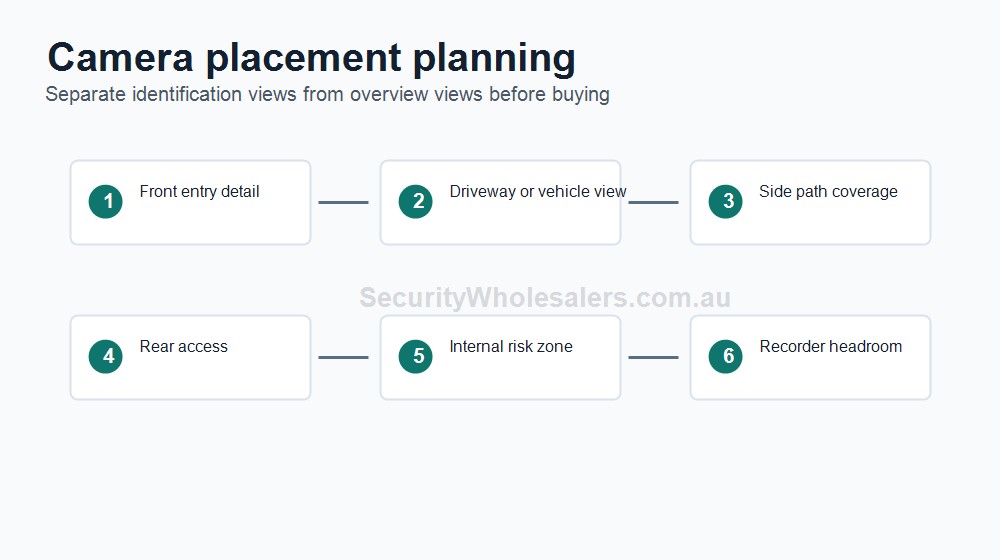
Before choosing the position, decide what the camera needs to answer later. Does the site need to identify a face at a front door, understand how a vehicle entered a driveway, review shop-counter interaction, or check whether someone approached a server room or loading dock after hours? Those are different placement tasks, and they usually need different angles, heights, and lenses.
| Review question | What the camera usually needs | Common mistake |
|---|---|---|
| Who came to the front door? | Clean face angle plus enough approach context | Mounting too high or using a lens that is too tight |
| How did the vehicle enter the driveway or gate? | Approach view, movement direction, and night performance | Only capturing a distant overview with no useful detail |
| What happened at the counter or reception desk? | Stable fixed coverage of interaction zone | Trying to cover too much of the room in one shot |
| Who used the rear door or loading point after hours? | Threshold coverage, approach line, and stronger night behaviour | Mounting the camera where bins, roller doors, or walls create glare or dead space |
| Did someone move through a blind side path or gate line? | Scene-specific angle that sees the actual path of travel | Wide overview that misses the approach edge entirely |
Front door placement
The front door is one of the most common places where buyers overestimate a tighter lens. A 4 mm lens can sound appealing because it sounds more zoomed in, but on many homes and small businesses it is too tight if the camera is close to the doorway or mounted on a narrow frontage. The result can be a cropped view that misses how the person approached, fails to show what happened just before the knock, or cuts off the shoulders and movement path at the moment you most want context.
Many front doors work better with a wider lens and a better mounting angle than with a tighter lens. If the front approach is short, the camera is close to the door, and the owner wants to review both the face and the way the person arrived, a wider view is often the stronger choice. A tighter lens may still suit a deeper set-back entry or a longer path, but it should be chosen because the geometry supports it, not because it sounds more impressive.
Example: townhouse front entry where a 4 mm lens would have been wrong
Situation: A townhouse owner wanted clear footage of visitors at a front door only a few steps back from the street path.
Solution used: The camera was placed to capture both the face at the door and the short approach line, using a wider field of view instead of a tighter 4 mm-style framing.
Why this was chosen: The tighter view would have cut away too much of the approach and left the owner with a narrow door-only image that missed the context of arrival.
Installation notes: The more useful change was not a bigger spec. It was getting the height and angle right so the camera saw the face properly instead of looking steeply down.
Driveway and garage placement
Driveways need more than a general front-yard overview. A useful driveway camera should help the user understand vehicle arrival, pedestrian movement near the vehicle, and any interaction at the garage, roller door, or side gate. The right angle often depends on whether the driveway is deep and narrow, short and wide, or shared with another lot or access path.
Garages and roller doors are common glare points at night. White panel doors, polished vehicles, and wet concrete can all change the result. This is why the driveway camera should not just be placed where it is easiest to cable. It should be placed where the night behaviour and the scene geometry still make sense.
Side access and blind spots
Side paths, service lanes, and narrow side access points are some of the most common blind spots on both homes and commercial sites. They are often approached at night and often missed by broad front or rear cameras. The placement question is usually whether the camera should look along the path, across it, or back toward the gate or access point depending on where the review value sits.
A side-path camera should not be so high or so wide that it only sees a thin strip of movement at the edge of the frame. A narrower, better-aimed view is often more useful than a wider shot that technically includes the path but provides weak detail where the person actually walks.
Backyard, gates, and after-hours approaches
Rear yards and gates often become more about after-hours movement than daytime activity. This can change both the placement and the camera type. A selective deterrence feature may be useful at a rear gate or side gate where after-hours trespass is the main concern, but it does not need to be used everywhere.
Gate scenes also vary. Sometimes the camera should favour identity at the pedestrian gate. Sometimes it should favour vehicle movement or approach review. A straight-on gate shot is not always the best answer. In many cases a slightly offset angle gives a better sense of movement and makes the footage easier to review later.
Example: rear gate and side lane on a small cafe
Situation: A cafe had no issue at the front counter, but repeated after-hours tampering near the rear gate and side service lane.
Solution used: The placement focused on the lane approach and gate threshold rather than trying to watch the whole rear yard with one wide shot. A deterrence-capable camera was reserved for this one higher-risk point.
Why this was chosen: The after-hours risk was concentrated on a predictable entry line, so one better-placed rear camera added more value than changing the whole system.
Installation notes: The camera angle avoided direct glare from nearby metal surfaces and bins, which would have weakened the night result.
Shop counter and reception placement
Counters, front desks, and reception areas usually need stable fixed coverage rather than broad room shots. The footage should show who approached, how the interaction unfolded, and what happened at the handover point. Trying to capture the whole shop, waiting room, and counter in one camera often leads to a wide scene with weak detail exactly where the interaction happened.
For a shop counter or office reception, it is often better to separate the front-door approach view from the interaction view. That way one camera answers the arrival question and the other answers the interaction question.
Warehouse docks, loading aprons, and car parks
Loading docks and car parks are scene-geometry problems as much as they are security problems. A dock camera needs to consider vehicle size, roller-door movement, pedestrian crossover, and whether the main issue is arrival review, loading conduct, or after-hours intrusion. Car parks often need different treatment again because vehicle lanes, parked cars, pedestrian movement, and lighting levels vary across the space.
On broader scenes, varifocal cameras or a more deliberate combination of fixed and motorised views can be more useful than trying to force one fixed camera to solve every part of the space.
Camera height and angle
There is no single perfect mounting height for every scene, but many poor systems share the same problem: the camera is mounted too high and ends up looking down at the tops of heads. Height should balance protection of the device with the need for a useful review angle. The scene should still show what the person looked like and how they moved through the area.
The camera also needs to be angled for the likely incident path. A front-door camera, a driveway camera, and a counter camera should not all be treated as if they want the same down-angle or same width.
Deterrence features and when placement changes
Deterrence features such as strobe, white light, and spoken warning can affect placement because they are usually used on the scenes where the site wants a more obvious after-hours response. That often means rear doors, side lanes, isolated car parks, gates, remote sheds, or other predictable trouble points. It does not mean every scene should use a deterrence camera.
Where deterrence is used, the installer should still think about the practical consequences: where the light will spill, what reflective surfaces are nearby, whether the audio warning is useful, and whether the feature will create nuisance behaviour or simply be ignored.
Privacy mistakes
Placement mistakes are not only technical. They can also be privacy mistakes. Cameras that look too far into neighbouring property, unnecessary internal staff areas, meeting rooms, shared residential circulation, or private windows can create problems even if the image quality is excellent.
The stronger approach is to keep the camera tied to the actual purpose of the scene. If the question is front-door arrival, cover the front-door arrival. If the question is common-property gate use, cover the gate and the immediate approach. Do not expand the field of view simply because the camera can see more.
When to use a fixed lens and when to use a varifocal camera
Fixed-lens cameras often suit predictable scenes such as front doors, rear doors, side paths, counters, and straightforward gates. Varifocal cameras become more useful where the scene is awkward, long, broad, or mixed in depth and the installer needs to tune the shot on site. That often applies to warehouse docks, broad driveways, loading aprons, car parks, and some larger commercial entries.
If the site is already saying "we can probably work out the zoom later" or "the scene is a bit awkward", that is usually a sign the placement question and the lens question should be solved together rather than forcing a simple fixed-lens answer.
Example: warehouse dock with mixed vehicle and staff movement
Situation: A warehouse needed review of a roller-door dock, forklift crossover, staff door, and the outside loading apron.
Solution used: The design separated the staff-door review from the broader dock scene and used a more tunable camera on the wider loading area rather than relying on one basic fixed overview.
Why this was chosen: The dock and apron were mixed-depth scenes with very different movement paths. One generic fixed shot would have left too much dead space and not enough usable detail.
Installation notes: The dock camera was positioned to avoid being blocked by roller-door structure and to reduce night glare from nearby truck surfaces.
Useful next guides
- CCTV Buying Guide Australia
- Best Home CCTV System Australia
- CCTV Systems for Small Business
- Office CCTV Systems Australia
- Retail Entrances, Checkouts, and Service Counters
- Warehouse CCTV Coverage Zones and Camera Placement
- Petrol Station CCTV Coverage Zones and Camera Placement
- Pharmacy CCTV Coverage Zones and Camera Placement
- Strata Car Parks, Driveways, and Gates
Frequently Asked Questions
-
What is the most important rule in camera placement?
Place the camera to answer a specific review question later. A camera should be positioned around the scene, angle, height, and likely incident path rather than simply mounted where it is easiest.
-
Why is a 4 mm lens often wrong for a front door?
A 4 mm lens can be too tight if the camera is close to the front door or mounted on a narrow frontage. It may miss the approach path, cut off shoulder movement, or fail to show how the person arrived at the door. Many front doors suit a wider view unless the geometry clearly supports a tighter lens.
-
How high should a security camera be mounted?
There is no single height for every scene. The right height depends on the task, but many poor results come from mounting cameras too high and losing facial detail. The camera should usually be high enough to protect the device but low enough to keep a useful review angle.
-
Should I use deterrence cameras everywhere?
Usually not. Deterrence features such as strobe or spoken warning are usually strongest on selected after-hours risk points like rear doors, side lanes, gates, isolated car parks, or remote edges rather than every camera on the site.
-
What is the biggest camera placement mistake?
Mounting the camera where it is convenient rather than where the scene actually works. That often leads to cameras looking down at the tops of heads, wide scenes with no useful detail, or blind spots at the point where incidents actually happen.
-
Should a camera look straight at a gate or across it?
Often a slightly offset view works better than a straight-on wide shot. The best gate view depends on whether the main task is identity, vehicle movement, approach review, or after-hours intrusion.
-
How do I avoid privacy mistakes with camera placement?
Keep the camera tied to a clear purpose, avoid covering more private space than necessary, and review side boundaries, neighbouring windows, shared access ways, and internal staff or resident areas carefully before finalising the position.
-
When should I use a varifocal camera instead of a fixed lens?
A varifocal camera becomes useful when the scene is awkward, long, wide, or mixed in depth and the installer needs tuning flexibility on site. Fixed lenses are often fine where the scene is short, stable, and predictable.
SecurityWholesalers product paths for Security Camera Placement Guide
Use these product paths as a practical starting point after the buying logic is clear. The right product list should follow the site design, not replace it.