












Commercial
Uniview PTZ Buying Guide
Specialist CCTV
Quick answer
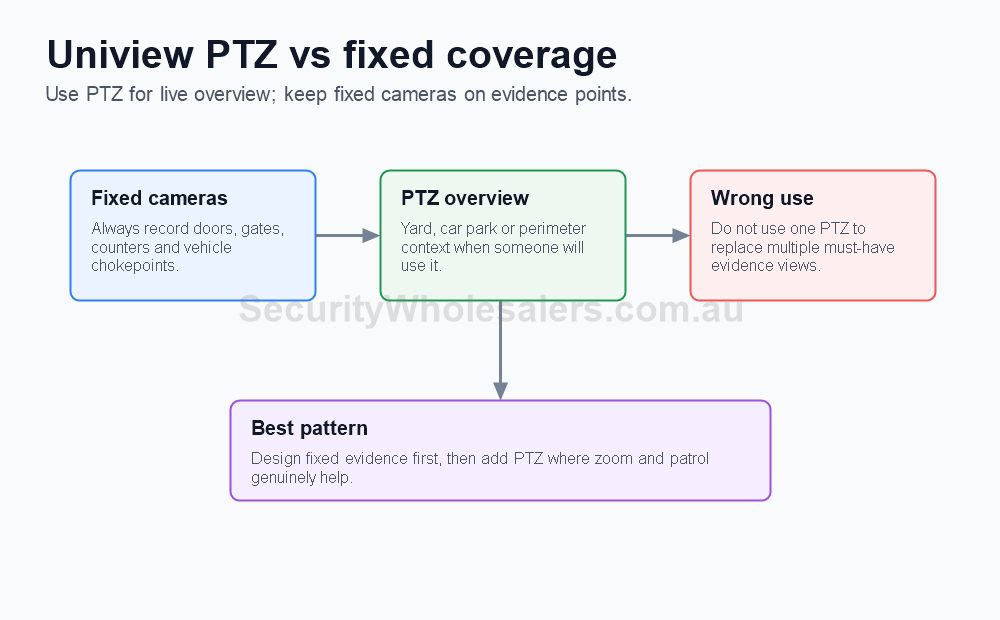
Buy a Uniview PTZ when the site genuinely needs live overview, zoom, or patrol presets across a broad space. Do not buy one just because the site feels large. Many jobs improve more by adding two or three better-placed fixed cameras than by adding one PTZ.
What PTZ adds that fixed cameras do not
A PTZ adds live steering, presets, tours, optical zoom, and flexible follow-up viewing. That makes it useful on car yards, transport edges, larger hospitality venues, broader forecourts, school grounds, and commercial sites where someone will actually use the PTZ to review a live scene.
What it does not change is the need for fixed evidence cameras at gates, doors, counters, dispatch points, roller doors, or plate-capture lanes.
5x vs 25x vs larger PTZ paths
| PTZ path | What it usually means | Common fit |
|---|---|---|
| 5x to 10x compact PTZ | Shorter-range overview with easier mounting and lower complexity | Compact car yards, hospitality entries, school courtyard edges, smaller forecourts |
| 20x to 25x external PTZ | More serious zoom range for wider yards and longer sight lines | Trade yards, transport depots, medium industrial exteriors, larger schools |
| 30x and above | Longer-range specialist PTZ where the scene and mounting position truly justify it | Large campuses, open perimeter scenes, specialist external monitoring |
Recommended buying paths
Compact PTZ path
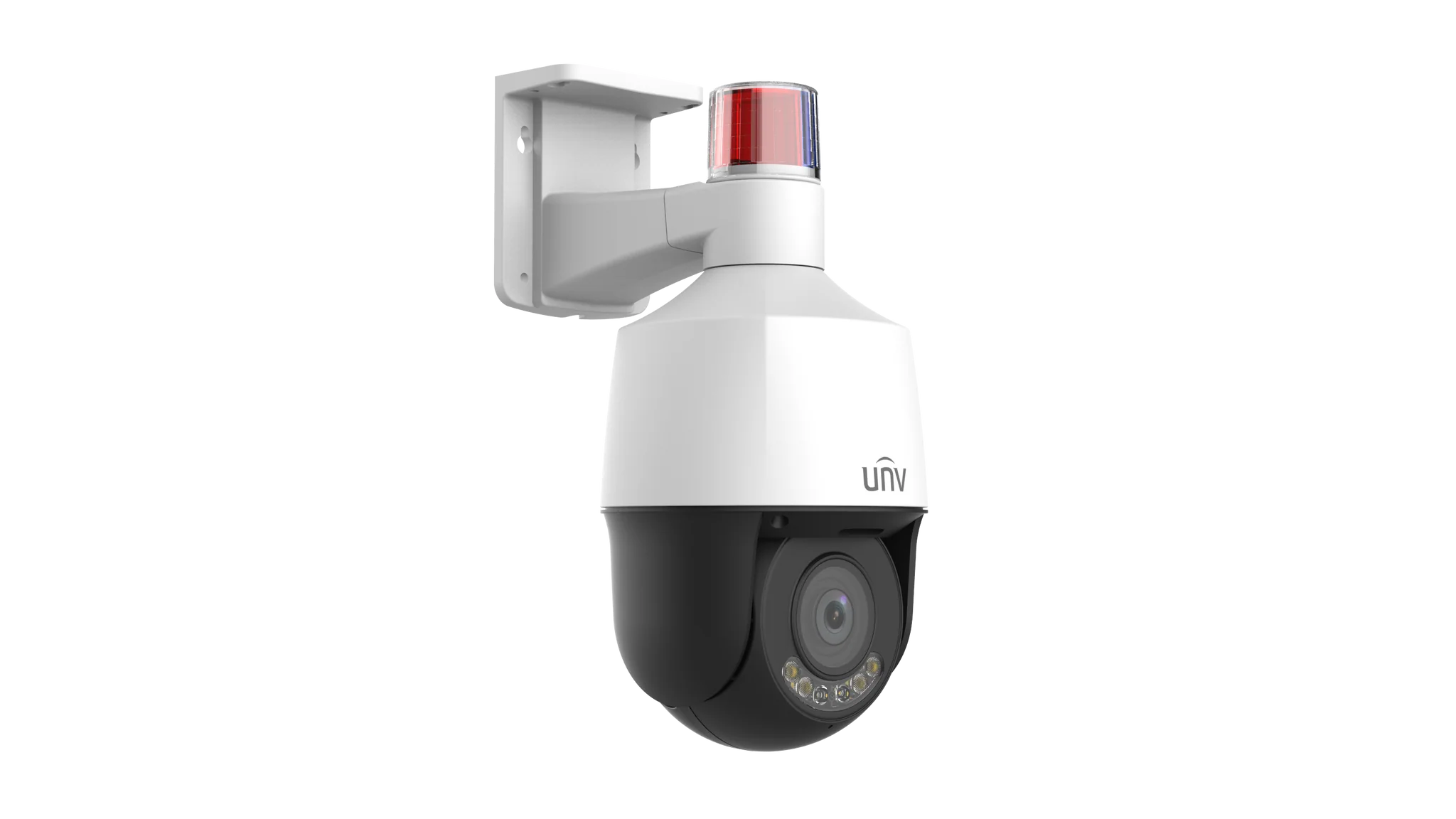
IPC6324LWH-AX5C-VG2 is the cleaner starting point when the site wants live overview plus a more obvious deterrence layer on a compact frontage or yard.
Longer-range PTZ path
IPC6424SR-X25-VF-B is the more serious external path when the site has distance, open space, and a genuine reason to zoom further.
Best support camera pairing
Pair PTZ with fixed turrets or bullets on the gate, office entry, loading point, or plate-capture lane so the site always has a stable evidence view.
Best buyer type
PTZ suits sites with active operators, larger exteriors, or real operational review. It is a poor first buy for simple passive-review jobs.
Where Uniview PTZ usually fits best
| Site type | PTZ role | What still needs fixed cameras |
|---|---|---|
| Car yard | Broad frontage and row overview | Entry gate, office door, key handover points |
| Transport depot | Yard follow-up and dispatch overview | Gate lanes, dispatch office, loading points |
| School or campus edge | After-hours review of wider open areas | Gateways, reception edge, walkway entries |
| Hospitality or event venue | Open forecourt or broad public-area overview | Entry doors, counters, cash points, service doors |
Dealer yard frontage
A compact car yard can justify a small-to-mid PTZ if staff regularly review test-drive departures, late-night vehicle activity, or customer movement across a broad frontage. It still needs fixed cameras at the entry gate and office door because the PTZ cannot be everywhere at once.
School grounds overview
A school can justify a PTZ on the main external grounds if staff want a live overview of a broader field edge, drop-off lane, or open area after hours. It should still be treated as a support view. The gates, reception edge, and walkway entries still need fixed evidence cameras.
Where PTZ is the wrong first answer
A small business with one front door, one rear lane, and a car park usually improves more with two fixed cameras than with one PTZ. If the owner mainly wants dependable playback rather than live steering, a PTZ is often just a more expensive distraction.
Mounting and installation notes
- Wall or parapet mounts are common on building edges looking across aprons, forecourts, and yards.
- Pole mounts make more sense where the PTZ needs a clearer central vantage point.
- Pendant or ceiling mounts are usually for internal open spaces or large covered zones.
- Check the sightline before buying more zoom. If trees, rooflines, trucks, or awnings block the scene, the extra zoom will not fix the layout.
Common PTZ mistakes
- Using PTZ instead of enough fixed cameras.
- Buying more zoom than the site can realistically use.
- Mounting too low so the PTZ is easy to tamper with or blocked by vehicles.
- Ignoring preset and patrol planning during commissioning.
Related Uniview guides
How to Choose a Uniview Camera
Use this next if the project still needs the fixed camera structure built around the PTZ.
How to Choose a Uniview NVR
Use this next if adding PTZ has pushed the recorder and storage plan upward.
Uniview 2026 Camera and NVR Reference Points
Turn the PTZ conversation into a current-model shortlist.
How to Install Uniview CCTV Systems
Commissioning, mounts, and handover matter more on PTZ than on ordinary fixed cameras.
Frequently Asked Questions
- When is a Uniview PTZ justified?
A Uniview PTZ is justified when the site has a real live-overview role, such as a car yard, transport edge, open forecourt, school grounds, or broader external yard where presets and zoom are actually used.
- What does 5x, 25x, or longer zoom mean in practice?
Zoom only matters when the PTZ has a clear sightline, a realistic mounting position, and a target distance that makes the zoom useful. A larger zoom number alone does not guarantee better results.
- Should a PTZ replace fixed cameras?
No. A PTZ should support fixed evidence cameras rather than replace them. Doors, gates, counters, lane entries, and other event points still need stable fixed coverage.
- Where are Uniview PTZs usually mounted?
Uniview PTZs are commonly mounted on walls, parapets, poles, or pendant arms depending on whether the scene is a yard, facade, forecourt, or open internal space.
- Which Uniview PTZ products are useful reference points?
Useful current references include the IPC6324LWH-AX5C-VG2 compact Tri-Guard PTZ and the IPC6424SR-X25-VF-B longer-range LightHunter PTZ.
SecurityWholesalers product paths for Uniview PTZ Buying Guide
Use these product paths as a practical starting point after the buying logic is clear. The right product list should follow the site design, not replace it.