















Support
Dahua NVR Offline in DMSS
DMSS offline
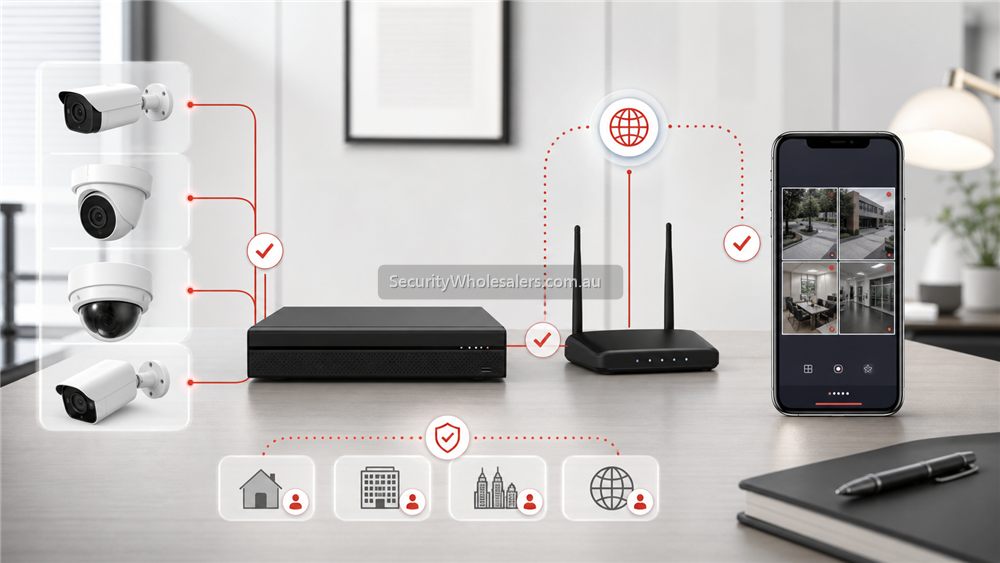
Most common causes
| Cause | What it looks like | What to do |
|---|---|---|
| NVR lost internet | Cameras may still record locally, but DMSS says offline. | Check NVR network cable, router and internet connection. |
| Router or ISP changed | DMSS worked before a modem swap, NBN change or network change. | Check NVR IP, gateway, DNS and platform access status. |
| Platform access disabled | Recorder is online locally but not reachable through DMSS. | Check P2P/platform access is enabled and showing online. |
| Wrong account or device binding | One phone works, another does not. | Check owner account, shared access and user permissions. |
Troubleshooting order
- Confirm the NVR has power and is recording locally.
- Check the network cable from NVR to router or switch.
- Open the NVR network menu and confirm IP, gateway and DNS settings.
- Check platform access/P2P status on the recorder.
- Restart router and NVR in a controlled way.
- Test DMSS on Wi-Fi and mobile data.
- If only one phone fails, check account sharing and app permissions.
Do not delete the device too early
Deleting and re-adding the device can make troubleshooting messier if the issue is platform access, account ownership or a network fault. Confirm the recorder is online at the NVR first, then adjust DMSS.
FAQ
- Can cameras still record if the Dahua NVR is offline in DMSS?
Yes. Remote access can fail while local recording continues, provided the recorder and hard drive are working.
- Why did DMSS stop after a modem change?
The NVR may have lost correct gateway, DNS or platform access connectivity after the network changed.
- Should I port forward Dahua for DMSS?
Most modern simple setups use platform access/P2P. Port forwarding should be treated carefully and is not the first fix for most buyers.
-
What should I record before changing any settings?
For Dahua NVR Offline in DMSS, record the exact model, firmware if known, current status, precise error wording, screenshots and the last known working condition. Change one item at a time.
-
Should I factory-reset the equipment while troubleshooting?
Not as an early step. A reset can erase network, recording, user, account or integration settings. Use it only with a configuration backup, known credentials and a model-specific recovery plan.
-
How do I confirm the problem is genuinely fixed?
Repeat the original test, then check the relevant local and remote paths separately. For an intermittent fault, monitor through the conditions that previously caused it.
-
What details should I send technical support?
Send the order number if available, exact product models, firmware if known, screenshots or photos, precise error wording, failure times and a short list of completed checks.
-
Should I change several settings at once?
No. Change one item, repeat the same test and record the result. Multiple simultaneous changes make it difficult to identify the fault or safely reverse the change.
Before you start
Record the exact model, version, error wording, affected item and last known working time. Photograph the current state and protect recordings, configuration and account ownership before making changes.
Step 1: Record the exact starting condition
Before changing Dahua NVR Offline in DMSS, reproduce one clear test and write down the affected device, channel or user, the exact error wording, and the last time it worked.
- Photograph the current status or error.
- Record the exact model and firmware or app version.
- Note what changed immediately before the fault.
- Protect recordings, account ownership and the current configuration.
Step 2: Follow the local path described above
Use the recorder, controller or device screen named in this guide before treating the phone app as the cause. Record the status you find before editing it.
- Start at the local device where possible.
- Use the exact channel, door, zone or user involved.
- Compare it with one working equivalent.
- Change one setting at a time.
Step 3: Correct the proven layer only
Keep power, cabling, storage, network, account and app checks separate. Correct only the layer that failed the controlled comparison.
- Resolve physical power or cabling before software.
- Prove local operation before remote access.
- Keep owner and shared-user permissions separate.
- Avoid reset, format or unbind options unless a backup and recovery plan exist.
Step 4: Repeat the original test and document it
Repeat the same test, then verify any local and remote outcomes separately. A saved setting or online icon is not enough on its own.
- Record the successful test time.
- Check the expected log, playback or hardware response.
- Restart only when it is a safe and relevant proof.
- Save the final screenshot with the site handover record.
Common mistakes
- Changing several unrelated settings before repeating the original test.
- Skipping the local device check and relying only on an app symptom.
- Resetting, formatting or unbinding equipment without a backup and ownership record.
- Escalating without the exact model, version, error text and test time.
Compare one failing path with one working path
Situation: One device, channel or user failed while another comparable item still worked.
Solution used: The two paths were compared at the local device first, one meaningful difference was corrected, and the original test was repeated.
Why this was chosen: The comparison isolated the affected layer without disturbing the rest of the system.
Installation notes: The final status, screenshot and test time were added to the handover record.
Troubleshooting table
| Symptom | What to check | What to do next |
|---|---|---|
| The local device also fails | Power, cable, storage or local configuration | Keep the test local and resolve the first failed layer before changing app or cloud settings. |
| Local operation works but the app fails | Ownership, sharing permission, cloud status or remote network | Keep the proven local setup and compare owner versus shared-user access on mobile data. |
| Only one channel, zone, door or user fails | Item-specific schedule, permission, wiring or assignment | Compare it side by side with one working item and change only the meaningful difference. |
| The fault started after another change | Router, password, firmware, account, power or configuration change | Document the last known working state and reverse only the relevant change where safe. |
| The fault is intermittent | Exact time, logs, signal, load, power and environmental pattern | Capture failure times and screenshots so support can correlate the event instead of guessing. |
When to contact support
Contact SecurityWholesalers support when the local result, exact model, firmware or app version and one controlled test are documented but the fault remains. Send the order number if available, screenshots, exact failure time and the checks already completed.
Related support guides
- All Technical Support Guides - Find the matching brand, app, recording, network, alarm, intercom or access-control guide.
Related buying guides
- SecurityWholesalers Buying Guides - Check compatibility and system-design guidance.
- Full Store Directory - Find the relevant product family.