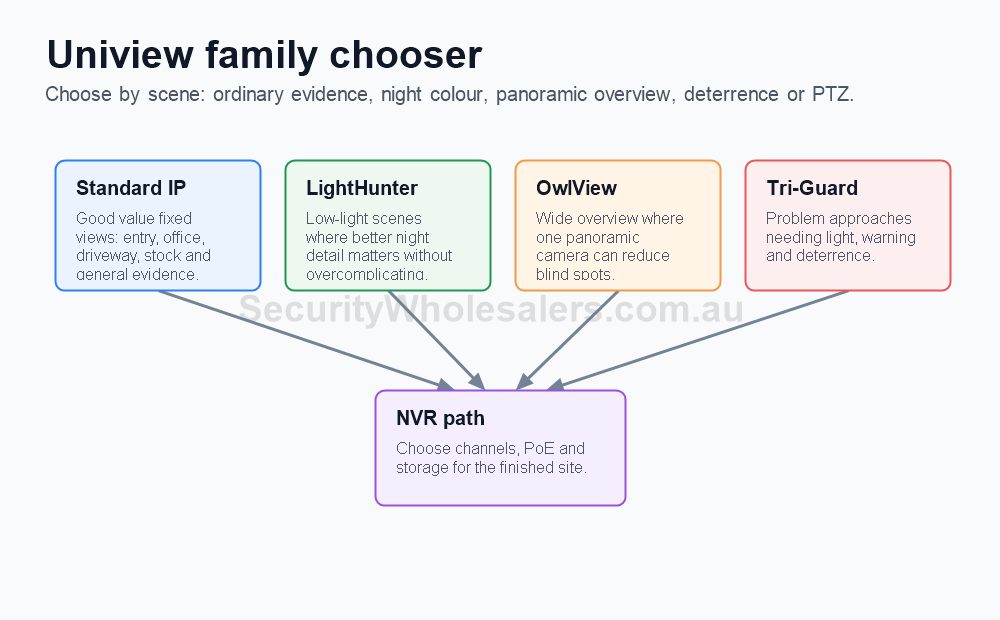
Where Tri-Guard fits
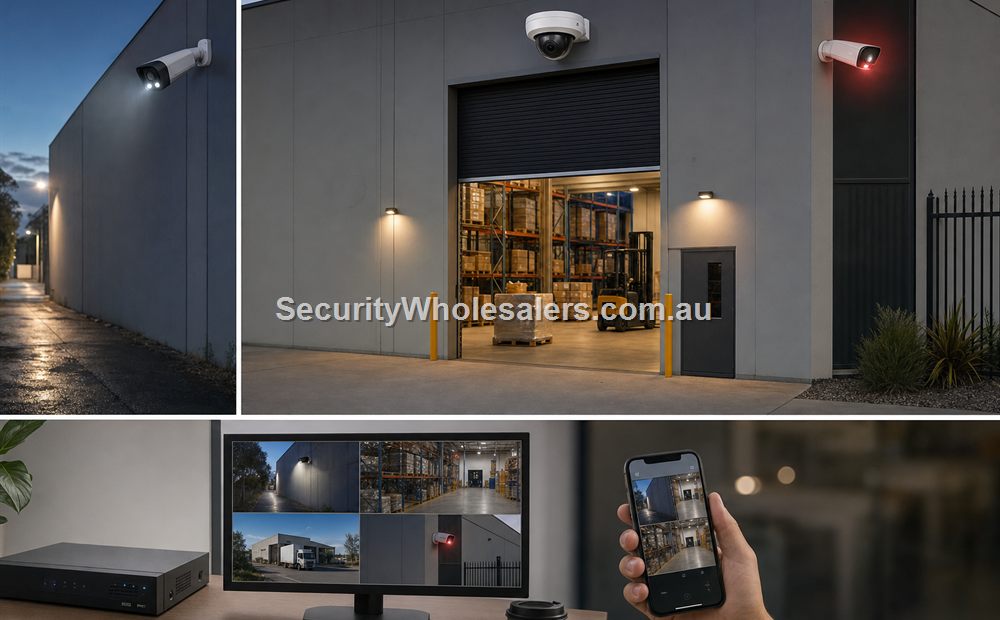
Tri-Guard belongs on selected risk points, not everywhere. It is usually justified on rear doors, side lanes, loading docks, roller-door aprons, gates, and after-hours external positions where visible warning and audio can change behaviour. It is much less useful on every internal corridor or every ordinary parking-bay view. In those scenes it may add cost and complexity without improving the outcome.
Example
Martin's suburban pharmacy
Martin's pharmacy has a front entrance, one dispensary boundary, a rear staff exit, and a small service lane. The entrance and internal areas can stay on ordinary fixed cameras. The rear staff exit and lane are the only places where a stronger night branch or deterrence feature may be worthwhile. That is a much better use of budget than forcing every camera into the premium end of the range.
Example
Nadia's panel workshop
Nadia's workshop has a broad front apron, a roller door, yard parking, and a narrow side passage. The front apron may need either a wider-view fixed camera or a motorised path depending on geometry. The side passage is a better candidate for OwlView or Tri-Guard because it is darker and more vulnerable after hours. The office door and reception counter do not need those stronger branches.
Relevant SecurityWholesalers products
Practical buying scenarios
Small site: choose the simplest camera family that solves the evidence task. Medium site: separate identification views from overview views. Complex site: design the recorder, app handover, permissions and future expansion before choosing the most interesting camera model.
Quote-ready checks
- What exact incident or workflow is this page trying to solve?
- Which views need identification detail and which only need overview?
- Does the recorder or management platform support the finished camera count?
- What must be tested at handover: live view, playback, alerts, export, users and account ownership?
- Where would this system become the wrong choice and need a different product family?
For How To Choose A Uniview Camera, the strongest Uniview quote should read like a site plan, not a box list. It should explain why each camera or recorder path is being chosen, where the buyer should avoid overbuying, and what happens if the site expands later.
Small, medium and complex examples
| Site size |
Practical direction |
What to avoid |
| Small |
Keep the system simple and solve the main evidence points first. |
Buying specialist features before the basic views are right. |
| Medium |
Plan recorder headroom, remote access and stage-two expansion. |
Filling the recorder or ignoring storage assumptions. |
| Complex |
Document permissions, network design, response workflow and handover. |
Choosing models without a support and review plan. |
This extra planning step is often what separates a useful Uniview system from a quote that only looks good on paper.
Buyer field notes
Start with the job: identify the scene, evidence requirement, lighting, recorder size and handover expectation before selecting the model. Avoid the common mistake: buying the most interesting feature before the normal evidence views are solved.
Quote example: a useful system usually has fixed evidence cameras first, then specialist cameras only where they solve a named problem. The recorder and app workflow should support the finished site.
Final buyer rule
The final Uniview choice should stay practical after install: useful views, sensible recorder headroom and a handover the buyer can actually follow.
Buyer field notes
Start with the job: identify the scene, evidence requirement, lighting, recorder size and handover expectation before selecting the model. Avoid the common mistake: buying the most interesting feature before the normal evidence views are solved.
Quote example: a useful system usually has fixed evidence cameras first, then specialist cameras only where they solve a named problem. The recorder and app workflow should support the finished site.
Final buyer rule
The final Uniview choice should stay practical after install: useful views, sensible recorder headroom and a handover the buyer can actually follow.
Buyer field notes
Start with the job: identify the scene, evidence requirement, lighting, recorder size and handover expectation before selecting the model. Avoid the common mistake: buying the most interesting feature before the normal evidence views are solved.
Quote example: a useful system usually has fixed evidence cameras first, then specialist cameras only where they solve a named problem. The recorder and app workflow should support the finished site.
Final buyer rule
The final Uniview choice should stay practical after install: useful views, sensible recorder headroom and a handover the buyer can actually follow.
Frequently Asked Questions
- What is the first useful Uniview camera decision?
The first useful decision is what the camera needs to see and prove later. That normally means deciding whether the scene is a straightforward fixed view, a difficult low-light view, a deterrence position, or a scene that needs motorised framing or PTZ support.
- When is a standard fixed Uniview camera enough?
A standard fixed Uniview camera is enough for many entries, counters, corridors, storerooms, and ordinary perimeter access points where the scene is stable and there is no unusual low-light or deterrence requirement.
- When should buyers step into OwlView or LightHunter?
Buyers should step into OwlView or LightHunter when the site has genuinely difficult low-light views and ordinary IR footage is likely to be disappointing or less useful in review.
- When does Tri-Guard make sense?
Tri-Guard makes sense on selected after-hours risk points such as rear doors, gates, side lanes, and loading aprons where visible warning and audio response are useful rather than intrusive.
- Is 8MP always the right Uniview camera choice?
No. 8MP can be very useful, but the better decision depends on lens, scene width, night conditions, mounting position, and whether the site will actually benefit from the extra detail.
- Which Uniview products are useful current camera reference points?
Useful current reference points include the IPC3618LE-ADF28K-GM fixed 8MP eyeball, current OwlView fixed cameras, selected LightHunter bullets or turrets, and newer Tri-Guard fixed cameras.
How to quote How To Choose A Uniview Camera properly
The practical value of How To Choose A Uniview Camera comes from how well it solves model selection on a real Australian site. A strong recommendation should talk about camera body, lens width, mounting height, night performance, analytics, recorder compatibility and support expectations, because those details decide whether the system is useful after the installer leaves.
Choose the body and lens for the scene first, then compare feature families. Megapixels alone do not make a useful security system. This is where a good buying guide should help: it should make the trade-offs visible before the customer spends money, not after the first incident exposes a weak view.
Small site
For a small Uniview How To Choose A Uniview Camera project, focus on the few views that would prove the most likely incident. It is better to have fewer well-planned cameras than more cameras that miss faces, plates, doors or night detail.
Medium site
For a medium How To Choose A Uniview Camera site, separate identification views from overview views. Use stronger cameras where people, vehicles or high-value stock must be identified, and use practical overview cameras where the goal is movement context.
Complex site
For a complex How To Choose A Uniview Camera site, plan the recorder, permissions and expansion path before finalising cameras. Larger jobs often fail because the hardware is good but the storage, network or user workflow was never properly designed.
What a 95/100 Uniview quote should include
- A short explanation of what each recommended camera is expected to prove.
- Enough recorder storage and spare channels for realistic future expansion.
- Notes on night performance, glare, weather exposure, mounting height and service access.
- A simple handover plan covering app access, playback, footage export and user permissions.
For How To Choose A Uniview Camera, the best buying decision is the one that still feels obvious six months later. If the buyer can understand why each device was chosen, how footage will be found, and where the system can grow, the quote is far more likely to deliver long-term value.
Final checks before ordering How To Choose A Uniview Camera
Before ordering How To Choose A Uniview Camera, ask the installer or sales team to describe the weakest part of the proposed design. That question is useful because every security system has a trade-off: lens width versus detail, deterrence versus discretion, recorder cost versus retention, or simplicity versus future expansion.
For How To Choose A Uniview Camera, the better Uniview purchase is usually the one with a clear explanation rather than the longest specification sheet. The quote should say which views are for identification, which are for overview, which settings need commissioning, and which parts of the system should be reviewed after the first few weeks of real use.
A final practical check for How To Choose A Uniview Camera is supportability. Choose a system that can be explained to the person who will actually use it: how to open the app, find yesterday's event, export a clip, add a user, and understand when a camera or recorder needs attention. That day-to-day clarity is what separates a decent product list from a genuinely useful Uniview security solution.
How to plan How to Choose a Uniview Camera properly
The practical value of How to Choose a Uniview Camera comes from how well it solves camera placement on a real Australian site. Before comparing model numbers, work through lens width, mounting height, blind spots, night glare, service access and evidence quality. Those details decide whether the system is useful in six months or merely impressive on the day it is installed.
Placement should be decided by what the footage must prove, not by where the wall happens to be easiest to reach. A strong quote should explain which parts of the job are essential, which parts are optional, and where spending extra will actually improve evidence, safety, access control or response.
Small site
For How to Choose a Uniview Camera, keep the design focused. Cover the highest-risk entry points or workflows first, choose equipment that is easy to use, and avoid adding features that nobody will maintain after handover.
Medium site
Separate critical views or doors from general coverage. Plan users, permissions, storage, power and network paths before filling every channel or controller output.
Complex site
For How to Choose a Uniview Camera, document zones, responsibilities and expansion. Larger sites need a staged design so the system can grow without replacing the recorder, controller, cabling or user workflow too early.
What a 96/100 recommendation should include
- A plain-English description of the incident, access event or workflow the system must solve.
- Enough headroom for likely expansion, extra users, additional cameras, extra doors or future monitoring.
- Installation notes covering cabling, power, mounting, weather, lighting, service access and handover.
- A clear explanation of what the buyer should not overbuy and what would be a false economy.