
















2026 Retail Theft Statistics Australia: Shoplifting, Store Theft & Business Security Trends Leave a comment
2026 Retail Theft Statistics Australia: Shoplifting, Store Theft & Business Security Trends
Retail theft is becoming one of Australia’s most visible business security problems
Retail theft is no longer just an occasional nuisance for shops. For many Australian retailers, it has become a regular operating cost, a staff safety concern and a customer experience problem.
The latest national police-recorded ABS data shows that theft excluding motor vehicle theft reached 595,660 recorded victims in 2024, up 6% from the previous year. This was the highest recorded number since 2003. Importantly for retailers, thefts at retail locations have become a much larger share of the overall theft picture, rising from 31.6% of theft locations in 2010 to 45.1% in 2024.
That means almost half of police-recorded theft incidents, excluding motor vehicle theft, are now connected to retail locations.
This article looks at what the latest Australian retail theft data shows, why the problem matters for small businesses and what retailers can do to improve prevention, evidence quality and staff safety.
Key retail theft statistics
- There were 595,660 recorded victims of theft, excluding motor vehicle theft, in Australia in 2024.
- This represented a 6% increase from 2023.
- The 2024 figure was the highest recorded number since 2003.
- The share of thefts occurring at retail locations increased from 31.6% in 2010 to 45.1% in 2024.
- Residential locations moved in the opposite direction, falling from 29.8% of theft locations in 2010 to 25.2% in 2024.
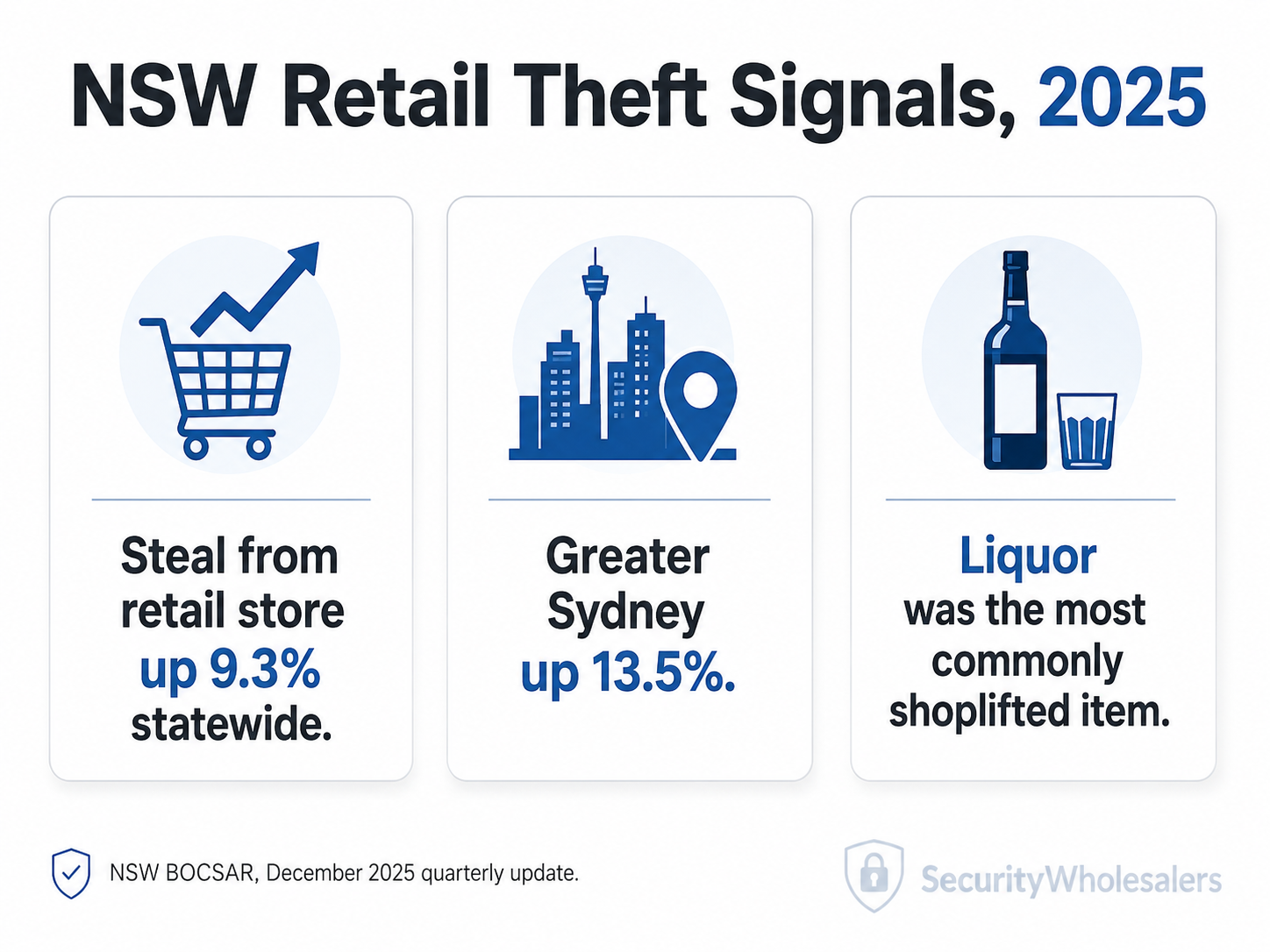
- In NSW, BOCSAR reported that steal from retail store increased 9.3% in the two years to December 2025.
- In Greater Sydney, the increase in steal from retail store was even higher, at 13.5% over the same period.
- BOCSAR reported that in NSW in 2025, the most commonly shoplifted item was liquor.
What counts as retail theft?
Retail theft generally includes shoplifting, stealing goods from a store, leaving without paying, concealing items, scanning cheaper items at self-checkout, staff theft, refund fraud and other dishonest activity involving retail stock or payment.
In ABS recorded crime data, the broader category used is usually theft excluding motor vehicle theft. This category includes thefts such as shoplifting and pickpocketing, but excludes motor vehicle theft. Because the ABS reports location data, we can see how much of this broader theft category is connected to retail locations.
For business owners, the important point is not only the legal definition. The practical issue is whether the store can:
- identify what happened;
- identify who was involved;
- produce useful evidence for police or insurers;
- reduce repeat offending;
- protect staff from confrontation; and
- reduce stock loss without making the store feel hostile to legitimate customers.
Retail theft is taking a larger share of Australian theft
The national ABS data shows a clear long-term shift. In 2010, retail locations accounted for 31.6% of theft incidents. By 2024, that had increased to 45.1%.
Over the same period, residential locations fell from 29.8% to 25.2% of theft locations.
This does not mean homes are no longer at risk. It means that retail premises have become a larger part of Australia’s recorded theft problem. For retailers, the trend is important because it supports what many stores already feel day to day: stock loss, shoplifting and difficult customer incidents are becoming more common and more costly.
Chart 1 — theft locations over time
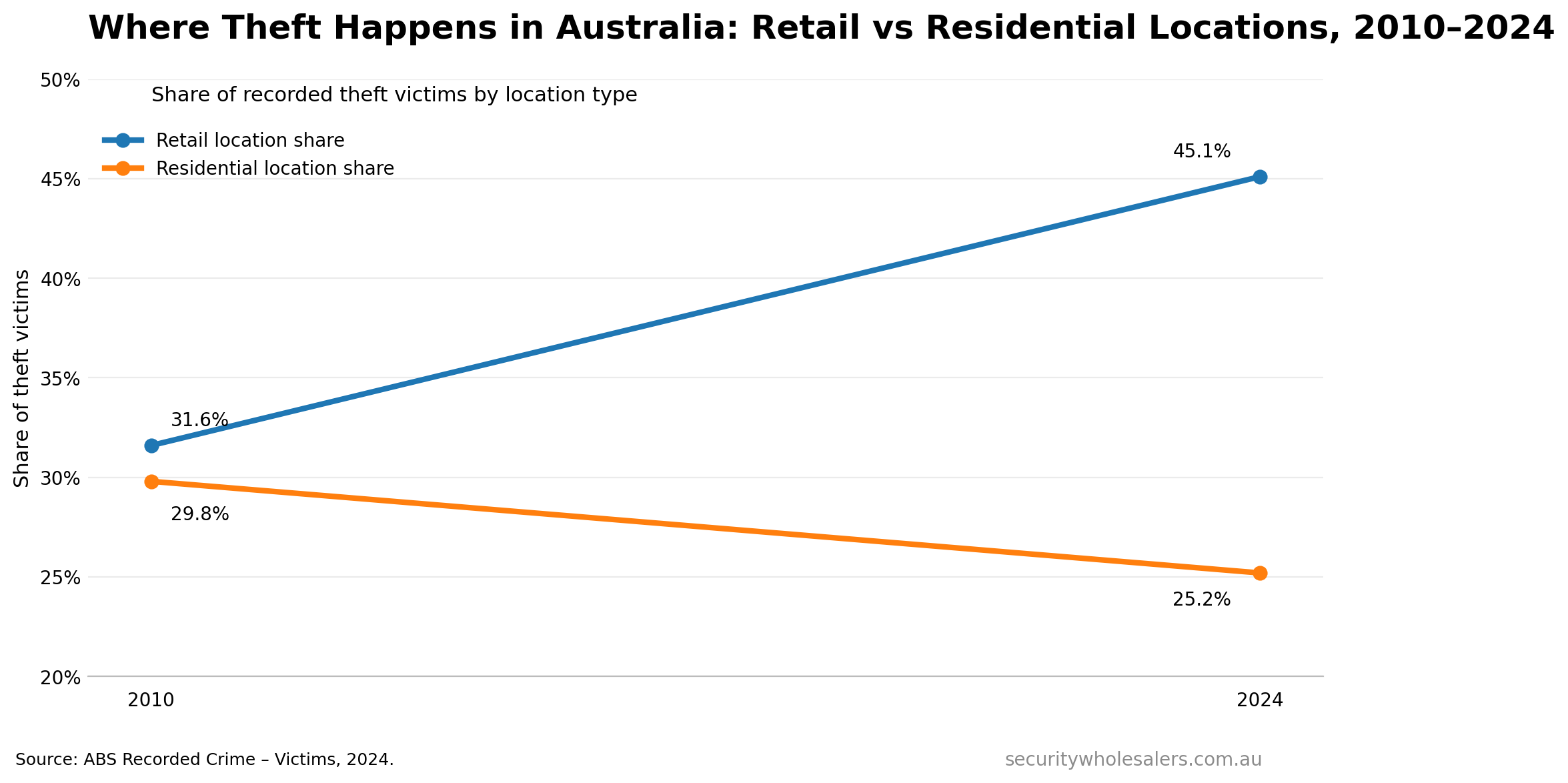
Chart 2 — retail location share
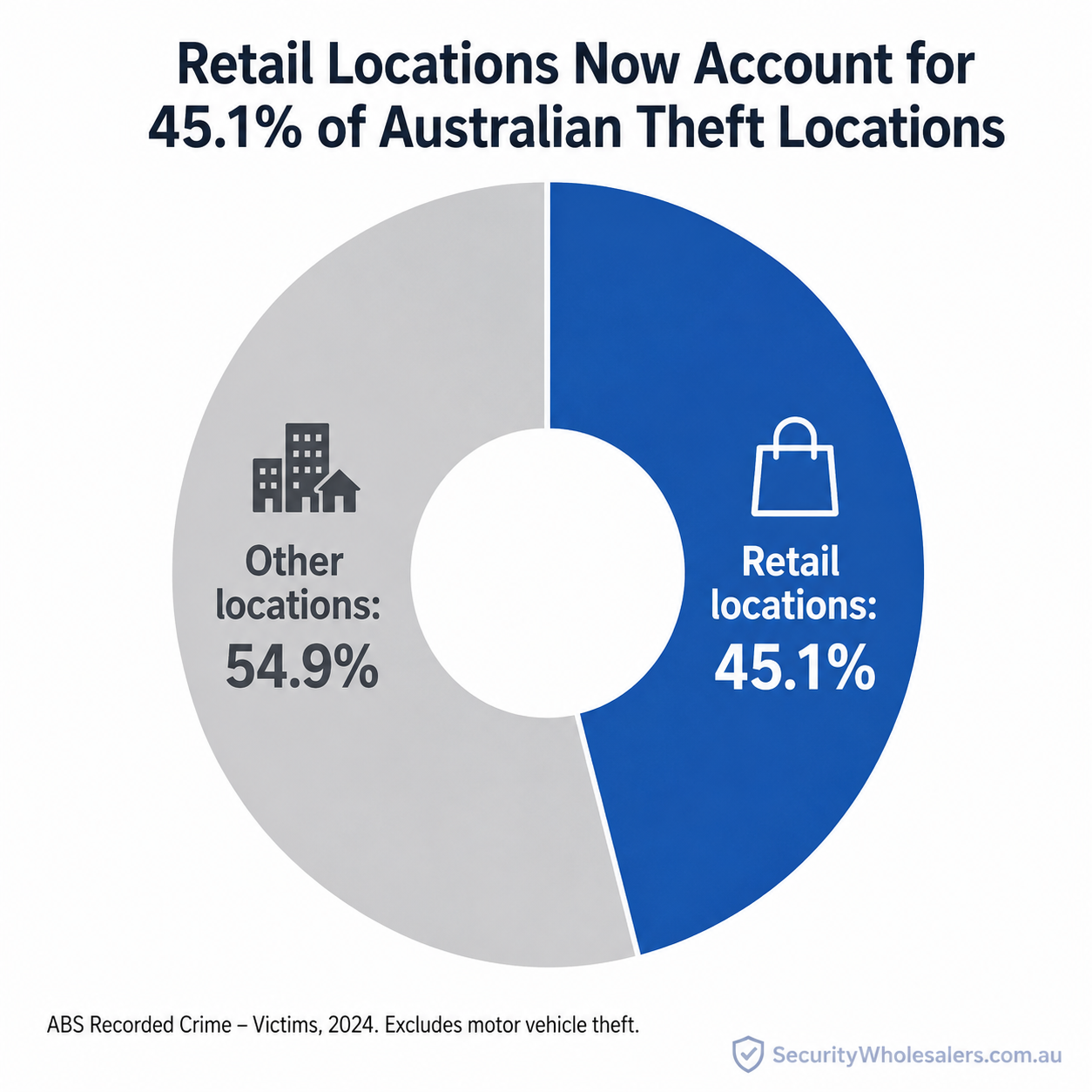
Chart 3 — NSW retail theft signal
NSW retail theft trends show the issue is not evenly spread
State and territory trends can vary significantly, which is why national figures should not be the only source used when assessing risk.
In NSW, BOCSAR reported that steal from retail store increased 9.3% over the two years to December 2025. The increase was concentrated in Greater Sydney, where retail theft rose 13.5%, while Regional NSW remained stable.
This matters for businesses because a retail theft prevention plan for a CBD bottle shop, a suburban pharmacy and a regional hardware store may look different. The products targeted, offender behaviour, staff risk, police response and evidence requirements can all vary by location and store type.
Which retail businesses are most exposed?
Retail theft can affect almost any store, but some businesses are more exposed because they sell goods that are small, easy to conceal, easy to resell or commonly targeted by repeat offenders.
High-risk retail categories often include:
- bottle shops and liquor retailers;
- supermarkets and convenience stores;
- pharmacies and chemists;
- electronics and mobile phone accessory stores;
- tool and hardware stores;
- fashion, footwear and sportswear stores;
- petrol stations;
- tobacconists and vape retailers where legal products are sold; and
- small specialty stores with limited staff coverage.
The issue is often not just one large theft. Many retailers suffer from repeated small thefts that gradually erode margin. A business may also experience aggressive behaviour when staff try to intervene, making staff safety just as important as stock loss.
Why many retail CCTV systems fail when they are needed most
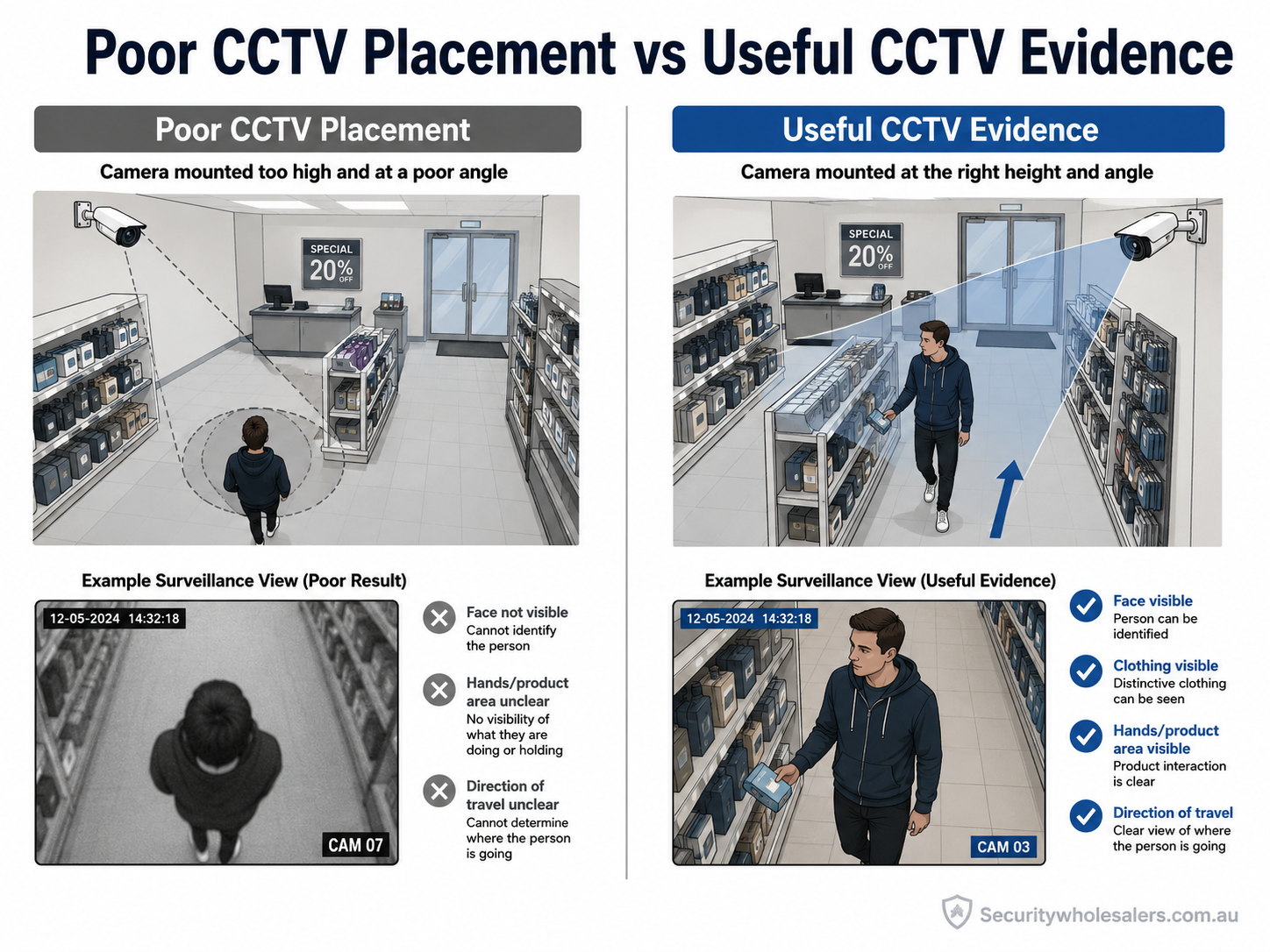
Many retail stores already have CCTV. The problem is that a camera system is not automatically useful just because it records video.
Common CCTV mistakes include:
- cameras mounted too high, only capturing the top of a person’s head;
- cameras pointed at shelves but not the customer’s face;
- poor lighting at the entrance or exit;
- no camera covering the POS area;
- no camera covering self-checkout or high-value product areas;
- wide-angle cameras used where a tighter identification shot is needed;
- recording quality set too low to save storage;
- no audio warning or staff alert process;
- incorrect time and date settings on the recorder; and
- footage overwritten before the incident is discovered.
A good retail CCTV system should be designed around evidence. It should answer five basic questions:
- Who entered the store?
- What did they take?
- Where did they conceal or carry the item?
- Did they pass all points of payment without paying?
- Which direction did they leave?
Best camera positions for retail theft prevention
For most small and medium retail stores, the best CCTV design is a mix of overview cameras and identification cameras.
Diagram 1 — retail CCTV placement
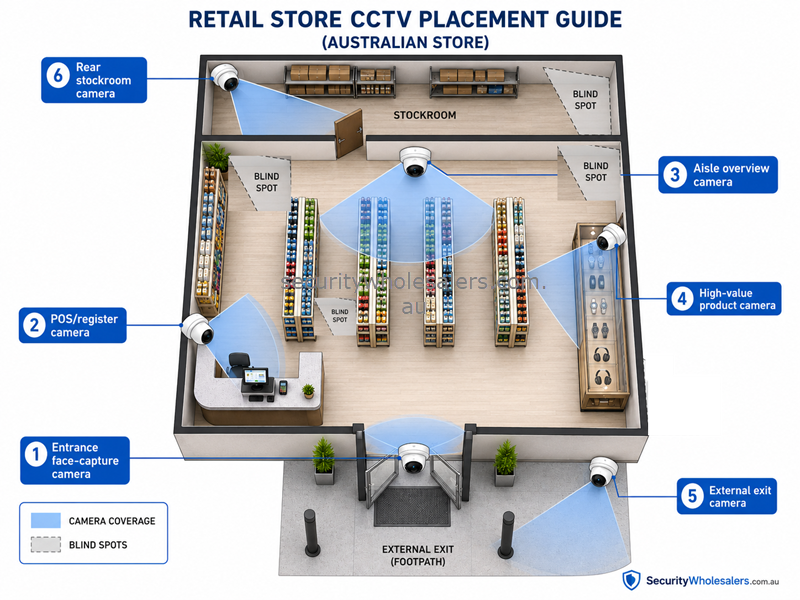
1. Entrance camera
The entrance camera should capture a clear face shot of people entering and leaving. This is often more useful than a ceiling camera over the aisles. Mounting height and angle matter. A camera that only captures hats, hair and shoulders may not be useful for identification.
2. POS/register camera
The register area is a key location for disputes, refund fraud, cash handling, payment issues and aggressive customer behaviour. A dedicated POS camera can help resolve incidents quickly.
3. High-value product camera
Stores should identify their most stolen products and make sure those areas have clear coverage. For a bottle shop, this may be premium spirits. For a pharmacy, it may be cosmetics, fragrances or high-value over-the-counter products. For a hardware store, it may be tools and accessories.
4. Aisle overview cameras
Overview cameras help show behaviour, movement and concealment. They are not always ideal for identifying a face, but they help complete the story of what happened.
5. Exit camera
An exit camera can capture the person leaving, the direction of travel and sometimes a vehicle or number plate if the layout allows.
6. Stockroom and rear access camera
Retail theft is not always customer-facing. Rear doors, staff entrances, loading areas and storerooms should also be protected.
Diagram 2 — poor vs useful evidence
Retail theft prevention checklist
- Place high-value products in areas visible to staff.
- Use entrance cameras for face capture, not just general coverage.
- Keep POS and self-checkout areas covered.
- Use clear signage advising that CCTV is in operation.
- Check that the NVR/DVR time and date are correct.
- Set recording retention long enough for delayed discovery of theft.
- Export important footage immediately after an incident.
- Train staff not to physically confront offenders.
- Keep incident notes with time, date, product, staff member and footage reference.
- Consider alarms, reed switches and back-to-base monitoring for after-hours risk.
- Use good lighting at entrances, exits and rear access points.
- Review camera angles every time the store layout changes.
How security technology can help retailers
Security technology will not eliminate retail theft by itself, but it can reduce opportunities, improve evidence and support staff safety.
Useful options include:
- CCTV with high-resolution cameras: useful for identification and incident review.
- Fisheye or panoramic cameras: useful for small stores needing wide coverage from one location.
- Audio warning cameras: useful in stockrooms, rear entries or after-hours protected areas.
- Alarm systems: useful for after-hours intrusion and staff duress.
- Access control: useful for staff-only areas, storerooms and back-of-house doors.
- Video verification: useful where a monitoring centre needs to confirm whether an event is genuine.
- Cloud or app access: useful for owners managing more than one store.
Important limitations of the data
Retail theft data should be interpreted carefully. Police-recorded crime data depends on incidents being reported and recorded. Some retailers do not report every theft, especially when the value is low or they believe there is limited chance of recovery.
Different data sources can also measure different things. ABS Recorded Crime – Victims is based on crimes recorded by police. Other sources, such as business surveys or insurance data, may measure losses, claims or perceptions of crime. These datasets are useful, but they should not be treated as identical.
Conclusion
Retail theft is now a major part of Australia’s theft landscape. The latest ABS data shows theft excluding motor vehicles at its highest level since 2003, and retail locations now account for a much larger share of theft than they did in 2010.
For retailers, the practical response should be calm and evidence-based. Good CCTV placement, proper lighting, staff procedures, alarm coverage and fast footage export can make a real difference.
The goal is not to turn a store into a fortress. The goal is to make theft harder, evidence clearer and staff safer.