

















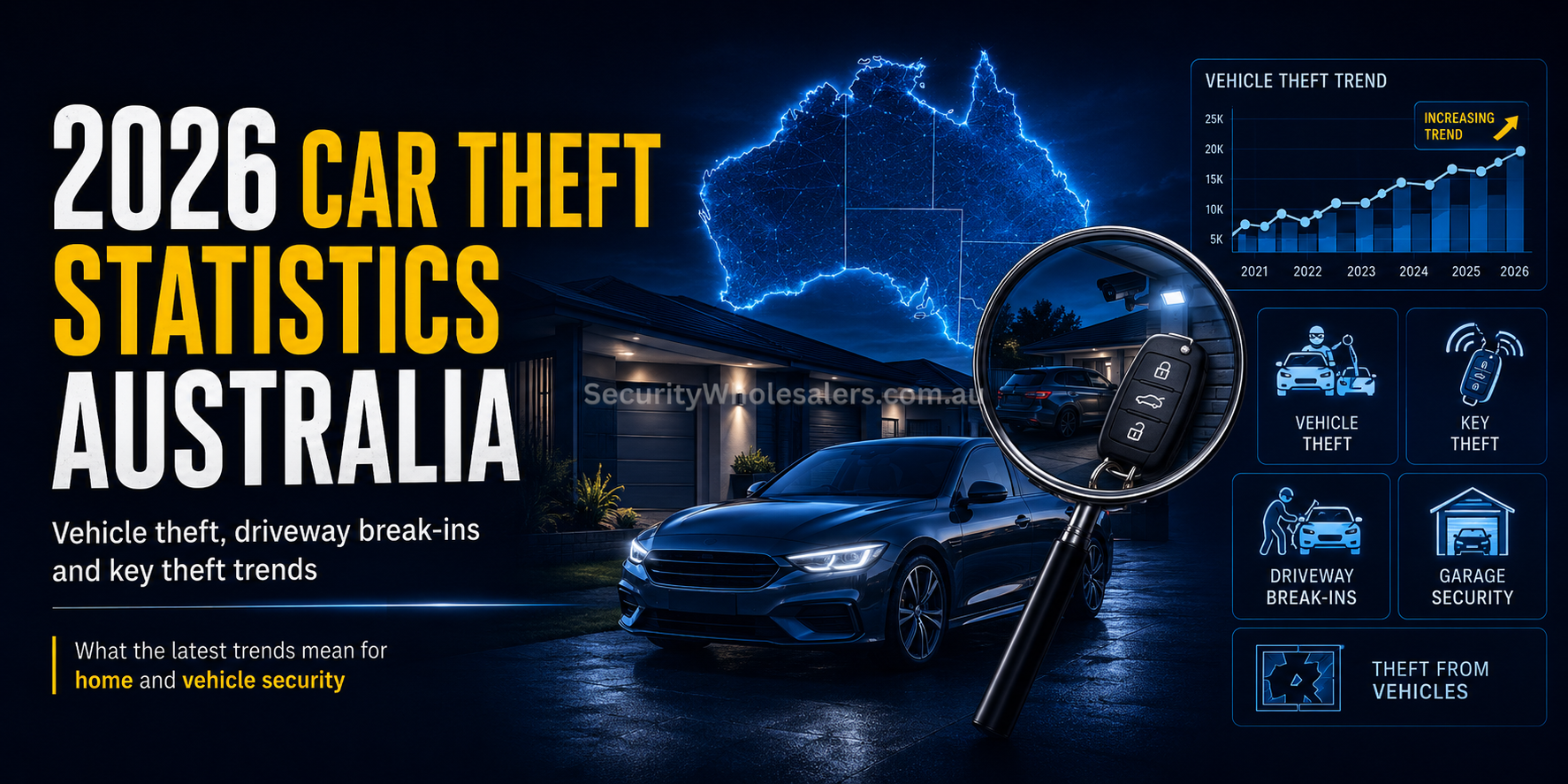
2026 Car Theft Statistics Australia: Vehicle Theft, Driveway Break-Ins & Key Theft Trends Leave a comment
Car theft is not just a street-parking problem
When Australians think about car theft, many picture a vehicle being stolen from a street, shopping centre or public car park. The latest data shows a more complicated picture.
ABS police-recorded data shows there were 65,603 victims of motor vehicle theft in Australia in 2024, an 8% increase from the previous year. Victoria and NSW were the two states that recorded increases, with Victoria up 41% and NSW up 6%.
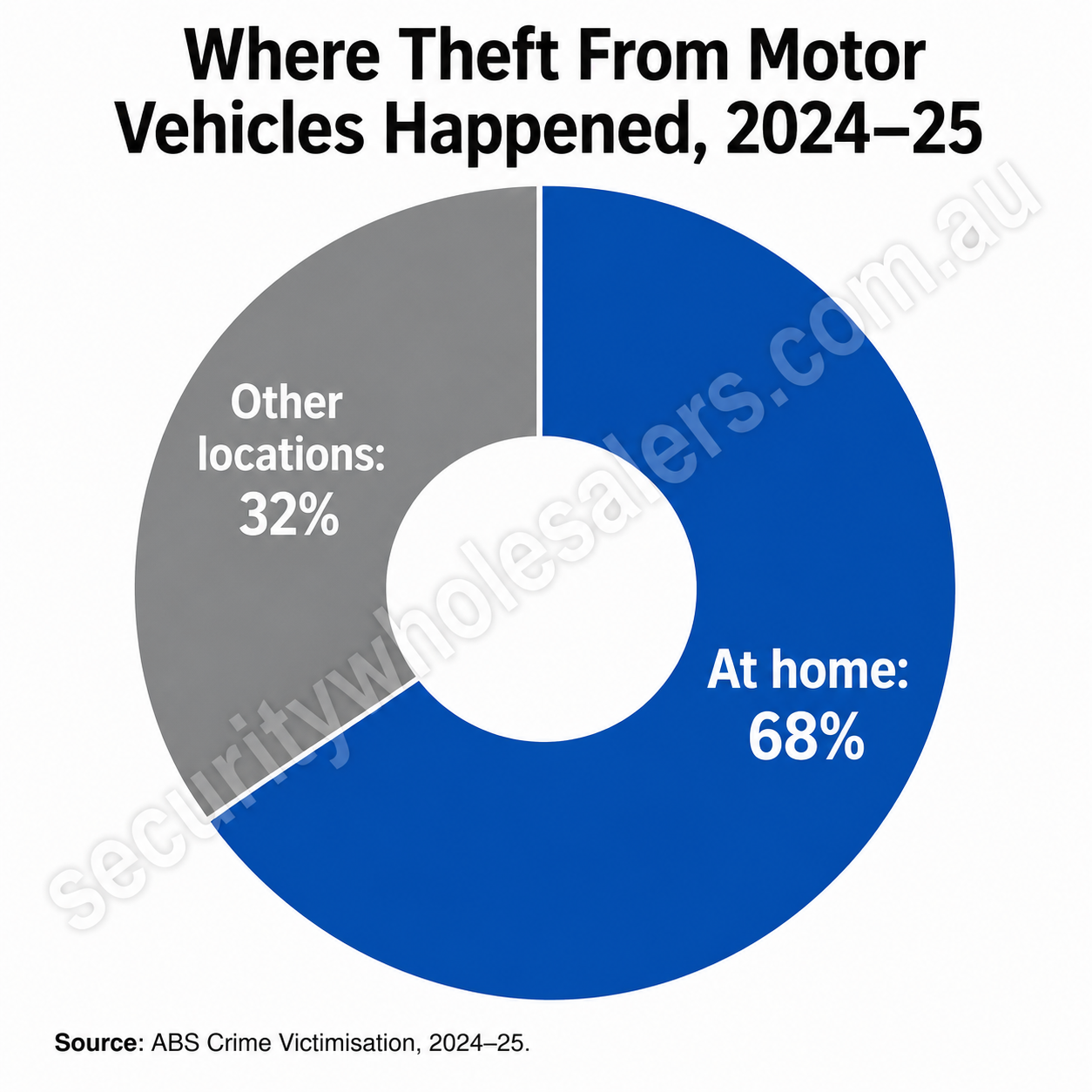
ABS household survey data also shows that car-related crime often happens at home. In 2024–25, an estimated 0.6% of households had a motor vehicle stolen, while 2.2% experienced theft from a motor vehicle. Of the most recent theft-from-vehicle incidents, 68% occurred while the vehicle was at the person’s home.
For homeowners, the message is clear: driveway, garage, carport and front-yard security should be treated as part of the home security system, not as a separate issue.
Key car theft and driveway crime statistics
Chart 1 — motor vehicle theft victims
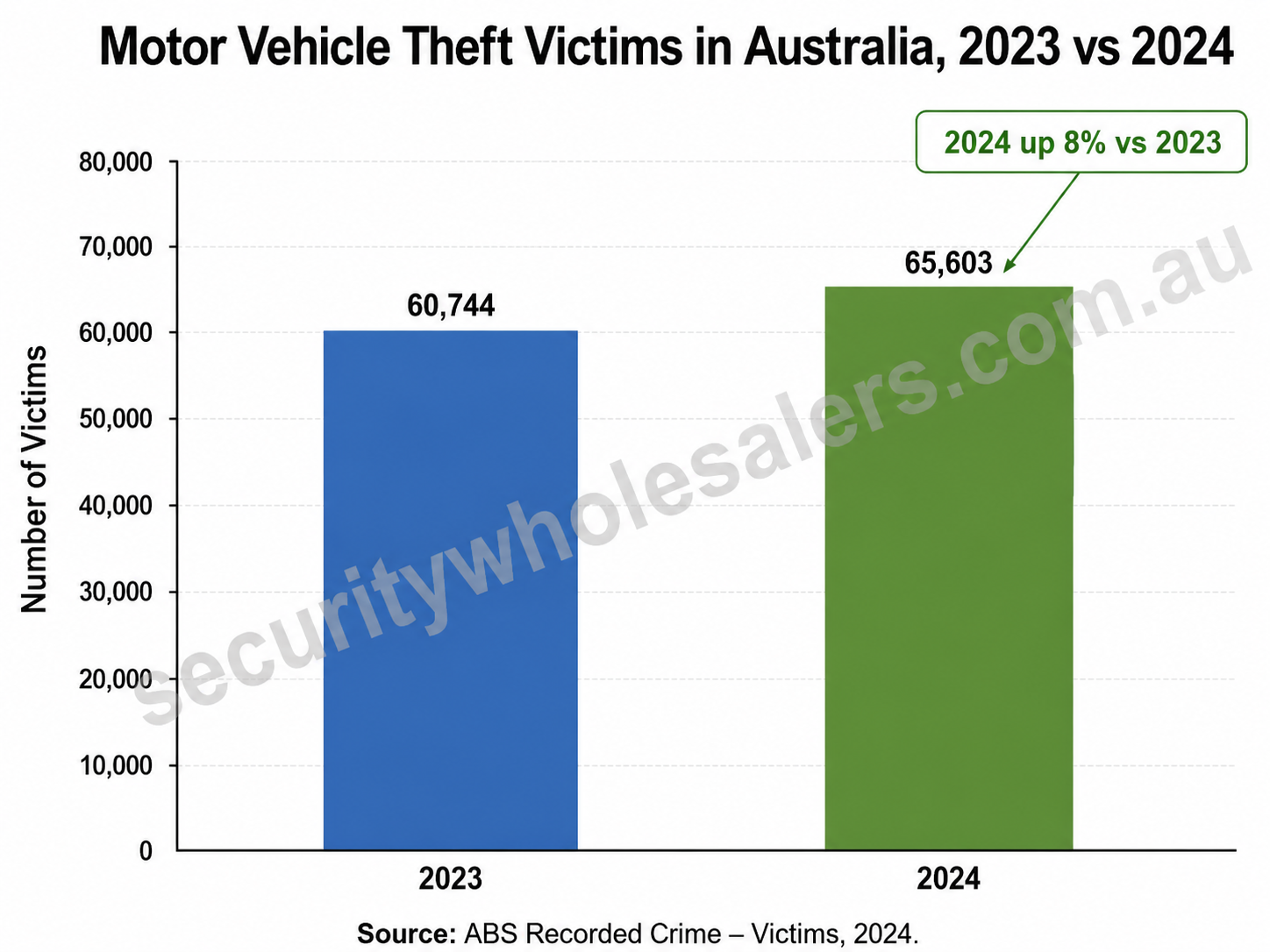
Chart 2 — household vehicle crime
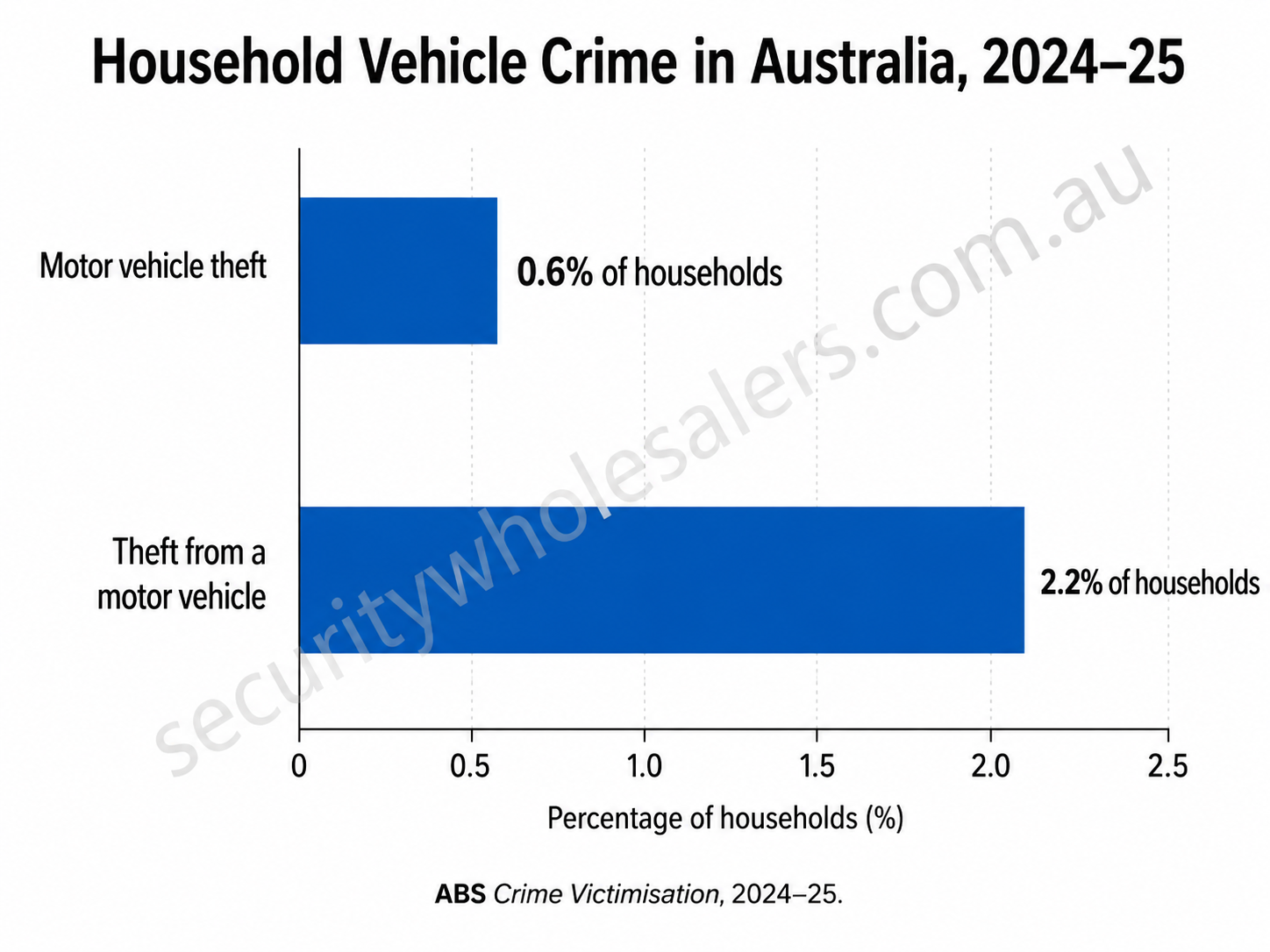
Chart 3 — theft from vehicle happens at home
- There were 65,603 recorded victims of motor vehicle theft in Australia in 2024.
- This was an 8% increase from 2023.
- Victoria recorded a 41% increase in motor vehicle theft victims in 2024.
- NSW recorded a 6% increase in motor vehicle theft victims in 2024.
- In 2024–25, 0.6% of households, or about 64,400 households, experienced motor vehicle theft.
- In 2024–25, 2.2% of households, or about 236,500 households, experienced theft from a motor vehicle.
- 68% of the most recent theft-from-vehicle incidents occurred while the vehicle was at the person’s home.
- For theft from motor vehicles, the most common property stolen included personal items such as jewellery and clothing, and money, purse or wallet.
- Insurance Council data released in 2026 reported Victoria recorded $243 million across more than 12,500 motor theft claims in 2025.
Motor vehicle theft vs theft from a motor vehicle
It is important to separate two different problems:
- Motor vehicle theft: the vehicle itself is stolen.
- Theft from a motor vehicle: property inside or attached to the vehicle is stolen.
Both can happen in driveways, garages, carports and apartment car parks. Both can be costly. But they require slightly different prevention strategies.
Motor vehicle theft often involves access to keys, remotes, garage access, vehicle electronics or unlocked vehicles. Theft from a motor vehicle often involves opportunistic access to visible valuables, wallets, tools, bags, sunglasses, devices or loose change.
Why driveway crime matters
The home driveway is one of the most overlooked parts of residential security.
Many homes have cameras covering the front door but not the driveway. Others have a camera pointed broadly at the street, but not enough detail to identify a person walking up the driveway, trying a car door or entering a garage.
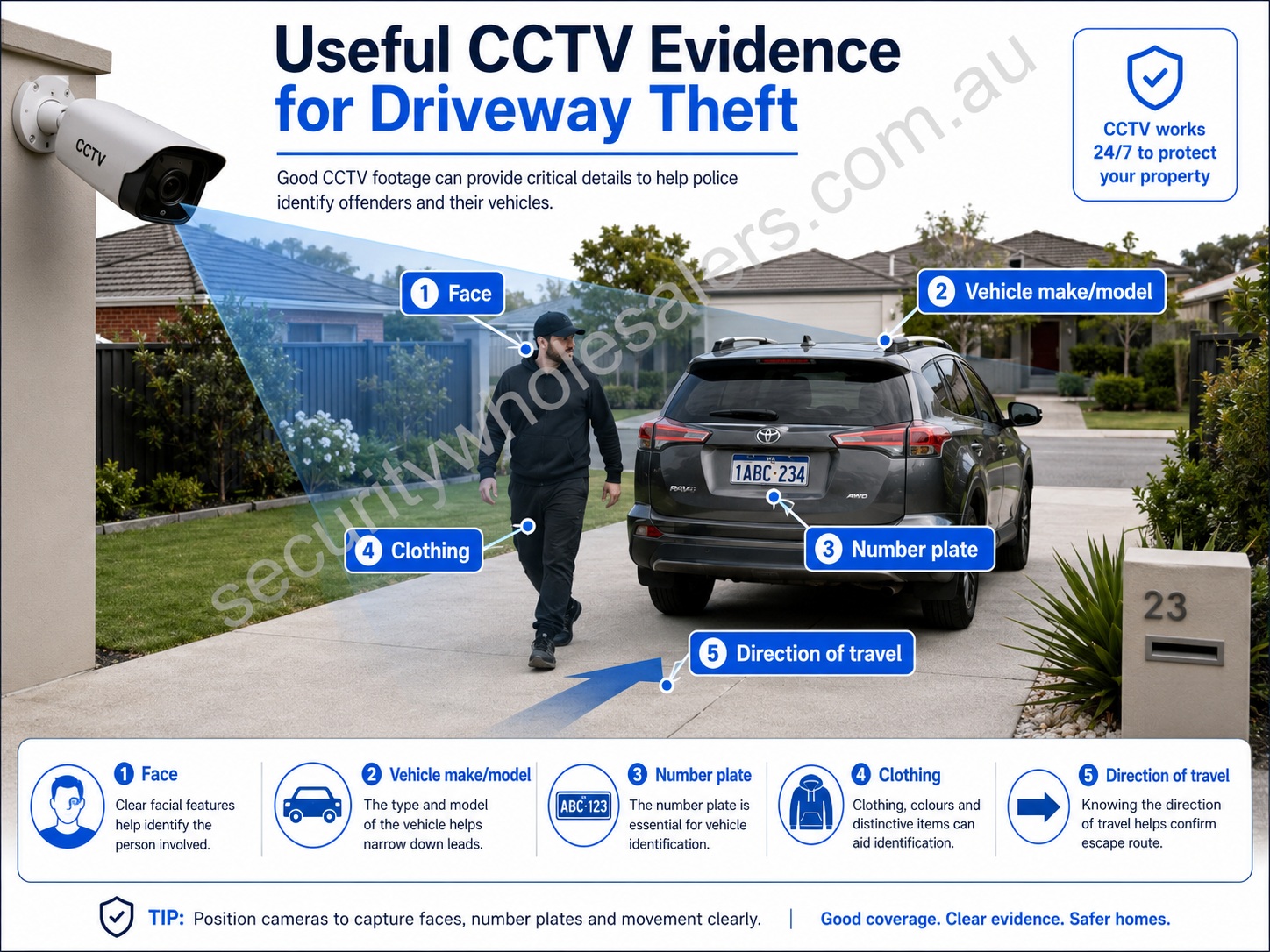
This can leave a major gap. A useful driveway security setup should aim to capture:
- a person approaching the driveway;
- a person entering or leaving the garage or carport;
- the face and clothing of anyone approaching vehicles;
- vehicle make, model and colour;
- number plates where practical;
- direction of travel after the incident; and
- any attempt to access the front door, garage door, side gate or meter box.
Victoria’s car theft problem stands out
National data can hide state-level differences. The ABS Recorded Crime data shows Victoria had 22,504 victims of motor vehicle theft in 2024, up 41% from 2023. This was Victoria’s highest recorded number since 2003, although still below the very high levels recorded in the early 2000s.
Insurance Council material released in 2026 also highlighted Victoria’s position in motor theft claims, reporting $243 million across more than 12,500 claims in 2025 across the analysed states.
This does not mean every Victorian household faces the same risk. Local suburb, parking type, vehicle type, garage access, lighting and security habits all matter. But it does show why homeowners should not assume car theft is only an issue in public car parks or commercial areas.
What thieves steal from cars
Vehicle theft vs theft from vehicle
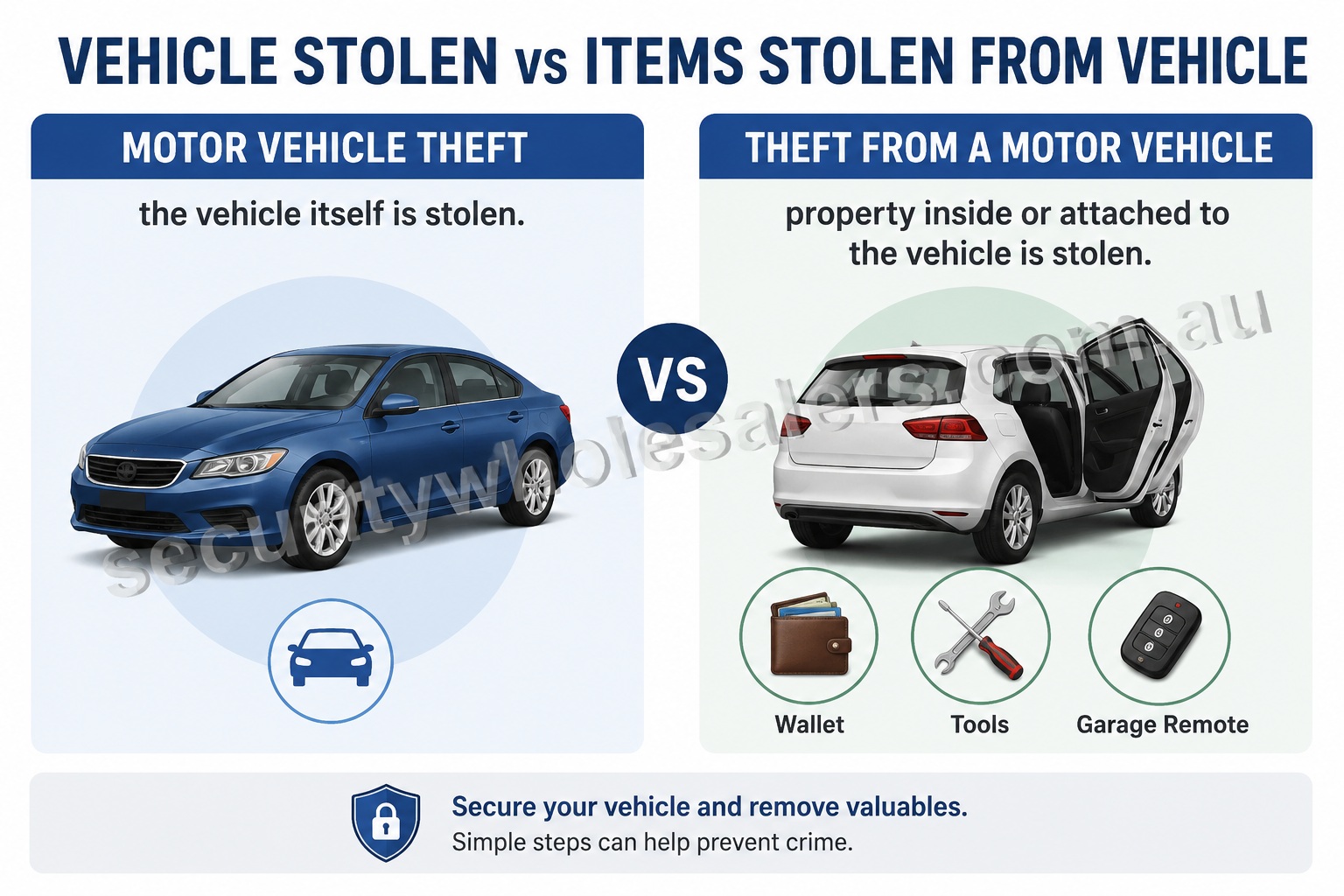
ABS Crime Victimisation data shows the most common types of property stolen from motor vehicles in 2024–25 included:
- personal items, such as jewellery and clothing;
- money, purse or wallet.
In practice, homeowners and renters should also be careful with:
- garage remotes;
- house keys;
- work tools;
- laptops and tablets;
- bags and backpacks;
- sunglasses;
- identity documents;
- fuel cards and credit cards;
- dash cams and accessories; and
- sports equipment.
One of the biggest risks is when a thief steals a garage remote or house keys from the car. What begins as theft from a motor vehicle can become a larger home security risk.
Best camera positions for driveway and vehicle security
Diagram 1 — driveway camera layout
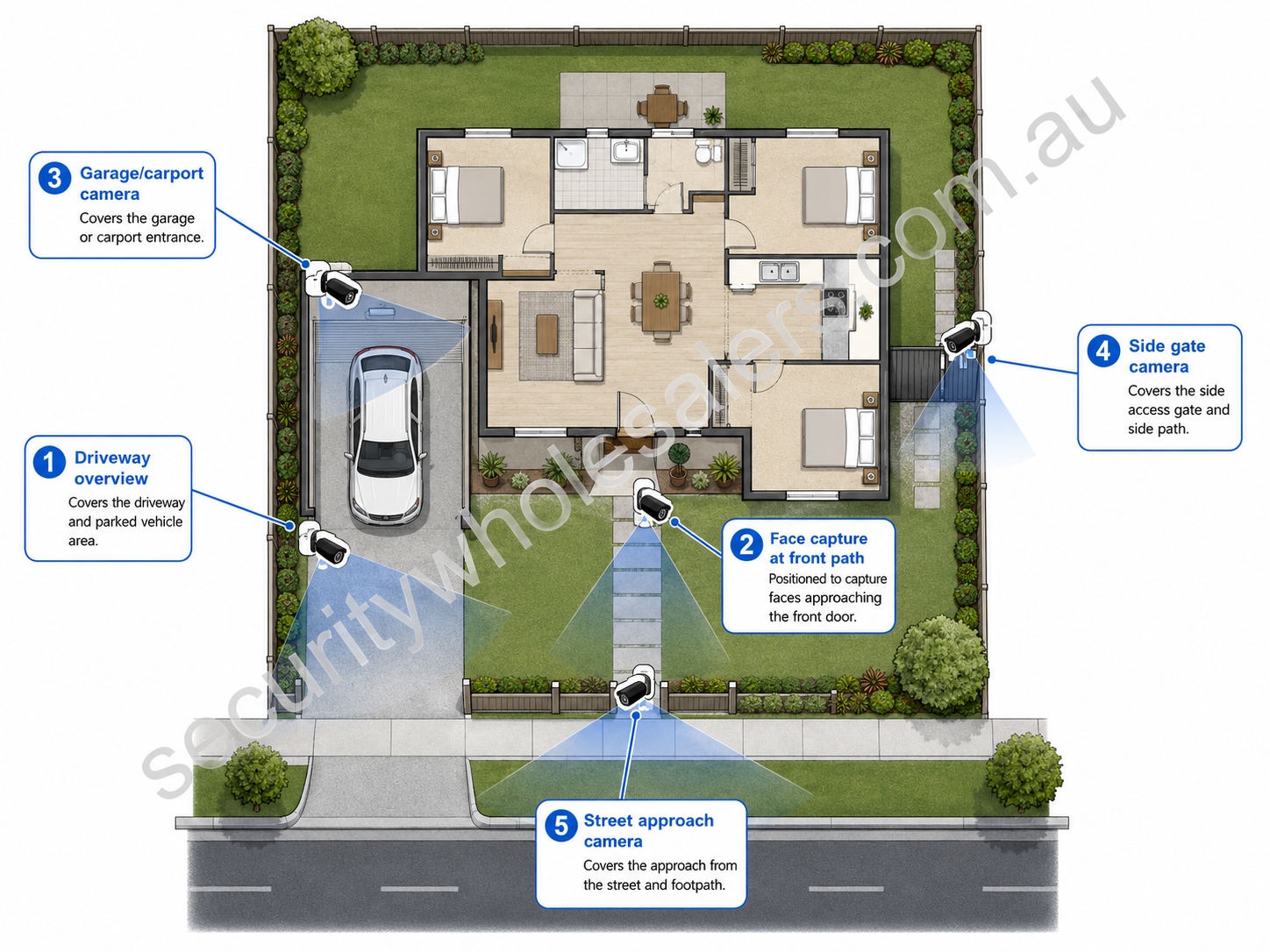
Diagram 2 — useful CCTV evidence for driveway theft
1. Driveway overview camera
A driveway overview camera should show the approach to the vehicle, garage or carport. This camera helps show the sequence of events.
2. Face-capture camera near the front path
A camera mounted near the front path or entrance can capture a clearer face shot than a high-mounted driveway camera. This is useful when a person walks towards the front door, garage or side gate.
3. Garage or carport camera
If vehicles are parked inside a garage or carport, a camera covering the entry point can be more useful than a camera pointed at the street.
4. Side gate camera
Many thieves use side access to move between the front and rear of the home. A side gate camera or sensor can help detect this movement.
5. Street approach or number plate camera
Where practical, a tighter camera view may help capture vehicles approaching or leaving. However, number plate capture is more demanding than general CCTV. It requires the correct camera angle, lens, shutter settings, lighting and distance.
Lighting matters
Night-time image quality is one of the most important practical issues in driveway security.
Some cameras use infrared, which can record in black and white at night. Others use white light or low-light colour technology to provide colour images. Colour can be useful for identifying clothing, vehicle colour and other details, but lighting must be designed carefully so it does not annoy neighbours or shine into the street unnecessarily.
A good driveway security setup often combines:
- camera coverage;
- motion-activated lighting;
- garage door sensors;
- front door sensors;
- side gate sensors;
- alarm system notifications; and
- clear signage.
Driveway and car security checklist
- Do not leave wallets, bags, tools or devices visible in the car.
- Remove garage remotes from vehicles parked outside.
- Keep car keys away from the front door and windows.
- Lock the car even when parked in the driveway.
- Use good lighting around the driveway and garage.
- Cover the driveway with CCTV, not just the front door.
- Check whether the camera captures faces or only the top of heads.
- Consider a reed switch or contact sensor on the garage door.
- Secure side gates and rear access paths.
- Keep shrubs and obstacles from blocking cameras.
- Make sure CCTV time and date settings are correct.
- Export footage immediately after an incident.
For apartments and townhouses
Apartment car parks and townhouse complexes have different challenges. Shared driveways, visitor parking, basement lighting and common property rules can make security more complicated.
Useful options may include:
- entry and exit cameras for the car park;
- cameras covering lift lobbies and stairwell access;
- access control for garage doors and pedestrian gates;
- improved lighting in basement car parks;
- signage to discourage opportunistic theft;
- body corporate-approved CCTV policies; and
- incident reporting procedures for residents.
Important limitations of the data
ABS Recorded Crime – Victims data is based on police-recorded incidents. ABS Crime Victimisation is a household survey. Insurance Council data is based on insurance claims. These sources are all useful, but they measure different things.
For example, a theft-from-vehicle incident may not be reported to police if the value is low. A vehicle theft may appear in police data but not in insurance claim data if the vehicle was uninsured or no claim was made. A household survey may capture incidents that never become police-recorded offences.
For the clearest picture, it is best to consider multiple sources together.
Conclusion
Car theft and theft from motor vehicles are not only public-space problems. The latest ABS household survey data shows that many theft-from-vehicle incidents happen while the vehicle is at home.
For homeowners, this means driveway and garage security should be treated as part of the overall home security plan. Cameras should be placed to capture useful evidence, not just broad views. Lighting, sensors, alarms and good everyday habits all play a role.
The best security system is not necessarily the most complicated one. It is the one that covers the actual weak points: driveway, garage, front path, side gate and vehicle access.
References
- Australian Bureau of Statistics – Recorded Crime: Victims, 2024
- Australian Bureau of Statistics – Crime Victimisation, 2024–25
- Australian Bureau of Statistics – Crime Victimisation Methodology, 2024–25
- Insurance Council of Australia – Victoria still leads Australia’s car crime insurance claims
- Insurance Council of Australia – Motor theft claims skyrocket in Victoria but fall in other states