

















Commercial
Best Warehouse CCTV System in Australia
Return to Warehouse CCTV Systems hub
Commercial
Most warehouse buyers are not really asking which single camera is best. They are asking a bigger question: what CCTV system should we buy for this site, with this floor plan, these dock doors, these aisles and this after-hours risk profile? That answer is usually a combination of fixed cameras, a sensible recorder size, realistic storage, disciplined lens choice and infrastructure that can cope with a working industrial environment.
A small trade warehouse may be well served by a disciplined 4 to 8 camera PoE system. A growing operational warehouse often needs 8 to 16 cameras because the entries, dispatch zone, roller doors, rear access points and internal traffic lines add up quickly. Larger logistics and multi-dock sites can move into 24 to 32 or more cameras once truck yards, dock aprons, perimeter lines and high-value internal zones are treated properly.
Quick answer
For a small trade warehouse, start with an 8 channel PoE NVR and 4 to 8 cameras. For most working warehouses, a 16 channel NVR with 8 to 16 cameras is the safer starting point. For larger logistics, 3PL, multi-dock or external-yard sites, plan around 24 to 32 or more cameras with separate PoE switching and proper storage sizing.
Glossary of what this guide covers
- Quick recommendation by warehouse type
- 8 vs 16 vs 32 camera warehouse CCTV systems
- Best system by budget and complexity
- What areas a warehouse system should cover
- Camera type recommendations
- NVR selection
- Storage and retention planning
- PoE, cabling and network planning
- Example warehouse system layouts
- Which brand should I choose?
- Common buying mistakes
- Workplace surveillance and governance
- Recommended buying paths
- Warehouse CCTV FAQs
Quick Recommendation Table
| Warehouse type | Typical camera count | Recommended system | Notes |
|---|---|---|---|
| Small trade unit / storage unit | 4 to 6 cameras | 8 channel PoE NVR kit | Covers front entry, roller door, internal overview, office and rear access. |
| Small warehouse / workshop | 6 to 8 cameras | 8 or 16 channel PoE NVR | Choose 16 channel if expansion is likely. |
| Medium warehouse | 10 to 16 cameras | 16 channel NVR with PoE or separate PoE switch | Better for aisles, loading docks, packing, dispatch and perimeter. |
| Larger warehouse / logistics site | 24 to 32 cameras | 32 channel NVR, PoE switches, storage planning | Suitable for multiple dock doors, yard, racking and external coverage. |
| High-bay / cold storage / 3PL / multi-building | 32 to 64+ cameras | Larger NVR or VMS-style design | Requires site design, network layout and retention calculations. |
Do not choose only by square metres. Camera count depends on doors, loading docks, aisles, blind spots, staff areas, external yard coverage, required identification detail and retention expectations.
Recommended Warehouse CCTV Packages
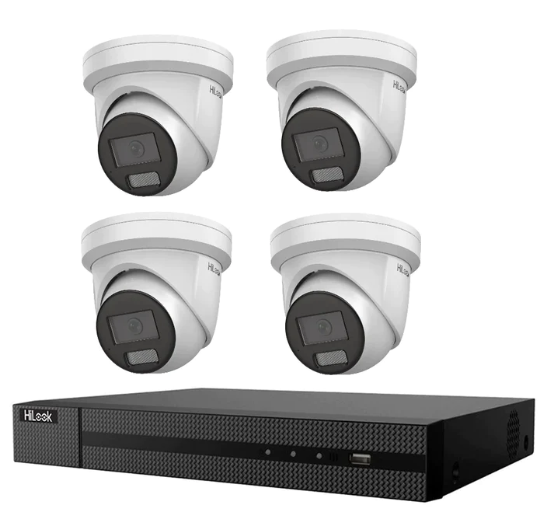
Small warehouse starter
Main pick: HiLook 6MP 4 camera turret kit
Best for: smaller trade units that mainly need front entry, roller door, internal overview and rear access coverage.
When to step up: move higher if the warehouse needs better detail, more than one external side, or likely expansion beyond four cameras.
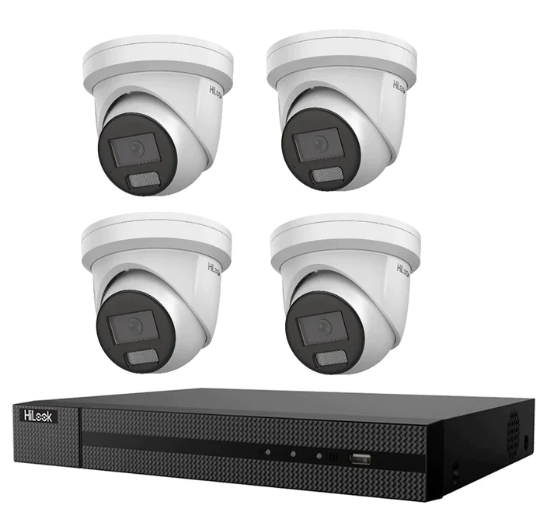
Small warehouse with stronger detail
Main pick: HiLook 8MP 4 camera turret kit
Best for: small warehouses that still want a packaged path but prefer more pixel density on entries, counters or internal movement zones.
When to step up: move beyond this when the site is becoming a real 6 to 8 camera or external-yard job.
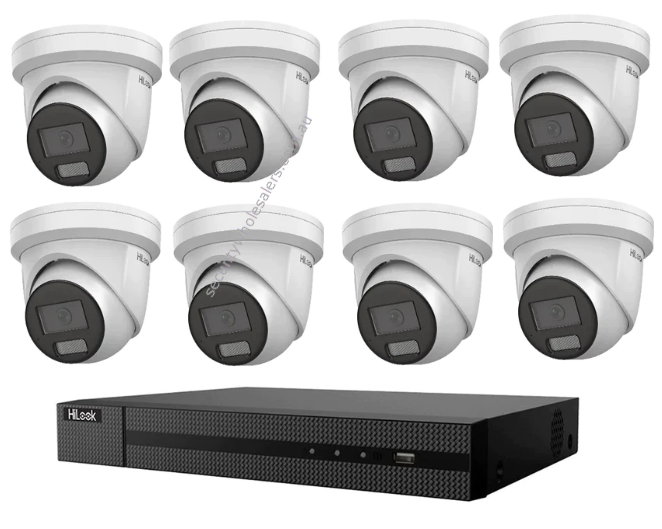
Small working warehouse
Main picks: HiLook 8MP 8 camera turret kit or Hikvision 8MP ColorVu 3.0 hybrid 8 camera kit
Best for: smaller working warehouses that want a full 8-camera path covering entries, roller doors, a bench zone and some external approaches from day one.
How to choose between them: the HiLook path suits value-led jobs that still want sharp fixed coverage, while the Hikvision ColorVu kit is stronger where the warehouse wants a more premium after-hours path with hybrid light, visible warning and a more commercial deterrence profile.
When to step up: move to a bigger recorder path if the warehouse expects more aisles, more perimeter or future dock coverage.
Growing warehouse build
Camera paths: HiLook IPC-T383H-MU 8MP turret camera or Hikvision ColorVu 3.0 smart hybrid turret with strobe and speaker
Recorder paths: HiLook 16 channel PoE NVR or Hikvision 16 channel Ultra Series NVR
Best for: 10 to 16 camera warehouses that are moving beyond a simple kit and need more realistic aisle, dock and perimeter headroom.
How to choose between them: the HiLook path is the cleaner value-led commercial step up, while the Hikvision path makes more sense where the warehouse wants stronger hybrid light, speaker or strobe capability and a broader recorder family.
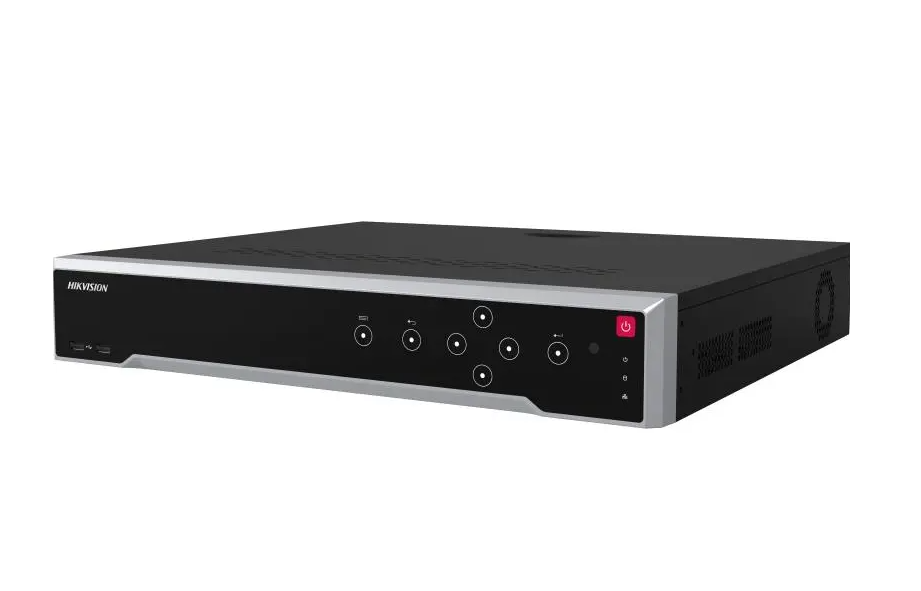
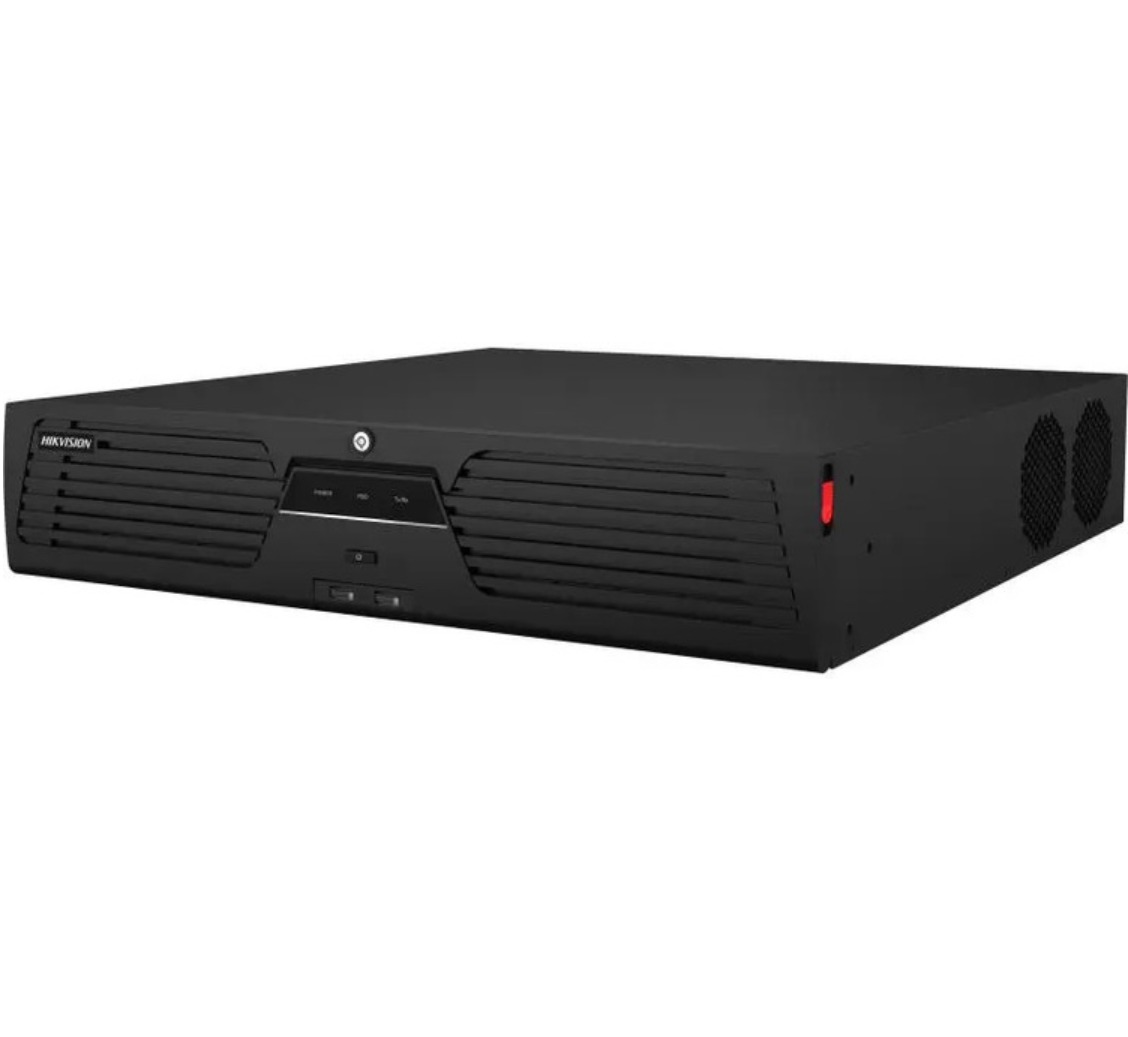
Larger logistics warehouse
Recorder path: Hikvision 32 channel M-Series NVR
Camera families: Hikvision 8MP AcuSense bullet cameras or Hikvision ColorVu 3.0 smart hybrid turret cameras
Best for: multiple dock doors, yard lines, gates and larger external warehouse faces where a more commercial recorder-and-camera path is justified.
How to choose between them: bullets are often cleaner for longer outdoor faces and visible deterrence, while the ColorVu smart hybrid turret path is useful where the warehouse wants stronger colour-at-night performance plus warning light and audio capability.
Enterprise / 64+ camera path
Recorder path: Hikvision 64 channel M-Series NVR
Camera families: Hikvision 8MP commercial bullet path or Hikvision ColorVu 3.0 smart hybrid turret path
Best for: larger 3PL, multi-building and broader enterprise warehouse layouts where the site is clearly beyond ordinary kit sizing.
How to choose between them: the bullet path remains strong for longer external runs and building faces, while the ColorVu smart hybrid turret path is useful where the site wants stronger warning presence and night colour performance at selected gates, docks or perimeter choke points.
8 vs 16 vs 32 Camera Warehouse CCTV Systems
8 camera warehouse system
Usually suitable for: small trade warehouses, compact storage units, smaller workshops and simple sites with one roller door, one rear access point and modest internal floor coverage needs.
Usually not enough when: the site has multiple aisles, more than one loading point, yard exposure, a high-value cage or several blind spots that need separate views.
NVR path: an 8 channel PoE NVR can work, but a 16 channel NVR is often smarter if the warehouse is likely to add dock, yard or perimeter cameras later.
16 camera warehouse system
Usually suitable for: many active warehouses where the system needs to cover entries, roller doors, loading activity, internal traffic paths, dispatch benches and an external layer.
Usually not enough when: the warehouse has multiple dock doors, a larger truck yard, several building faces, long perimeter lines or separate buildings.
NVR path: a 16 channel NVR is the common commercial starting point here, but the recorder should still be checked for bandwidth, drive bays and real growth headroom.
32 camera warehouse system
Usually suitable for: larger logistics warehouses, 3PL sites, multi-dock operations, bigger yards, gate control, cross-dock layouts and warehouses with several separate risk layers.
Usually not enough when: the site spreads across multiple buildings, needs long retention on many high-resolution cameras, or is moving into VMS-style enterprise management.
NVR path: a 32 channel NVR with separate PoE switching is the normal path, with some sites then moving into larger recorder or VMS planning once camera count and operational complexity climb again.
Best System by Budget / Complexity
Entry Warehouse System
Typical build: 4 to 8 IP cameras and an 8 channel PoE NVR.
Best for: small trade units, storage units and small workshops where coverage needs are straightforward.
What it does well: front entry, one roller door, internal overview, a bench or counter zone and rear access.
Better Warehouse System
Typical build: 8 cameras on a 16 channel NVR.
Best for: growing businesses that know the yard, dock or internal risk will expand.
Why it is often smarter: spare channels are cheaper to leave open now than to replace a recorder later.
Recommended Warehouse System
Typical build: 12 to 16 cameras on a 16 channel NVR.
Best for: many operational warehouses with real dock, dispatch, perimeter and internal-traffic needs.
Typical mix: turret, bullet and varifocal cameras rather than one camera type everywhere.
Commercial Warehouse System
Typical build: 24 to 32 cameras, 32 channel NVR, separate PoE switching and larger surveillance drives.
Best for: logistics, larger warehouses, dock-heavy sites and yards with real after-hours exposure.
What changes here: the switching, cabinet layout, bandwidth and retention planning matter as much as the cameras.
Enterprise / Multi-Site System
Typical build: 64+ cameras or a VMS-style layout.
Best for: 3PL, corporate, cold store, multi-building and high-risk environments.
Reality check: these sites need a managed network design, storage strategy and formal access policy, not a generic kit mindset.
What Areas Should a Warehouse CCTV System Cover?
- Main staff or customer entry
- Office or reception entry
- Roller doors
- Loading docks
- Internal aisles
- Pallet racking
- Dispatch and packing benches
- High-value goods cage
- Rear doors and fire exits
- External perimeter
- Vehicle gate
- Truck yard
- Car park
- Bin area
- Plant room, comms room and NVR location
For long aisles and racking runs, read Pallet Racking and Motorised Zoom Cameras. For dock and apron design, go deeper into Loading Dock CCTV Design. For the external layer that takes over once the shift ends, read After-Hours Warehouse Perimeter CCTV.
Camera Type Recommendations
Turret Cameras
Turret cameras are often the best general-purpose internal warehouse camera. They suit open floor areas, offices, dispatch benches and broader internal coverage where the site needs a practical commercial camera rather than a highly specialised view. They are often easier to keep working cleanly than domes in dusty environments.
Bullet Cameras
Bullet cameras work well on external walls, long approaches, roller doors, driveways, perimeter lines and visible deterrence positions. In a warehouse context they are often useful where the buyer wants the camera to be obvious, wants a stronger external profile, or needs a housing style that suits longer-range external optics.
Dome Cameras
Dome cameras can still be useful where vandal resistance or a lower-profile appearance matters, but warehouses should be careful with dust, insects, condensation and IR reflection. If the dome is likely to get dirty or the scene relies heavily on night illumination, a turret or bullet can sometimes be the more practical choice.
Varifocal / Motorised Zoom Cameras
These are strongly recommended for loading docks, long aisles, yard entries, gates and racking areas where a standard wide 2.8 mm lens may not provide enough useful detail. They are particularly useful when the installer needs to commission a narrow aisle properly rather than accept a broad but weak view. The deeper aisle and lens discussion lives in the warehouse pallet-racking guide.
PTZ Cameras
PTZ cameras can be very useful for live overview of large yards or the building face, but they are not a replacement for fixed cameras. A PTZ only shows the scene it is looking at that moment. If the site wants evidentiary coverage of dock doors, gates or crossings, fixed views still need to do that job. The deeper planning note is in How to Use One PTZ Without Designing the Whole System Around It.
Active Deterrence / Full Colour Cameras
These are useful for after-hours external perimeter, roller doors, gates and dock aprons where the operator wants more than passive review. They can help around repeated trespass or after-hours approach points, especially when the camera position, lighting and policy settings are chosen properly. For the night-focused layer, go to After-Hours Warehouse Perimeter CCTV.
ANPR / Number Plate Cameras
Only choose these where the site genuinely needs dedicated vehicle plate capture. Standard CCTV cameras are not reliable number plate cameras unless distance, angle, lens, shutter and vehicle path are all correct. If the brief is "read every plate at the gate", that needs its own design conversation.
NVR Selection
The NVR should be selected around channel count, incoming bandwidth, storage bays, hard drive capacity, user access and future expansion. Too many sites treat the recorder as a box that comes bundled with the cameras. In a warehouse, the NVR is part of the commercial decision because footage needs to be available when there is a dispatch dispute, a forklift review, a delivery argument or an after-hours break-in.
| Camera count needed | Recommended NVR | Why |
|---|---|---|
| 1 to 4 cameras | 8 channel NVR | Avoids buying a recorder with no room to grow. |
| 5 to 8 cameras | 8 or 16 channel NVR | 16 channel is better if expansion is likely. |
| 9 to 16 cameras | 16 channel NVR | A common warehouse size where internal and external coverage both matter. |
| 17 to 32 cameras | 32 channel NVR | Better for larger warehouse, yard and loading dock coverage. |
| 32+ cameras | 64 channel NVR or VMS | Requires network and storage planning, not just more camera ports. |
For deeper recorder and retention planning, read NVR and Storage Sizing.
Storage and Retention
Warehouses often need footage for dispatch disputes, forklift incidents, staff entry and exit questions, stock loss, delivery disputes and after-hours incidents. Many businesses aim for around 30 days retention, but some need 60 to 90 days depending on insurance requirements, stock value, internal policy or operational review cycles.
| System size | Recording approach | Storage planning note |
|---|---|---|
| 4 to 6 cameras | Continuous on key views or continuous across all channels if the site is simple | Still check storage properly. A small recorder drive can disappear quickly if resolution and frame rate are pushed up. |
| 8 cameras | Often continuous on all main cameras, or continuous internally with event logic on some external views | This is where buyers often underestimate storage because docks, roller doors and approaches can stay busy all day. |
| 16 cameras | Commonly continuous on operationally important cameras, with event logic only where it has been tested carefully | A 16 camera warehouse should not assume the bundled drive is enough. Bitrate, codec, FPS and retention target all start to matter much more. |
| 24 to 32 cameras | Usually planned as a serious recorder-and-storage job rather than an afterthought | At this size, camera count, resolution mix and continuous recording can push the site into larger drive sets and stronger NVR selection quickly. |
| 64+ cameras | Normally a formal storage design with retention, export and access policy decided early | Do not guess. Large systems should be sized around actual bitrate assumptions, operational review needs and whether the site is recorder-led or VMS-led. |
- More cameras increase storage demand.
- Higher resolution increases storage demand.
- Continuous recording uses more storage than event recording.
- Higher frame rate uses more storage.
- H.265 and H.265+ can help reduce storage.
- Use surveillance-grade hard drives.
- Do not assume a small included drive will be enough for a 16 camera warehouse.
If your site still needs help turning those assumptions into a recorder and hard-drive plan, use the CCTV storage calculator.
PoE, Cabling and Network Planning
Wired PoE is normally preferred for warehouse CCTV. Warehouses are often poor environments for Wi-Fi cameras because of metal structures, racking, distance, forklifts and interference. A clean warehouse CCTV system is usually built around sensible cabling routes, secure switching and recorder placement that protects the system instead of leaving it exposed.
- Cat6 Ethernet normally has a 100 metre limit.
- Larger sites may need PoE switches at remote points.
- Very long distances may need fibre uplinks, point-to-point wireless bridges or suitable extenders.
- Check the total PoE budget, not just port count.
- PTZs, active deterrence cameras and long runs can increase PoE demand.
- Consider UPS backup for the NVR, PoE switch, router and critical links.
- Secure the NVR and switch in a cabinet or protected comms area.
For the deeper infrastructure planning piece, read Warehouse CCTV PoE and Network Planning.
Example System Layouts
Example A: 4 to 6 Camera Small Warehouse
Situation: A trade warehouse has one front entry, one roller door, a small packing bench, a rear door and a modest internal floor.
Solution used: Front entry, roller door, internal overview, packing bench, rear door and one external approach camera.
Why this was chosen: The site did not need heavy aisle segmentation. It needed sensible coverage of access points and the work area where disputes or shrinkage could happen.
Installation notes: This is often where an 8 channel PoE kit makes sense, but it still needs the right lenses and recorder drive size.
Example B: 8 Camera Small Warehouse System
Situation: A small warehouse wants better visibility of the outside approach and roller door activity without overbuilding the job.
Solution used: Two external perimeter or approach cameras, two roller or loading door cameras, two internal overview or aisle cameras, one office or staff entry camera and one dispatch or packing bench camera.
Why this was chosen: Eight cameras let the site separate external and internal risk instead of relying on one wide camera to do both jobs badly.
Installation notes: A 16 channel recorder can still be the smarter buy if the site is likely to add yard or rear perimeter coverage later.
Example C: 16 Camera Operational Warehouse System
Situation: A working warehouse has active dispatch, multiple access points, forklift movement and a high-value cage.
Solution used: Four external perimeter cameras, three loading dock or roller door cameras, four aisle or racking cameras, two dispatch or packing cameras, one office or reception entry camera, one high-value cage camera and one gate or yard overview camera.
Why this was chosen: This is the point where most sites stop being a simple "camera kit" job and become a real commercial layout problem.
Installation notes: Recorder channel headroom, drive count and PoE switching should all be planned before the mounting starts.
Example D: 24 to 32 Camera Logistics Warehouse
Situation: A larger warehouse has multiple loading docks, cross-dock movement, truck yard exposure and a busy external perimeter.
Solution used: Multiple loading dock cameras, cross-dock coverage, truck yard and gate cameras, internal aisle coverage, dispatch verification, external perimeter cameras and office or staff entry cameras.
Why this was chosen: The warehouse needed reliable review across several separate risk layers, not just broad overview footage.
Installation notes: This is normally where 32 channel recording, separate PoE switching, cabinet security and a proper storage plan all become non-negotiable.
Example E: Cold Store / High-Bay / 3PL
Situation: The building has high mounting heights, longer sight lines, specialist environmental conditions and a more formal operational standard.
Solution used: A more careful model selection process, more deliberate lens choice, stronger network planning and a recorder path that can cope with higher camera count and longer retention demands.
Why this was chosen: Generic home-style CCTV kits are the wrong tool once condensation, heater requirements, high mounting and maintenance access become part of the brief.
Installation notes: This is where commercial brands, housing choices and long-term serviceability matter much more than a headline price.
Which Brand Should I Choose?
HiLook
Good value for small warehouses, storage units and budget-conscious PoE systems where the site still wants a proper NVR-based system rather than consumer hardware.
Hikvision
Better for broader commercial choice, AcuSense, ColorVu, larger recorder options and more specialised cameras once the warehouse becomes more complex.
Dahua
Strong for WizSense, active deterrence, full-colour options and practical perimeter detection where after-hours external coverage matters.
Uniview
A strong commercial alternative with good NVR and IP camera options for warehouses that want a capable business-grade system.
Uniarch
A sensible value option for smaller business systems and practical PoE kits when the site does not need a broad specialist camera range.
TP-Link VIGI
Good for straightforward small-business systems where ease of use and ecosystem simplicity matter more than specialist warehouse camera breadth.
AXIS / Hanwha
Higher-end commercial and enterprise pathways where advanced analytics, VMS integration, environmental hardening or corporate standards matter.
No brand is automatically best for every warehouse. The right answer depends on whether the site is a simple 6 camera storage shed, a growing operational warehouse, or a larger commercial site that needs stronger recorder depth, better analytics or more specialised camera families.
Common Mistakes
- Buying a 4 camera kit for a serious warehouse.
- Choosing only wide-angle 2.8 mm cameras.
- Mounting cameras too high for face or incident detail.
- Ignoring loading dock backlight and truck apron contrast.
- Using Wi-Fi cameras in a metal warehouse.
- Forgetting the 100 metre Ethernet limit.
- Not checking PoE budget.
- Not allowing spare NVR channels.
- Using ordinary desktop hard drives.
- Forgetting UPS backup.
- Relying on a PTZ instead of fixed coverage.
- Not planning signage, notice and footage access rules.
- Putting the NVR in an unsecured warehouse corner.
Workplace Surveillance / Governance Note
Warehouse CCTV may capture employees, contractors, visitors and delivery drivers. Businesses should consider workplace surveillance, privacy, signage, notice, access permissions and footage release procedures before installation. Requirements vary by state and territory. This page is general buying guidance, not legal advice. For the policy layer, read Warehouse CCTV Governance and Workplace Surveillance.
Suggested Next Reads
Recommended Buying Paths
Small warehouse
Best fit: HiLook, Uniarch or TP-Link VIGI 4 to 8 camera PoE kits.
Practical product path: start with HiLook 8MP T381H-MU kits for a normal fixed-lens warehouse path, or look at HiLook flashing-light kits where the site wants stronger visible after-hours deterrence at a roller door or side approach.
Growing warehouse
Best fit: an 8 camera layout on a 16 channel NVR, or a 12 to 16 camera build based around Hikvision, Dahua or Uniview.
Practical product path: this is often where buyers stop thinking in kit-only terms and start combining Hikvision cameras, Dahua cameras or Uniview cameras with a larger NVR.
Operational warehouse
Best fit: a 16 channel NVR, mixed turret, bullet and varifocal cameras, surveillance HDDs and PoE switching where required.
Practical product path: this is usually a proper commercial build using Hikvision, Dahua or Uniview cameras, matched to surveillance hard drives and PoE switches instead of treating those items as extras.
Large logistics warehouse
Best fit: a 32 channel NVR or VMS-style plan split into dock, aisle, perimeter, yard, gate and dispatch zones.
Practical product path: this usually means a broader Hikvision or comparable commercial path with separate switching, more deliberate recorder planning and a site layout that is commissioned in layers rather than all at once.
Related Buying Categories
CCTV Kits
Starter kits for smaller warehouse sites or buyers who want a packaged NVR-and-camera entry point.
IP Cameras
Browse turret, bullet, varifocal and specialist camera types used in warehouse systems.
NVRs
Compare recorder sizes, PoE and non-PoE options, storage bays and expansion pathways.
Hikvision CCTV
A deeper commercial camera and recorder ecosystem for warehouses that need broader choice.
HiLook CCTV
Value-driven kits and small-business CCTV pathways for simpler warehouse jobs.
Dahua CCTV
Good for active deterrence, perimeter detection and broader commercial CCTV system building.
Uniview CCTV
A practical commercial alternative for warehouse cameras and NVRs.
Uniarch CCTV
A value option for smaller warehouse systems where the brief is more straightforward.
TP-Link VIGI
Small-business-oriented CCTV hardware for simpler PoE deployments.
PoE Switches
Important once the site grows beyond a small direct-to-recorder layout.
Surveillance Hard Drives
Use surveillance-grade storage rather than ordinary desktop drives.
UPS Backup
Helps keep the recording path alive through power disturbances.
Camera Brackets and Junction Boxes
Useful once the install needs proper mounting, weather sealing or safer cable terminations.
Cat6 Cable
Warehouse systems live or die on cable quality and route planning.
Warehouse CCTV FAQs
What is the best CCTV system for a warehouse?
The best warehouse CCTV system is usually a wired IP camera system with the right mix of internal and external cameras, a properly sized NVR, surveillance drives and PoE infrastructure that suits the size of the building. The correct answer depends on the site layout, not just brand or megapixels.
How many cameras does a warehouse need?
Some small units need only 4 to 6 cameras. Many working warehouses land around 8 to 16 once roller doors, offices, dispatch and internal movements are mapped properly. Larger logistics sites can require 24 to 32 or more.
Is an 8 camera CCTV system enough for a warehouse?
It can be enough for a smaller warehouse or workshop if the layout is disciplined and the brief is realistic. It becomes less likely once the site needs several aisles, multiple access points, yard coverage or dock detail.
Is a 16 camera CCTV system better for warehouses?
For many operational warehouses, a 16 camera system usually gives enough room to cover internal flow, access points, dock exposure and some external risk without forcing one camera to do several jobs badly.
Should I choose a 16 channel or 32 channel NVR?
Choose around real coverage and expansion. A 16 channel recorder often fits medium warehouses. A 32 channel recorder makes more sense once the site has several docks, a larger yard, multiple buildings or growth plans.
Are Wi-Fi cameras suitable for warehouses?
Usually not as the preferred commercial answer. Warehouses are often harsh Wi-Fi environments because of metal shelving, long distances, interference and physical obstacles. Wired PoE is more stable.
What camera type is best for loading docks?
Loading docks normally need a mix. A wider camera can show context, while a tighter varifocal or motorised zoom camera gives usable detail at the dock face, dispatch bench or roller-door line.
What camera type is best for pallet racking aisles?
Varifocal or motorised zoom cameras are often the better answer because they let the installer tune the view to a long, narrow aisle. Wide fixed lenses can waste pixels across shelving and still miss usable detail.
Do warehouses need 4K cameras?
Not everywhere. Some broad scenes benefit from 4K, but the bigger issue is whether the camera is in the right place with the right lens and lighting. A poorly placed 4K camera is not automatically a strong warehouse camera.
How much storage does warehouse CCTV need?
More than many buyers first expect. Camera count, frame rate, resolution, activity levels and continuous recording all drive storage demand. Busy external zones can consume a lot of disk space.
Should warehouse CCTV record continuously?
Many sites use continuous recording on the most important channels because dispatch disputes and forklift incidents do not always align neatly with event triggers. Some sites combine continuous and event-based recording to manage storage.
Can I add more cameras later?
Usually yes, if the recorder, switch capacity, cable paths and storage were planned with spare room. That is why leaving spare channels is often sensible even on a smaller first-stage system.
Are PTZ cameras good for warehouses?
They can be useful for overview and live response, especially across larger yards or the warehouse face, but they should not replace fixed cameras. Evidence footage still needs fixed views in the right places.
Do I need signs for warehouse CCTV?
Warehouses should think about signage, notice and controlled access because the system may capture workers, visitors and drivers. The exact obligations vary, so the policy side should not be ignored.
What is the best CCTV brand for warehouses?
It depends on the size of the site, the budget and how specialised the camera mix needs to be. HiLook can suit smaller value-led sites, while Hikvision, Dahua and Uniview often make more sense as the warehouse becomes more commercially complex.