Product Overview
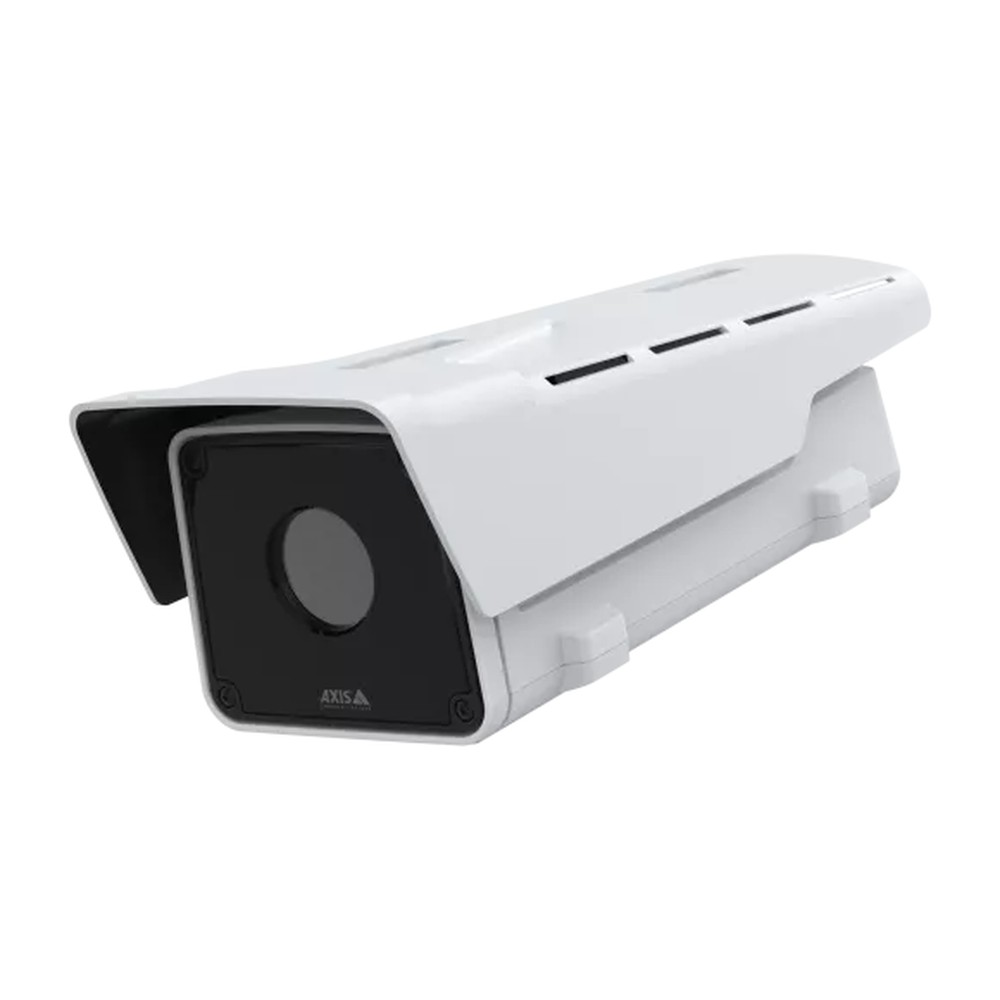
For perimeter security applications where lighting conditions cannot be relied upon, the AXIS Q2101-TE delivers thermal imaging across a fixed 28-degree horizontal field of view using an uncooled 384×288 microbolometer sensor and a 13mm athermalized lens. Engineered as a rugged box-form camera rated IP66, IP67, and IK10, it is built for exposed outdoor mounting on fence lines, industrial yards, warehouse perimeters, and critical infrastructure where conventional visible-light cameras struggle with darkness, smoke, or glare. Equipped with an ARTPEC-8 processor and an onboard Deep Learning Processing Unit, it supports AXIS Perimeter Defender, AXIS Fence Guard, AXIS Loitering Guard, and early fire detection analytics. It also includes remote temperature monitoring across a range of -40 degrees C to 350 degrees C, making it suited to environments where heat anomaly detection is as important as intrusion detection. This model operates in ambient temperatures from -40 degrees C to 60 degrees C, ensuring consistent performance in both extreme cold and industrial heat.
Key Capabilities
Thermal Detection Independent of Light
The 384×288 uncooled microbolometer operates across an 8-14 micrometre spectral range, detecting heat signatures in total darkness, heavy fog, smoke, and glare conditions where visible-light sensors fail. The 17 micrometre pixel size and NETD of 40 mK at 25 degrees C deliver high thermal sensitivity for perimeter and industrial monitoring.
Early Fire Detection Analytics
Onboard early fire detection analytics monitor heat anomalies in real time, enabling earlier intervention before flames develop. Combined with remote temperature monitoring across -40 degrees C to 350 degrees C, this makes the Q2101-TE a practical tool for high-risk industrial sites such as recycling facilities, fuel storage areas, and waste processing plants.
AXIS Perimeter Defender and Fence Guard
The camera supports AXIS Perimeter Defender, AXIS Fence Guard, AXIS Loitering Guard, and AXIS Motion Guard via the ACAP application platform. When PT-mounted, thermometric guard tours allow up to 10 polygonal detection areas per preset, giving operators structured coverage across complex perimeter layouts.
ARTPEC-8 with Onboard DLPU
The ARTPEC-8 SoC with 2048 MB RAM, 8192 MB Flash, and a dedicated Deep Learning Processing Unit runs analytics at the edge without dependence on server-side processing. This reduces network load and supports faster alarm response, which is critical in perimeter intrusion scenarios requiring immediate deterrence or notification.
IP66, IP67, and IK10 Outdoor Hardening
Dual ingress protection ratings of IP66 and IP67, combined with an IK10 impact resistance rating, mean this camera is built to withstand pressure washdowns, sustained rain, temporary immersion, and deliberate physical interference. The aluminum housing and operating range of -40 degrees C to 60 degrees C suit exposed industrial and perimeter deployments year-round.
2-Way Audio and Configurable I/O
Full-duplex 2-way audio is supported through edge-to-edge technology connecting network speakers for audio alarms. Four alarm inputs and outputs via terminal block allow integration with barriers, sirens, access control, and third-party systems. This supports active deterrence workflows where a detected intrusion can trigger both an audio response and an automated physical barrier.
Best For
- Perimeter Intrusion Detection: The 13mm lens with 28-degree horizontal field of view and AXIS Perimeter Defender support make this suited to monitoring fence lines, boundary approaches, and controlled access zones where reliable detection regardless of lighting is the primary requirement.
- Early Fire and Heat Anomaly Monitoring: Onboard fire detection analytics and remote temperature monitoring across -40 degrees C to 350 degrees C allow this camera to serve dual roles at industrial sites, monitoring both intruder presence and developing heat events simultaneously.
- Harsh Environment Industrial Sites: Ratings of IP66, IP67, and IK10 combined with an operating range of -40 degrees C to 60 degrees C make this appropriate for ports, mining facilities, chemical plants, and outdoor substations where standard cameras cannot operate reliably year-round.
- Critical Infrastructure Protection: The ARTPEC-8 processor with onboard DLPU and support for AXIS Fence Guard and AXIS Loitering Guard allows operators to configure automated, analytics-driven responses across power generation sites, water treatment facilities, and transport hubs without requiring constant manual monitoring.
Why Choose the AXIS Q2101-TE 13mm 8.3fps
The AXIS Q2101-TE in the 13mm configuration provides a targeted 28-degree horizontal field of view that concentrates detection capability on specific approach corridors or fence sections rather than spreading coverage thinly across wide angles. The uncooled microbolometer with a NETD of 40 mK at 25 degrees C is more thermally sensitive than entry-level thermal sensors, which matters when detecting human or animal intrusions at the ranges this lens supports. Early fire detection is included as a confirmed onboard analytic, not an add-on purchase, and the ARTPEC-8 platform with DLPU means these analytics run at the edge. The aluminum IK10 housing, dual IP66/IP67 rating, and -40 degrees C to 60 degrees C operating range exceed what most standard security cameras offer for exposed outdoor mounting. Axis Edge Vault with Axis device ID provides hardware-level cybersecurity suited to critical infrastructure environments. Available through Security Wholesalers, the Q2101-TE is a purpose-built thermal solution for buyers who need detection performance that visible-light cameras cannot deliver.
Buyer Decision Tips
Buyer Tip – Thermal Detection vs. Identification: The AXIS Q2101-TE is a detection camera, not an identification camera. Thermal imaging detects heat signatures to trigger alarms and analytics, but it does not produce visible-light images suitable for facial recognition or licence plate reading. If your site requires both perimeter detection and evidence-quality identification, plan for a paired visible-light camera on the same perimeter, managed via your VMS. The 13mm lens on this model covers approximately 28 degrees horizontally, so calculate your detection zone width against mounting height and standoff distance before specifying quantities.
Buyer Tip – Frame Rate and Recording Requirements: At 8.3fps, this camera captures significantly fewer frames per second than a standard 25fps visible-light camera. For perimeter intrusion and fire detection analytics this is adequate, but confirm with your VMS vendor that the system handles 8.3fps thermal streams correctly. Storage calculations based on standard 25fps assumptions will overestimate requirements. H.265 with Axis Zipstream reduces storage load further. Plan NVR and storage sizing specifically around this frame rate and your chosen resolution output.
Key Features & Technical Specifications
| Model |
AXIS Q2101-TE 13mm 8.3fps (Part No. 02651-001) |
| Sensor Type |
Uncooled microbolometer |
| Resolution |
384×288 pixels (upscalable to 768×576); pixel size 17 µm |
| Frame Rate |
Up to 8.3 fps |
| Lens |
Athermalized fixed 13mm, F1.0; horizontal field of view: 28 degrees; minimum focus distance: 4 m |
| Spectral Range |
8-14 µm |
| Thermal Sensitivity (NETD) |
40 mK at 25°C, F1.0 |
| Temperature Monitoring Range |
-40°C to 350°C (-40°F to 660°F) |
| Processor |
ARTPEC-8 with onboard Deep Learning Processing Unit (DLPU) |
| Memory |
2048 MB RAM; 8192 MB Flash |
| Video Compression |
H.265, H.264, M-JPEG; Axis Zipstream |
| Analytics |
AXIS Video Motion Detection, AXIS Motion Guard, AXIS Fence Guard, AXIS Loitering Guard, AXIS Perimeter Defender, early fire detection; audio detection; active tampering alarm |
| Audio |
2-way full-duplex audio; edge-to-edge network speaker support |
| I/O |
4 alarm inputs/outputs (2 supervised, 2 unsupervised); 12 V DC output, max 50 mA; serial connectors |
| Local Storage |
Memory card slot |
| Network Connector |
RJ45 10BASE-T/100BASE-TX/1000BASE-T PoE |
| Power |
PoE IEEE 802.3af/802.3at Type 2 Class 4 (typical 4.6 W, max 25.5 W); 8-28 V DC (typical 4.1 W, max 25.5 W) |
| Ingress Protection |
IP66 and IP67 |
| Impact Rating |
IK10 |
| Operating Temperature |
-40°C to 60°C |
| Operating Humidity |
10-100% RH (condensing) |
| Housing |
Aluminum; wall-mount box form; halogen free |
| Dimensions / Weight |
404 x 159 x 150 mm; 3.3 kg |
| Cybersecurity |
Signed OS; Axis Edge Vault with Axis device ID; VAPIX and ACAP open API |
| Certifications |
CSA, UL/cUL, UKCA, CE, KC, VCCI, RCM |
Ideal Use Cases
Industrial Perimeter Fencing
AXIS Fence Guard and AXIS Perimeter Defender run on the onboard DLPU, detecting movement along fence lines or boundary approaches without dependence on ambient lighting. The IK10 housing and IP66/IP67 ratings withstand outdoor exposure along unmanned perimeter runs at mining sites, logistics centres, and industrial parks.
Recycling and Waste Facilities
Early fire detection analytics monitor heat anomalies in material stockpiles and processing areas where spontaneous combustion is a known risk. Remote temperature monitoring up to 350 degrees C allows the Q2101-TE to flag developing heat events before they escalate, triggering alarms through the 4-alarm I/O system to suppression or response equipment.
Port and Maritime Environments
Salt air, condensation, and near-total darkness at night make thermal imaging more practical than visible-light cameras at wharves and container yards. The IP67 rating and operating range down to -40 degrees C support installation in environments with spray, humidity, and extreme temperature swings, while AXIS Loitering Guard monitors restricted dock access zones.
Power Generation and Substation Sites
Critical infrastructure sites require both perimeter integrity and thermal monitoring of electrical equipment. The Q2101-TE covers both requirements, with AXIS Perimeter Defender detecting unauthorised access and remote temperature monitoring flagging overheating transformer or switchgear panels. Axis Edge Vault cybersecurity is appropriate for sensitive infrastructure deployments.
Dark or Unlit Outdoor Approaches
Loading docks, rear access lanes, and perimeter pathways without lighting infrastructure cannot be reliably covered by visible-light cameras. The uncooled microbolometer on the Q2101-TE detects heat signatures regardless of illumination, and the thermometric guard tour function supports systematic scanning of multiple zones from a single PT-mounted unit.
Choosing the Right Model
- Choose this model if: Your site requires perimeter intrusion detection or early fire detection in conditions where visible-light cameras are unreliable due to darkness, smoke, glare, or fog. The 13mm lens suits focused detection along a specific approach corridor or fence section, and the confirmed ARTPEC-8 platform supports edge analytics without server dependency.
- Choose a wider field of view thermal model if: Your perimeter coverage zone is broader than the 28-degree horizontal field of view of this lens allows. A shorter focal length thermal lens would provide wider angular coverage from the same mounting point, reducing the number of cameras required across an open area. Assess your detection distance and zone width before committing to the 13mm configuration.
- Choose a visible-light camera instead if: Your primary requirement is producing evidence-quality footage for facial recognition, licence plate capture, or post-incident review. Thermal imaging identifies heat signatures for detection and alerting, but does not capture visible detail. Pair this camera with a visible-light unit if both detection and identification are required at the same location.
FAQs
- What does the AXIS Q2101-TE actually detect, and how does it differ from a standard security camera?
The Q2101-TE uses an uncooled microbolometer to detect heat radiation emitted by people, animals, and vehicles across an 8-14 micrometre spectral range. Unlike visible-light cameras that depend on illumination, it detects thermal contrast regardless of lighting. It does not produce colour or greyscale images of faces or licence plates. Its role is detection, alarm triggering, and analytics, not visual identification or evidence capture.
- What is the detection range of the 13mm lens?
Axis does not publish a fixed detection range because effective range depends on target size, thermal contrast, environmental conditions, and application requirements. The 13mm lens provides a 28-degree horizontal field of view with a minimum focus distance of 4 metres. For formal range calculations, Axis’s camera selector and perimeter defender documentation provide criteria-based estimation tools based on target type and required detection probability.
- Can the Q2101-TE detect fire and perform perimeter intrusion detection simultaneously?
Yes. The ARTPEC-8 processor with onboard DLPU runs multiple analytics concurrently. Early fire detection and AXIS Perimeter Defender can operate in parallel, with separate alarm outputs configured for each event type. The 4 alarm inputs and outputs via terminal block allow independent notification or automation responses for each analytic trigger, such as alerting a fire suppression system while simultaneously activating a siren for intrusion.
- What does the temperature monitoring range of -40 degrees C to 350 degrees C enable in practice?
This range allows the Q2101-TE to monitor heat signatures across a spectrum from cold ambient outdoor environments down to -40 degrees C through to elevated temperatures associated with pre-fire heat events, overheating electrical equipment, or industrial process anomalies up to 350 degrees C. Polygonal detection zones can be assigned to specific areas of interest such as a battery bank, transformer, or material stockpile, with alarms triggered when temperatures exceed defined thresholds.
- Does the Q2101-TE require a separate server or VMS to run its analytics?
No. Analytics including AXIS Perimeter Defender, AXIS Fence Guard, early fire detection, and AXIS Loitering Guard run directly on the camera via the ARTPEC-8 SoC and onboard DLPU. The 2048 MB RAM and 8192 MB Flash support edge processing without routing video to a server for analysis. A VMS is recommended for recording, alarm management, and operator interface, but analytics processing does not depend on it.
- How is the Q2101-TE powered, and what cabling infrastructure does it need?
The camera accepts PoE IEEE 802.3at Type 2 Class 4, drawing a typical 4.6 W and up to 25.5 W at maximum load. It also accepts 8-28 V DC for direct power supply installations. Standard Cat6 Ethernet cabling to a compatible PoE switch is sufficient for most installations. The maximum PoE cable run is 100 metres per the IEEE 802.3 standard. For longer runs, mid-span injectors or DC power with separate network cabling should be planned.
- Is the Q2101-TE suitable for Australian compliance requirements, and where can I purchase it?
The camera carries RCM certification, confirming compliance with Australian electromagnetic compatibility and electrical safety requirements. It also holds CE, UL/cUL, CSA, UKCA, KC, and VCCI certifications. Axis Edge Vault with Axis device ID provides hardware-level cybersecurity suited to critical infrastructure operators with network security obligations. The AXIS Q2101-TE is available through Security Wholesalers for Australian installers and integrators working on commercial and industrial projects.
Additional Information
AXIS 02651-001 Datasheet