Product SKU: Q6100-E
Product Overview
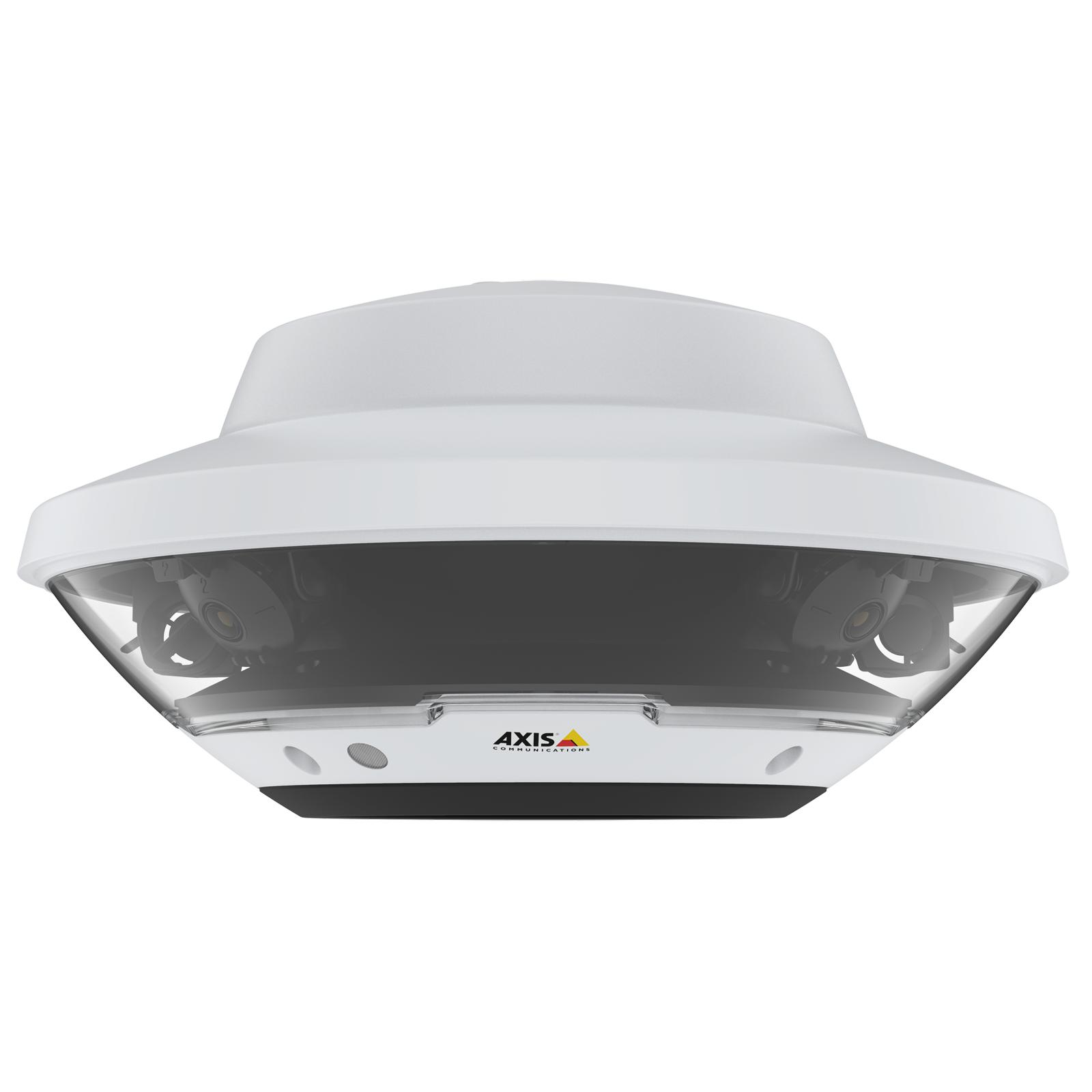
Wide-area monitoring at city scale demands a fundamentally different approach to sensor architecture, and the Axis Q6100-E is built around exactly that premise. Rather than stretching a single sensor across a full horizontal plane, it uses 4 independent 5MP sensors arranged to deliver a continuous 360-degree field of view at a combined resolution of 20MP, with each sensor covering its dedicated 90-degree quadrant at full native sharpness. Featuring exchangeable and individually tiltable lens assemblies, the Q6100-E can be adjusted after mounting to match the actual geometry of a site, which is critical for elevated pole-top positions at intersections, transport nodes, and public precincts where fixed-angle optics would leave ground-level coverage gaps. It integrates directional audio detection and is rated to IP66, IK10, and NEMA 4X for exposed infrastructure deployments. Designed to pair with AXIS Q61 Series or AXIS Q63 Series PTZ cameras via one-click control, it serves as the overview layer in a combined situational awareness and targeted detail architecture.
Key Capabilities
4-Sensor 360-Degree Imaging at 20MP
Four dedicated 5MP sensors each handle a 90-degree quadrant independently, producing a combined 20MP panoramic output with consistent edge-to-edge sharpness. This discrete-sensor approach avoids the geometric compression and peripheral resolution loss that is inherent to single-sensor fisheye designs when stretched across equivalent coverage angles.
One-Click PTZ Integration
The Q6100-E is designed to function alongside AXIS Q61 Series or AXIS Q63 Series PTZ cameras in a paired architecture. Operators can direct the companion PTZ to any point in the panoramic feed with a single click, combining continuous 360-degree overview with optical zoom tracking from one installation position without switching between separate interfaces.
Exchangeable and Tiltable Lens System
Each of the 4 sensor heads accepts exchangeable lenses and can be tilted independently post-installation. For elevated pole or wall mounts, the tilt angle of each sensor directly determines how much ground-level area falls within usable coverage, making this adjustment a site-survey decision rather than a factory default accepted at purchase.
Infrastructure-Grade Housing: IP66, IK10, NEMA 4X
The combination of IP66 ingress protection, IK10 mechanical impact resistance, and NEMA 4X corrosion and severe weather certification places this housing above the threshold of standard commercial-grade enclosures. It is suited to exposed outdoor infrastructure including coastal sites, industrial compounds, and energy facilities where environmental stress is a design constraint.
Wide Dynamic Range Imaging
WDR handles high-contrast scenes such as sunlit open plazas with shaded entry points, or transport concourses mixing natural and artificial light sources. Subject detail remains recoverable across the full panoramic field rather than being lost to overexposure in bright zones or underexposure in shadow areas.
Directional Audio Detection
The Q6100-E identifies the approximate bearing of a sound event relative to the camera position, allowing operators to correlate an audio trigger with the correct quadrant in the 360-degree visual feed. This spatial audio layer supports faster incident response across large open areas without requiring a separate dedicated audio device.
Best For
- City Intersections and Town Squares: A single pole-top Q6100-E covers all approach roads and pedestrian flows in every direction simultaneously at 20MP combined resolution, with the tiltable lens system adjusted post-install to match the intersection geometry and mounting height.
- Transport Hubs and Station Concourses: Full-perimeter 360-degree coverage from one mounting position reduces the number of infrastructure runs and camera positions required to eliminate blind spots across high-throughput multi-entry environments.
- Critical Infrastructure Perimeters: IP66, IK10, and NEMA 4X ratings support deployment at substations, water treatment facilities, and energy sites where weather severity, corrosion risk, and physical interference exceed the tolerance of standard commercial housings.
- Stadiums and Arena Entry Plazas: The 20MP output and WDR imaging retain usable subject detail across crowd-dense outdoor concourses under high-contrast daytime lighting, with the companion PTZ available to focus on any individual without switching views.
- Open Campus and Hospital Precincts: Distributed foot traffic across large grounds is covered from fewer elevated positions, with directional audio detection adding a second incident-awareness layer across areas where audio events may occur away from the nearest camera.
Why Choose the Axis Q6100-E
The Axis Q6100-E addresses a structural limitation in single-sensor panoramic cameras: stretched coverage produces inconsistent resolution. By assigning a dedicated 5MP sensor to each 90-degree quadrant, it delivers 20MP of synchronised panoramic output where sharpness is uniform from centre to edge across the full 360-degree field. The exchangeable, tiltable lens design means each sensor assembly can be precisely directed to the actual ground geometry of the site after mounting, rather than committing to fixed optics before installation conditions are fully understood. The confirmed NEMA 4X rating extends environmental suitability beyond what IP66 alone covers, making it a practical specification for coastal, industrial, and infrastructure-adjacent deployments. Directional audio detection adds spatial incident awareness without a separate device, and one-click PTZ integration with AXIS Q61 or Q63 Series cameras creates an overview-and-detail solution from a single pole or wall position. Available through Security Wholesalers, the Q6100-E is a purpose-built component in a larger AXIS system rather than a general-purpose panoramic camera.
Buyer Decision Tips
Buyer Tip 1 – PTZ Dependency: The Q6100-E is not designed as a standalone unit. It functions as the overview layer in a system that requires a compatible AXIS Q61 Series or AXIS Q63 Series PTZ camera to enable one-click targeted tracking from the panoramic feed. Before ordering, confirm that the companion PTZ is within scope for the same project. Deploying the Q6100-E without a compatible PTZ unit means the core overview-and-detail architecture this camera is built around cannot be fully realised on site.
Buyer Tip 2 – Lens Selection and Tilt Planning: The correct lens focal length for each sensor head should be determined during the site survey based on mounting height and required ground-level coverage radius. For elevated pole-top installations, the tilt angle of each sensor assembly has a direct and significant effect on how much of the pedestrian or traffic zone falls within usable coverage. Specifying the wrong lens before installation can require a return visit to swap lens modules on-site, so this decision should be confirmed as part of the pre-installation design process, not after the camera is mounted.
Key Features & Technical Specifications
| Model |
Axis Q6100-E (01710-001) |
| Number of Sensors |
4 x 5MP |
| Total Combined Resolution |
20MP |
| Field of View |
360 degrees |
| Video Compression |
H.264 |
| Wide Dynamic Range |
Yes |
| Lens Type |
Exchangeable and tiltable (per sensor head) |
| Audio |
Directional audio detection |
| Weather Protection |
IP66 |
| Vandal Resistance |
IK10 |
| Environmental Rating |
NEMA 4X |
| Power Input |
PoE+ |
| Mains Frequency |
50Hz |
| PTZ Integration |
One-click PTZ control with AXIS Q61 Series or AXIS Q63 Series cameras |
| Compatibility Requirement |
Requires AXIS Q61 Series or AXIS Q63 Series PTZ camera for full system operation |
Ideal Use Cases
Urban Intersections
All approach roads and pedestrian crossings are covered from a single pole-top position using the 4-sensor 360-degree array. The tiltable lens assemblies are adjusted after mounting to direct each 90-degree quadrant toward the ground zone relevant to the intersection layout and traffic flow pattern.
Rail and Bus Terminal Concourses
High-throughput transport environments with simultaneous multi-directional passenger flows benefit from the continuous 360-degree perimeter view. One paired installation position replaces multiple directional camera runs, reducing cabling complexity while maintaining full coverage of entry, exit, and platform access zones.
Stadium and Arena Entry Plazas
Crowd-dense external concourses are monitored at 20MP combined resolution with WDR preserving subject detail under high-contrast outdoor lighting during events. The one-click PTZ integration allows operators to direct the companion unit to any area of the panoramic view without switching systems or losing the overview context.
Energy and Utilities Infrastructure
IP66, IK10, and NEMA 4X ratings support installation at exposed substations, water treatment facilities, and power infrastructure where corrosion, windblown particulate, and physical interference risk would eliminate standard commercial enclosures as a viable option for long-term outdoor deployment.
Open Campus Environments
University and hospital precincts with large open grounds require fewer elevated camera positions when 360-degree coverage is achieved per mounting point. Directional audio detection adds a spatial incident-awareness layer that helps operators identify which quadrant of the panoramic view to focus on when a sound event is detected across open ground.
Choosing the Right Model
- Choose this model if: You are building a paired overview-and-PTZ system using AXIS Q61 Series or AXIS Q63 Series equipment and require uninterrupted 360-degree coverage at 20MP combined resolution from a single outdoor-rated housing. The exchangeable, tiltable lens system is particularly relevant for elevated installations where post-mount angle adjustment is needed to achieve the correct ground-level coverage geometry.
- Choose a different model if: The project requires a fully standalone panoramic camera with no dependency on a companion PTZ unit, or if the installation scope does not include a compatible AXIS Q61 or Q63 Series PTZ. Applications requiring partial directional coverage rather than a full 360-degree perimeter view, or projects with tighter infrastructure budgets, may be better served by a fixed multi-directional camera with fewer sensor heads and a lower overall system cost.
FAQs
- Does the Axis Q6100-E operate as a standalone camera, or does it require a companion PTZ?
The Q6100-E captures panoramic imagery independently but is specifically designed to function as the overview layer in a paired system with a compatible AXIS Q61 Series or AXIS Q63 Series PTZ camera. The one-click PTZ targeting that defines its operational architecture cannot be used without the companion unit present in the same installation. It should not be specified as a standalone replacement for a conventional panoramic camera.
- Why does the 4-sensor approach produce better results than a single-sensor fisheye at the same total resolution?
A fisheye lens maps a flat sensor onto a circular 360-degree field by applying geometric correction that compresses effective resolution toward the outer edges of the image. Four independent 5MP sensors each capture their 90-degree quadrant at full native resolution without any geometric stretching, producing consistent sharpness from the centre of each quadrant to its edge. The result is a 20MP combined panoramic field where detail quality is uniform rather than degrading toward the periphery.
- What does the tiltable lens system allow that a fixed-lens panoramic camera does not?
Each sensor assembly on the Q6100-E can be tilted independently after the camera is mounted, directing the optical axis of that sensor at the specific angle required to maximise usable ground-level coverage from the actual mounting height. For pole-top installations at intersections or elevated wall mounts at transport hubs, this post-mount adjustment determines how much of the pedestrian and vehicle zone falls within each sensor’s coverage area. A fixed-angle lens commits to one optical geometry regardless of site conditions.
- What does NEMA 4X certification add beyond the IP66 rating?
IP66 covers protection against dust ingress and high-pressure water jets. NEMA 4X extends this to include resistance to corrosion, windblown dust and debris, and hose-directed water from any direction, with additional requirements relevant to chemical and salt-air exposure. For coastal installations, industrial compounds, or sites adjacent to chemical processing, NEMA 4X is the rating that confirms housing suitability where IP66 alone may not account for the full range of environmental stresses present.
- What is directional audio detection and what is it not?
Directional audio detection identifies the approximate bearing of a sound event relative to the camera position, allowing operators to correlate an audio alert with the correct quadrant in the 360-degree panoramic view. It is a detection and spatial localisation function. The Q6100-E does not have a confirmed built-in microphone and speaker combination for real-time voice communication, and it should not be specified for applications where two-way audio interaction is a requirement.
- How should VMS and storage capacity be calculated for the Q6100-E?
The Q6100-E produces simultaneous video streams from 4 individual 5MP sensors, so the VMS or network recorder must handle the combined processing and storage load across all 4 channels in addition to any streams from the paired PTZ unit. H.264 compression is confirmed for this model, which helps manage bandwidth and storage volume, but server CPU capacity, network throughput, and total storage should be scoped for the full multi-sensor output as part of the system design process rather than treated as a single-channel camera load.
- Where is the Axis Q6100-E available for purchase in Australia?
The Axis Q6100-E (01710-001) is available through Security Wholesalers. Given that this camera requires a compatible AXIS Q61 Series or AXIS Q63 Series PTZ unit to form a complete system, it is strongly recommended to confirm and order both components together so the full overview-and-detail architecture is in place before the installation date.
Additional Information