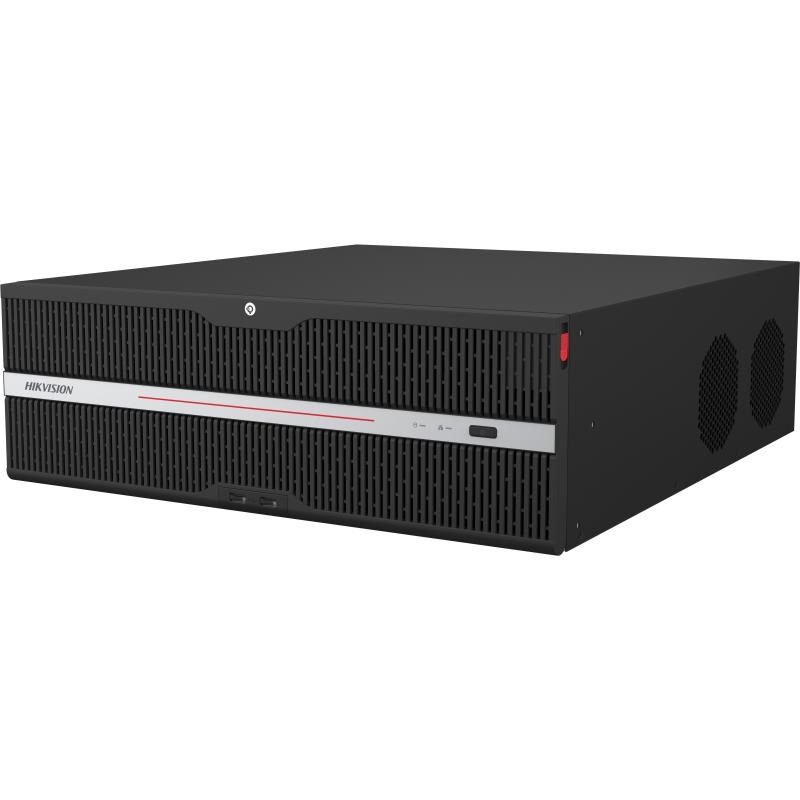
Product SKU: DS-96256NXI-S16R
Product Overview
The Hikvision DS-96256NXI-S16R is a 256-channel AcuSense Ultra Series network video recorder designed for large-scale commercial and enterprise surveillance systems. It supports IP camera input up to 32 MP, provides high recording bandwidth and includes 16 SATA interfaces for substantial local storage capacity. The recorder also supports RAID, N+M hot spare operation and redundant power, making it better suited to sites where recording continuity and storage resilience are critical. Intelligent analytics include facial recognition, perimeter protection, video structuralisation and AcuSearch, with additional camera-based functions available when supported by connected devices. Multiple HDMI and VGA outputs, including an HDMI output up to 8K, allow the recorder to support complex control-room display requirements. This model is best suited to campuses, transport facilities, warehouses, shopping centres, large offices and multi-building sites where camera count, bandwidth, storage design and centralised monitoring must all be planned at enterprise scale.
Key Capabilities
256-Channel Camera Capacity
Connect and manage up to 256 IP cameras from one central recorder. This high channel count suits large sites that need unified recording, playback and monitoring rather than multiple smaller recorders spread across the network.
Enterprise Storage Architecture
Sixteen SATA interfaces support substantial internal storage, while RAID 0, 1, 5, 6 and 10 provide several ways to balance capacity, redundancy and performance. N+M hot spare support further strengthens recorder resilience in larger system designs.
High Recording Bandwidth
Incoming bandwidth up to 1280 Mbps supports demanding camera networks with high channel counts and high-resolution streams. The system designer should still calculate the complete bitrate load, particularly when RAID mode is enabled.
AcuSense Search and Analytics
The recorder supports facial recognition, perimeter protection, video structuralisation and AcuSearch. These tools help operators locate relevant events and classify targets more efficiently than reviewing large volumes of footage manually.
Multi-Screen Control-Room Output
Four HDMI outputs and two VGA outputs support complex local display layouts. HDMI 3 provides output up to 8K, allowing the recorder to serve high-resolution monitoring environments when the display arrangement is configured correctly.
Redundant Power Design
Redundant power supplies improve availability in installations where a single power supply failure should not immediately interrupt recording. This feature is particularly relevant to critical infrastructure and continuously monitored commercial sites.
Best For
- Large Commercial Sites: Suitable for shopping centres, major warehouses, office campuses and other properties requiring centralised recording across many cameras.
- Control Rooms: Multiple HDMI and VGA outputs support complex monitoring layouts and high-resolution local display requirements.
- Long-Retention Systems: Sixteen HDD bays and RAID support suit projects where large storage capacity and data resilience are important.
- AI-Assisted Investigation: AcuSearch, facial recognition, perimeter protection and video structuralisation help operators review events more efficiently.
- Critical Recording Environments: RAID, N+M hot spare and redundant power support projects where recording continuity must be prioritised.
Why Choose the DS-96256NXI-S16R
The DS-96256NXI-S16R is intended for projects that have moved beyond the capacity and resilience of standard commercial NVRs. Its 256-channel architecture, high network bandwidth, 16 internal HDD bays and RAID support allow one recorder to manage a very large surveillance environment while maintaining structured storage and playback. The key difference is not simply the channel count. This model also provides enterprise-focused features such as redundant power, N+M hot spare, multi-screen video output and integrated analytics for faster investigation. Supplied by Security Wholesalers, it is better suited to professionally designed systems where recording throughput, storage retention, AI workload and control-room display requirements have all been calculated in advance. Buyers should choose it for its scale and system resilience rather than treating it as a larger version of a basic NVR.
Buyer Decision Tips
Buyer Tip: Do not size this recorder by channel count alone. Confirm the combined camera bitrate, required AI functions, playback demand, RAID mode and monitor layout because each of these can affect the practical capacity of the final system.
Buyer Tip: Sixteen 20 TB drives provide a large raw capacity, but usable storage will be lower after RAID is configured. Calculate retention using the intended resolution, frame rate, recording schedule, compression settings and RAID level before selecting hard drives.
Key Features & Technical Specifications
| Product Type |
256-channel Ultra Series AcuSense network video recorder. |
| IP Camera Inputs |
Up to 256 IP camera channels. |
| Maximum Camera Resolution |
Up to 32 MP. |
| Incoming Bandwidth |
Up to 1280 Mbps in standard operation. |
| Outgoing Bandwidth |
Up to 1024 Mbps in standard operation. |
| RAID Mode Bandwidth |
Up to 640 Mbps incoming and 512 Mbps outgoing. |
| Decoding Capacity |
Up to 2 channels at 32 MP, 8 channels at 8 MP, 16 channels at 4 MP or 32 channels at 1080p at 30 fps. |
| Synchronous Playback |
Up to 16 channels. |
| Recording Resolution |
Supports recording resolutions up to 32 MP. |
| Video Compression |
H.265+, H.265, H.264+ and H.264. |
| AI by NVR |
Facial recognition, perimeter protection and video structuralisation. |
| AcuSearch |
Up to 32 channels by NVR, with compatible camera-based AcuSearch available across supported channels. |
| Face Libraries |
Up to 64 face picture libraries with up to 300,000 face pictures. |
| Face Comparison |
Up to 16 channels, with comparison speed up to 24 pictures per second. |
| HDMI Outputs |
4 HDMI outputs, including HDMI 3 output up to 8K at 30 Hz. |
| VGA Outputs |
2 VGA outputs up to 1080p. |
| HDMI Input and Loopback |
1 HDMI input and 1 matching HDMI loopback output. |
| Audio Output |
2-channel RCA audio output. |
| Two-Way Audio |
1-channel RCA two-way audio interface. |
| HDD Interfaces |
16 SATA interfaces for 3.5-inch hard drives. |
| Maximum HDD Capacity |
Up to 20 TB per HDD. |
| Included Storage |
Hard drives are not stated as included. |
| RAID Support |
RAID 0, RAID 1, RAID 5, RAID 6 and RAID 10. |
| Hot Spare |
Supports N+M hot spare operation. |
| Network Interfaces |
4 × RJ45 10/100/1000/2500 Mbps self-adaptive Ethernet interfaces. |
| Remote Connections |
Up to 512 remote connections. |
| eSATA |
1 eSATA interface. |
| USB Interfaces |
2 × USB 2.0 on the front and 4 × USB 3.0 on the rear. |
| Alarm Inputs and Outputs |
32 alarm inputs and 16 alarm outputs. |
| Serial Interfaces |
1 × RS-232 and 2 × RS-485 half-duplex interfaces. |
| Power Supply |
Redundant power supply. |
Ideal Use Cases
Shopping Centres
Supports centralised recording for large numbers of cameras covering entrances, retail areas, loading zones, car parks and back-of-house spaces.
Warehouses and Logistics
Suitable for extensive camera networks across loading docks, storage aisles, dispatch zones, yards and perimeter areas.
Education Campuses
Provides high channel capacity for schools, universities and training campuses with multiple buildings and central monitoring requirements.
Transport Facilities
Supports large camera deployments and multi-screen monitoring for terminals, depots, platforms, vehicle areas and passenger access points.
Corporate Campuses
A practical central recorder for offices and multi-building commercial sites requiring structured storage, analytics and control-room display outputs.
Critical Infrastructure
RAID, hot spare support and redundant power suit environments where storage resilience and continuous recording are major design priorities.
Choosing the Right Model
- Choose this model if: The project requires up to 256 cameras, high recording bandwidth, 16 HDD bays, RAID, redundant power and complex control-room outputs.
- Choose a smaller recorder if: The site has a substantially lower camera count and does not require enterprise storage, multi-screen output or high-availability features.
- Plan the system carefully if: The project uses RAID, high-resolution cameras or extensive AI analytics, because bandwidth, decoding capacity and usable storage must be calculated together.
FAQs
- How many IP cameras can the Hikvision DS-96256NXI-S16R support?
The DS-96256NXI-S16R supports up to 256 IP camera channels, with camera input resolution up to 32 MP. It is designed for large surveillance systems where many cameras need to be recorded and managed from one enterprise-grade recorder. Camera bandwidth, storage planning and decoding requirements should still be calculated before installation so the final system remains within the recorder’s confirmed performance limits.
- How much recording bandwidth does the DS-96256NXI-S16R provide?
The DS-96256NXI-S16R supports up to 1280 Mbps incoming bandwidth and 1024 Mbps outgoing bandwidth in standard operation. In RAID mode, these limits are 640 Mbps incoming and 512 Mbps outgoing. This distinction matters when planning a high-channel-count system because enabling RAID improves storage resilience but changes the available recording and output bandwidth.
- How many hard drives can be installed in the DS-96256NXI-S16R?
The DS-96256NXI-S16R provides 16 SATA interfaces for 3.5-inch hard drives, with support for up to 20 TB per drive. Hard drives are not stated as included with the recorder, so storage must be selected separately. Final retention time depends on camera count, resolution, frame rate, compression settings, recording schedule and the usable capacity remaining after RAID is configured.
- Which RAID levels are supported by the DS-96256NXI-S16R?
The DS-96256NXI-S16R supports RAID 0, RAID 1, RAID 5, RAID 6 and RAID 10, as well as N+M hot spare operation. RAID can improve storage availability and help reduce the risk of data loss caused by drive failure, but it also reduces usable storage capacity. The selected RAID level should match the required balance between resilience, write performance and retention time.
- What AI analytics are supported by the DS-96256NXI-S16R?
The DS-96256NXI-S16R supports NVR-based facial recognition, perimeter protection and video structuralisation, together with camera-based analytics such as AcuSearch, Motion Detection 2.0, ANPR, people counting and VCA where supported by the connected cameras. Actual channel capacity varies by function, so the required analytics workload should be checked during system design rather than assuming every AI feature can run across all 256 channels simultaneously.
- Can the DS-96256NXI-S16R display video at 8K resolution?
Yes. HDMI 3 supports video output up to 8K at 30 Hz, while the recorder also provides additional HDMI and VGA outputs for multi-screen monitoring. The available output combinations depend on the selected display mode. Buyers planning a control room should confirm the required monitor layout, output resolution and independent display arrangement before installation.
- Is the DS-96256NXI-S16R suitable for large commercial surveillance systems?
Yes. The DS-96256NXI-S16R is built for large, high-channel-count installations such as campuses, warehouses, transport facilities, shopping centres and multi-building sites. Its 256-channel capacity, 16 drive bays, RAID support, high network bandwidth and multiple display outputs suit centralised monitoring environments. Security Wholesalers can supply the recorder for projects where these capacities align with the final camera, storage and network design.
- What should be checked before choosing the DS-96256NXI-S16R?
Confirm the final camera count, total incoming bitrate, AI workload, storage retention target, RAID level, monitor layout and network architecture before selecting the DS-96256NXI-S16R. A common mistake is to size only by channel count. This recorder can support 256 cameras, but bandwidth, decoding capacity, storage utilisation and analytics limits must also match the intended design, especially when RAID and high-resolution cameras are involved.