

















Commercial
TVT NVR Buying Guide
TVT CCTV
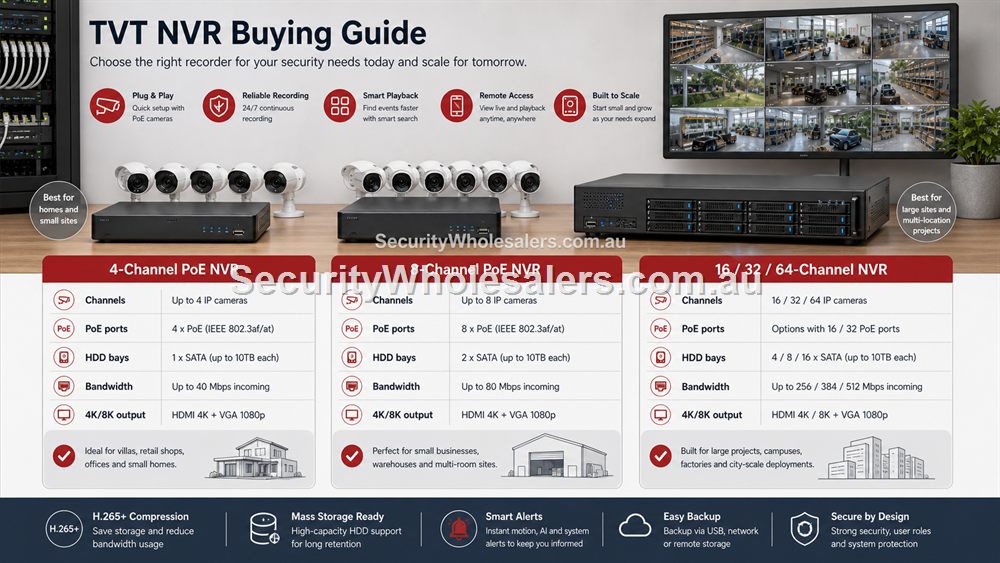
How to think about TVT NVR Buying Guide
TVT NVR Buying Guide should be approached as a site design decision rather than a catalogue exercise. The right TVT camera or recorder depends on the view, the lighting, the distance, the storage target and the support path after installation. A buyer comparing TVT products for nvr buying should ask what problem the equipment is solving before comparing megapixels or channel counts.
For nvr buying, the practical questions are: what must be identified, what only needs overview, where does night performance matter, how will footage be recorded, and how likely is the system to grow? When those questions are answered for TVT NVR Buying Guide, the product path becomes much clearer.
Common nvr buying mistakes to avoid
For TVT NVR Buying Guide, the biggest mistake is buying by one specification. A higher megapixel camera can still be wrong if the lens is too wide, the lighting is poor or the NVR storage is undersized. A recorder with enough channels can still be wrong if it has insufficient storage or bandwidth. A full-colour camera can still be wrong if visible light will annoy neighbours or customers.
The second nvr buying mistake is leaving handover vague. The owner should know where the recorder is, how remote viewing is managed, what each camera is named, what the storage expectation is and what to do if internet or app access changes.
What good nvr buying looks like after installation
A good TVT NVR Buying Guide outcome is easy to explain. The camera names match real locations, the recorder has enough storage for the agreed retention target, the high-detail cameras are aimed at the right choke points and overview cameras are not expected to identify faces across a large scene.
The nvr buying system should also be serviceable. Cable routes, power, network switch locations, recorder login ownership and remote viewing setup should be documented so a future support person can understand the job quickly.
NVR sizing is more than channel count
A TVT NVR must be sized for channel count, camera resolution, recording mode, storage target and network layout. A four-channel recorder can suit a small home or tiny shop, but it leaves no space once the buyer adds a driveway, side path, stockroom or rear door camera. An eight-channel recorder is often a more comfortable small-system path.
For larger sites, 16-channel and larger NVRs should be treated as system infrastructure. The buyer should think about HDD bays, recorder bandwidth, PoE switching, monitor output, remote viewing and whether the site has multiple camera groups.
Retention planning
Retention means how long footage remains before it is overwritten. It is affected by camera count, resolution, frame rate, compression, recording schedule, motion/event settings and hard drive size. A higher-resolution camera system may need more storage to keep the same number of days.
A good TVT NVR quote should state the expected retention assumption. If the buyer expects 30 days, the system should be designed for that rather than hoping the default hard drive is enough.
NVR bandwidth and storage sanity check
A TVT NVR buyer should confirm more than the number printed before "channel". Higher-resolution cameras, continuous recording, busy scenes and longer retention targets all increase the recorder and storage requirement. If the site may later add more cameras, choose the recorder and hard drive path with expansion in mind rather than treating the first camera count as permanent.
Fast selector
| Buyer situation | Recommended TVT path | Why |
|---|---|---|
| Small/simple site | 4MP/6MP cameras and small PoE NVR | Good value and easy support. |
| Higher-detail scene | 8MP or higher camera path | More useful pixels for entrances, cars or wider views. |
| Night evidence is important | Full-colour or dual-light camera path | Better after-hours scene information when lighting is planned. |
| Larger site | 16-channel or larger NVR with storage plan | Avoids outgrowing the recorder. |
Expert buyer notes
For TVT NVR Buying Guide, the best result usually comes from assigning each camera a job. Door cameras identify. Driveway cameras capture vehicles and direction. Wide cameras explain what happened. Fisheye or panoramic cameras provide context. Night cameras need a lighting plan. NVRs record the result and must be sized for the number of cameras, resolution, frame rate and retention target.
For this tvt nvr buying guide page, avoid asking one camera to do every job. A wide camera can show a whole room but may not identify a face at distance. A high-resolution camera can capture more detail but needs storage and lighting. A dual-light camera can improve night evidence but visible light must be acceptable for the site. A recorder can have enough channels but still need a better hard drive plan.
A tvt nvr buyer should decide what a successful review looks like before choosing the hardware. If the goal is to identify a person at a counter, the camera needs the right distance and angle. If the goal is to understand activity in a yard, the design may need wider context and stronger night planning. If the goal is staff safety or incident review, camera names and recorder access need to be simple enough that footage can be found quickly.
A strong TVT NVR Buying Guide order includes the product path and the installation assumptions. It should describe camera count, camera roles, recorder size, expected storage retention, night behaviour, remote viewing ownership and future expansion. That level of detail prevents the common problem where the hardware is technically fine but the finished system does not answer the site's real questions.
Worked buying example for TVT NVR Buying Guide
Picture a buyer comparing TVT options for tvt nvr buying guide. The weaker approach is to start with a recorder size and fill it with cameras that sound impressive. The better approach is to mark the site plan first: entrances that need identification, open areas that need overview, night scenes that need lighting decisions, and any camera that may require higher resolution or a special form factor.
From there, the tvt nvr buyer can choose a TVT path with confidence. A smaller system may use a 4/8-channel PoE NVR and a mix of 4MP/6MP cameras. A more demanding TVT NVR Buying Guide project may use 8MP cameras at key points, dual-light or full-colour cameras at night-sensitive areas, and a 16-channel or larger NVR with enough storage. The exact model list should follow that site map, not the other way around.
The final check for TVT NVR Buying Guide is whether the system will still make sense six months later. Camera names should match real locations, the recorder should have a known storage expectation, app access should be owned by the right person, and any future expansion should be obvious. This is especially important for TVT buyers because the range can suit small jobs and larger systems, but only if the design is clear before ordering.
For SecurityWholesalers customers comparing TVT products, the safest buying path for tvt nvr buying guide is to send the site story with the order: what the site is, what needs to be seen, what happens at night, how many days of footage matter, and whether the system is likely to grow. Those details allow the camera and recorder choice to become a recommendation rather than a guess.
The final sanity check for tvt nvr is simple: if someone who did not install the system can look at the notes and understand the camera roles, recorder size, storage expectation and app ownership, the design is in good shape. If those details are unclear, refine the TVT plan before buying.
Quote-ready ordering checklist
- Camera count now and likely future camera count.
- Which views need identification and which only need overview.
- Night lighting: IR, full colour, dual illumination or existing site lighting.
- NVR channel count, PoE needs, storage target and monitor/app requirements.
- Cable routes, mounting heights, weather exposure and network handover.
Good, better and best buying path
| Path | Best fit | What changes |
|---|---|---|
| Good | Small home, small office or basic shop coverage | Use sensible 4MP/6MP cameras and a small PoE NVR with clear camera names. |
| Better | Small business, larger home or mixed day/night site | Add spare NVR channels, stronger camera placement, dual-light/full-colour choices where useful and a clearer storage target. |
| Best | Warehouse, multi-zone business, larger retail or higher-risk site | Design the system around camera roles, NVR bandwidth, storage retention, network layout, UPS discussion and handover documentation. |
Recommended SecurityWholesalers TVT product paths
TVT 4-channel PoE NVRs
Compact recorder path for small homes, small shops and simple four-camera systems.
Choose this if: Choose this if the system is definitely small and the buyer does not expect many extra cameras.
Watch out: A 4-channel recorder can be outgrown quickly. Leave expansion room if the site is uncertain.
TVT 8-channel PoE NVRs
The stronger default for many small businesses and larger homes because it gives room beyond a basic four-camera start.
Choose this if: Choose this for 4-8 camera systems, or where the site may add cameras later.
Watch out: Check HDD capacity and camera resolution before assuming retention time.
TVT 16-channel NVRs
A practical path for warehouses, larger homes, small commercial sites and multi-zone CCTV.
Choose this if: Choose this when the site has several camera groups or may grow beyond 8 cameras.
Watch out: Plan PoE switching, cabinet layout and storage rather than focusing only on channel count.
TVT 32/64-channel NVRs
Larger recorder paths for multi-building, warehouse, strata, school, industrial or larger commercial CCTV systems.
Choose this if: Choose this when the site has many cameras, multiple switches or a serious recording requirement.
Watch out: Large systems need design: bandwidth, storage, network topology, roles and handover documentation.
Real quote scenarios
| Scenario | Practical TVT design | Why it works |
|---|---|---|
| Small site | 4-6 cameras, PoE NVR, clear camera names. | Simple, supportable and easy to expand modestly. |
| Medium business | 8-12 cameras, 16-channel recorder, mixed overview/detail cameras. | Matches camera roles to site risk. |
| Complex site | Multiple camera groups, larger NVR, storage and network plan. | The recorder and network are designed before hardware is ordered. |
Final decision table
| Decision | Choose lower/spec simpler | Choose higher/spec stronger |
|---|---|---|
| Resolution | Overview, short distance, controlled storage | Identification, wider views, car parks or entrances |
| Night mode | IR where discreet black-and-white is acceptable | Full colour or dual light where colour evidence matters |
| Recorder | 4/8-channel PoE for small systems | 16/32/64-channel for larger sites or growth |
| Storage | Shorter retention and lower camera count | Longer retention, higher resolution or continuous recording |
TVT NVR Buying Guide FAQs
- Is TVT a good CCTV option?
TVT can be a strong practical CCTV choice when the camera resolution, recorder, storage and installation conditions are matched properly.
- Should I buy the highest megapixel TVT camera?
Not automatically. Higher resolution helps in the right scene, but placement, lens angle, lighting, storage and recorder capacity are just as important.
- How many TVT cameras do I need?
Count the views, not just the building size: entrances, driveways, counters, blind spots, yards, offices and high-risk areas may each need different camera roles.
- Does SecurityWholesalers supply TVT products?
Yes. SecurityWholesalers lists TVT CCTV products including cameras and NVR options in the TVT category.
- What is the safest way to choose TVT NVR Buying Guide?
Write down the site problem, camera count, night requirement, recorder size, storage target and future expansion before ordering.
- Can TVT NVR Buying Guide be installed DIY?
Some buyers can install simple systems, but larger TVT systems should be planned carefully around cabling, PoE, network, storage, mounting height and handover.