












Commercial
Best CCTV System for Car Washes in Australia
Return to CCTV Systems for Car Washes hub
Commercial Buying Guide
Car-wash buyers are usually asking a practical system question: what CCTV should we buy for this site, these bays, this payment method, this queue flow and this after-hours vandalism risk? The answer is normally a mix of outdoor-rated fixed cameras, some tighter or adjustable views where needed, a sensible NVR size, surveillance-grade storage and cable routes designed for a harsh wet environment.
Quick answer
A small self-serve site may only need 4 to 8 cameras. A typical multi-bay car wash should usually plan around 8 to 12 cameras. Larger 24/7 sites with more payment points, vacuums, tunnel flow or perimeter exposure often need 12 to 16 or more cameras, stronger storage planning, better lighting awareness and more deliberate PoE and equipment protection.
Glossary of what this guide covers
- Recommendation table by site type
- 4 vs 8 vs 16 camera car-wash systems
- Coverage zones and placement logic
- Camera type recommendations
- NVR and recorder selection
- Storage and retention
- PoE, cabling and network planning
- Recommended buying paths
- Recommended packages and product paths
- Related buying categories
- Car-wash CCTV FAQs
At-a-Glance Recommendation Table
| Site type | Typical camera count | Recommended system | Notes |
|---|---|---|---|
| Single automatic bay | 4 to 6 cameras | 8 channel PoE NVR with fixed entry, payment and exit coverage | Usually covers the approach, kiosk, bay entry, bay exit and one after-hours external point. |
| Small self-serve wash | 4 to 8 cameras | 8 channel PoE NVR with outdoor-rated cameras | Enough for one or two bays, payment, vacuums and exposed external edges. |
| Multi-bay self-serve wash | 8 to 12 cameras | 16 channel NVR with mixed fixed and tighter bay views | Needed once several bays, more than one payment point or heavier after-hours risk are involved. |
| 24/7 car wash with vacuums | 10 to 14 cameras | 16 channel NVR, surveillance HDDs and better low-light planning | Vacuums, side entries and external equipment areas often become the real after-hours problem points. |
| Larger site with pay station, tunnel wash and perimeter | 12 to 16+ cameras | 16 channel or larger NVR with stronger storage and protected switching | Needs more careful separation between payment, tunnel flow, perimeter and plant-area coverage. |
Do not choose only by land size. Camera count depends on bays, payment methods, queue flow, vacuum positions, night lighting, perimeter exposure, vandalism risk and how much usable detail the operator wants for disputes later.
4 vs 8 vs 16 Camera Car Wash CCTV Systems
4 camera site system
Suitable for: a very small or simple car wash with one payment point, one entry path and limited after-hours exposure.
Not enough when: the site has several bays, vacuums, separate entry and exit risk or any meaningful external perimeter.
Recorder path: an 8 channel NVR is still the safer buying position.
8 camera car-wash system
Suitable for: many self-serve and small multi-bay sites that need entry, payment, bay and vacuum coverage without overspending.
Not enough when: the site runs 24/7 with bigger perimeter exposure or several bay lines.
Recorder path: 8 channels may work, but 16 often makes future expansion much easier.
16 camera car-wash system
Suitable for: larger and more commercial sites where payment, tunnel flow, several bays, vacuums, plant areas and after-hours perimeter all need separate treatment.
Not enough when: the site becomes a broader multi-use forecourt or service environment.
Recorder path: 16 channel NVR with stronger storage, secure cabinet space and more deliberate switch protection.
Coverage Zones for Car Washes
| Area | Recommended camera type | What to capture | Notes |
|---|---|---|---|
| Bay entry | Fixed or varifocal turret/bullet | Vehicle arrival, driver approach, entry timing | High-value camera for disputes and misuse review. |
| Bay exit | Fixed turret or bullet | Vehicle departure and condition context | Helps complete the entry-to-exit review chain. |
| Wash bays | Outdoor-rated fixed camera | Bay usage, movement and context | Needs hardware suitable for wet and reflective conditions. |
| Payment terminal or kiosk | Fixed turret or dome | Interaction, approach, transaction context | Often one of the most important cameras on the site. |
| Vacuum area | Bullet or turret | Use, loitering and after-hours misuse | Often becomes a night-time problem zone. |
| Chemical or store room threshold | Fixed threshold view | Restricted-area access | Better to treat the threshold deliberately than hope a distant overview covers it. |
| Plant room | Bullet or fixed threshold view | Access and tampering | Important for service and security review. |
| Coin or token machine | Fixed camera | Interaction and tampering context | Often worth a dedicated view. |
| Driveway entry | Varifocal or bullet | Vehicle approach and traffic context | Needs glare and lane geometry considered properly. |
| Street approach or perimeter | Bullet, varifocal or deterrence camera | After-hours approach and vandalism exposure | Useful where the site is open and exposed to the street. |
Go deeper with Car Wash CCTV Coverage Zones and Camera Placement and Payment Points, Bays and Plant-Area CCTV.
Typical Car Wash Layout Diagram
On most car washes, the useful evidence chain is entry, payment, bay and exit. Vacuum and perimeter views become the extra layers that solve after-hours misuse and vandalism.
Important environmental note
Wet areas, overspray, night glare and reflected light matter just as much as megapixels. A camera that is technically high resolution but badly placed in a reflective or wet environment can still be a poor car-wash camera.
Camera Type Recommendations
Fixed cameras
Usually the backbone of a good car-wash system because entries, exits, payment points and bay lines all benefit from stable repeatable evidence views.
Bullet cameras
Often a good fit outdoors on entries, side approaches, perimeters and exposed equipment areas.
Dome cameras
Useful in covered or protected customer interaction zones, but use care in harsher wet environments.
Varifocal or motorised zoom cameras
Helpful on wider queue lanes, forecourts and awkward entry geometry where a standard wide lens may not give enough useful detail. See Fixed, Motorised, PTZ and Deterrence Cameras.
PTZ cameras
Useful as an overview on larger sites, but not a replacement for dedicated entry, bay and payment cameras.
Active deterrence or full-colour cameras
Best used after hours at payment machines, vacuums, side entries or perimeter points where visible warning may help discourage misuse.
ANPR or LPR cameras
Only recommend these where the operator genuinely needs number-plate capture and the lane geometry, angle, distance and shutter planning are right.
NVR / Recorder Selection
| Camera count needed | Recommended recorder | Why |
|---|---|---|
| 1 to 8 cameras | 8 channel NVR | Good starting point for smaller self-serve sites. |
| 9 to 16 cameras | 16 channel NVR | Common for multi-bay and 24/7 sites with broader external exposure. |
| 16+ cameras | Larger NVR or staged design | Needs more deliberate storage, switching and cabinet protection. |
Choose the recorder around channel count, drive bays, incoming bandwidth, retention goals and how securely the head-end equipment can be protected from moisture, tampering and power events. For more detail, continue with Recording, Storage, UPS and Network Planning.
Storage and Retention
Car washes often need footage for damage disputes, payment issues, trespass, vandalism and after-hours misuse. Busy external scenes can generate more data than buyers first expect, especially when the system records continuously.
| System size | Recording approach | Storage planning note |
|---|---|---|
| 4 to 8 cameras | Often continuous on key channels | Payment, bay entry and exit cameras often justify continuous recording. |
| 8 to 12 cameras | Usually more continuous recording | External activity, FPS, codec and resolution can lift storage demand quickly. |
| 12 to 16+ cameras | Heavier storage planning | Use surveillance-grade drives and plan retention before buying the NVR. |
Use the CCTV Storage Calculator if you want a more realistic storage estimate before purchasing.
PoE, Cabling and Network Planning
Wired PoE is normally preferred for car washes, but the cable routes, conduit protection and equipment placement need more care than on a dry indoor site. Wet areas, chemical exposure, glare, external poles and service access all influence the right design.
- Cat6 Ethernet normally has a 100 metre limit.
- Protect cable routes from moisture, impact and service access issues.
- Use secure protected cabinet space for the NVR, switch and router.
- Check PoE budget carefully where night lighting, deterrence or several outdoor cameras are involved.
- UPS backup is worth considering if outage continuity matters for dispute review.
Recommended Buying Paths
Entry / small site
Best fit: HiLook or TP-Link VIGI where the car wash is smaller and the brief is more straightforward.
Why: Good for value-led sites that still want a proper NVR and business-style camera path.
Standard / recommended site
Best fit: Hikvision, Dahua or Uniview for a stronger outdoor commercial mix.
Why: Better suited to wet-area cameras, stronger low-light options and bigger site layouts.
Larger or higher-risk site
Best fit: 16 channel commercial build with stronger low-light, better switching and more deliberate head-end protection.
Why: Suits larger 24/7 sites, heavier vandalism exposure and more equipment zones.
Premium pathway
Best fit: Higher-end Hikvision, Hanwha or Axis path where more advanced analytics or corporate standards matter.
Why: Better suited to larger and more formally managed commercial sites.
Recommended Packages and Product Paths
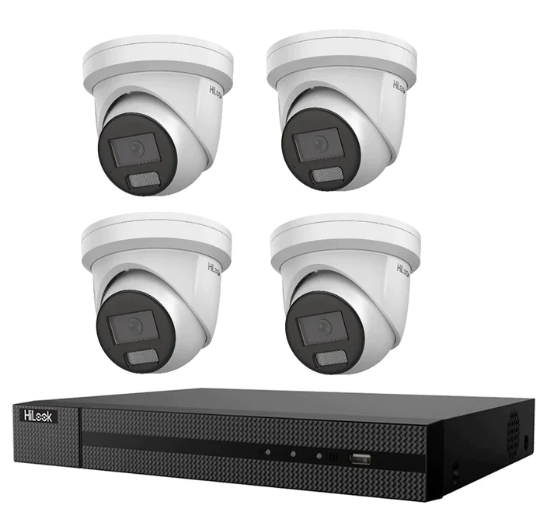
Single-bay or simple covered wash
Main pick: HiLook 8MP 4 camera turret kit
Best for: a simpler site where the cameras can be mounted out of direct overspray while still watching the entry, payment point, bay line and exit.
When to step up: move up if the site has several bays, exposed vacuums, stronger after-hours vandalism risk or heavy glare issues.
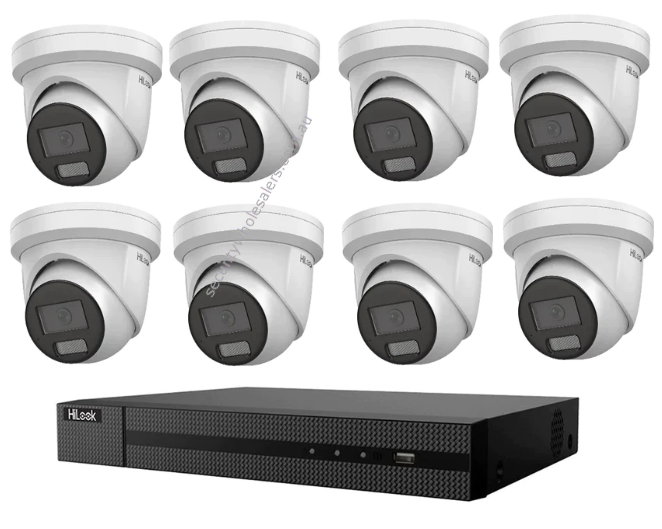
Small self-serve or multi-bay starter
Main picks: HiLook 8MP 8 camera turret kit or Hikvision 8MP ColorVu 3.0 hybrid 8 camera kit
How to choose: the HiLook kit suits a value-led site with normal coverage needs, while the Hikvision ColorVu kit is stronger where the wash wants better night colour and visible warning around payment or vacuum zones.
When to step up: move beyond kit-only thinking once the site is truly 24/7, has several payment points or needs tougher perimeter treatment.
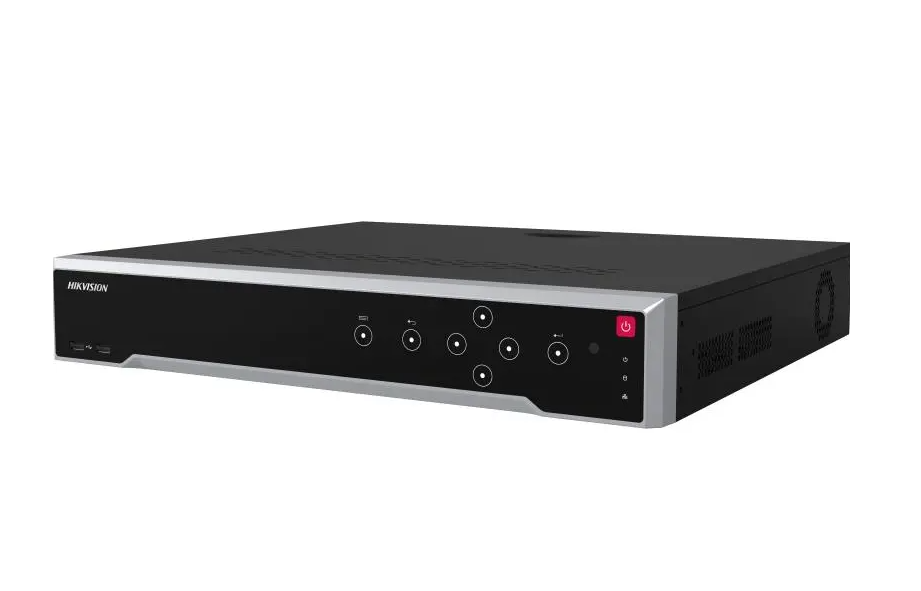
24/7 site with payment and perimeter risk
Camera path: Hikvision ColorVu 3.0 smart hybrid turrets or Hikvision 8MP AcuSense bullet cameras
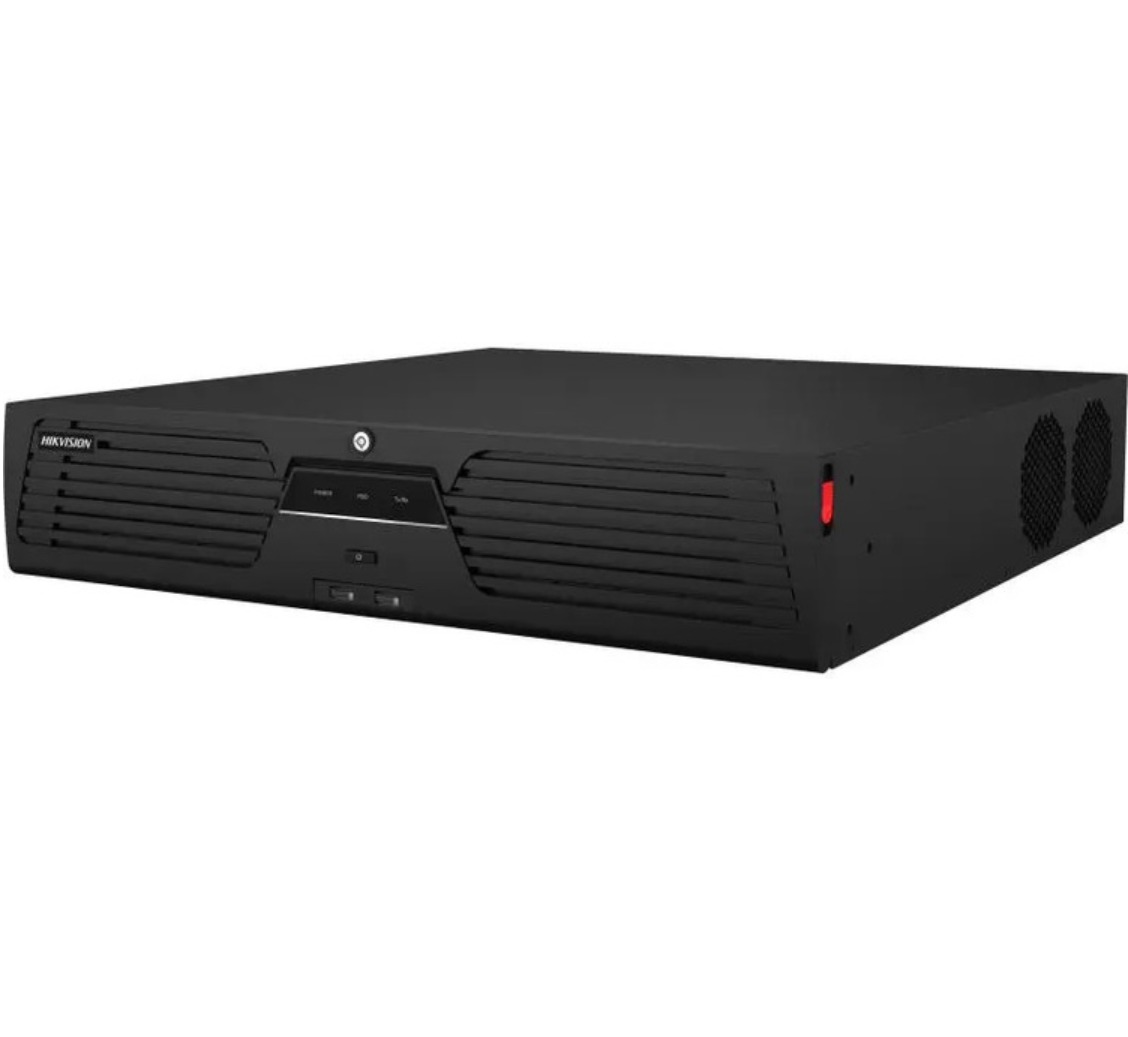
Recorder path: Hikvision 16 channel Ultra Series NVR
Best for: exposed car washes that need stronger after-hours deterrence, outdoor reliability and more disciplined payment-point evidence.
Larger tunnel or perimeter-heavy site
Recorder path: Hikvision 32 channel M-Series NVR
Camera families: a mix of external bullets and smart hybrid turrets.
Best for: tunnel, vacuum and perimeter layouts where the site is clearly beyond a small self-serve CCTV brief.
Related Buying Categories
CCTV Kits
Useful for smaller car-wash starting points.
IP Cameras
Browse fixed, bullet, dome and varifocal cameras.
NVRs
Choose recorder size around channel count and retention.
Hikvision CCTV
Broader commercial CCTV range for outdoor and low-light work.
HiLook CCTV
Value-led path for simpler sites.
Dahua CCTV
Commercial alternative with strong low-light and deterrence options.
Uniview CCTV
Commercial alternative for car-wash CCTV builds.
PoE Switches
Important once the site grows beyond a very small direct-to-recorder layout.
Surveillance Hard Drives
Use surveillance-grade drives for car-wash retention.
UPS Backup
Helps keep recording alive through short power disturbances.
PTZ Cameras
Useful as a supplement on larger sites.
Suggested Next Reads
Compliance / Privacy Note
CCTV may capture staff, customers, contractors and members of the public. Operators should consider signage, notice, camera purpose, footage access, retention and workplace or privacy requirements before installation. Avoid inappropriate areas such as toilets, change rooms and other sensitive spaces. This page is general buying guidance, not legal advice.
After You Buy: Useful Support Guides
Car Wash CCTV FAQs
What is the best CCTV system for a car wash?
For many car washes, the best system is a wired IP camera system with outdoor-rated fixed and varifocal cameras on the entry, payment point, wash bays, vacuum area and after-hours perimeter, backed by a correctly sized NVR and surveillance-grade drives.
How many cameras does a car wash need?
A small self-serve site may use 4 to 8 cameras. Multi-bay car washes often land around 8 to 12, while larger 24/7 sites with more payment points, vacuums and perimeter exposure can move into 12 to 16 or more.
What cameras work best around water and glare?
Outdoor-rated fixed or varifocal cameras with strong WDR, practical low-light performance and suitable housing choices usually work better than generic indoor-style cameras in wet and reflective environments.
Should a car wash use active deterrence cameras?
They can be useful after hours at payment machines, side approaches, vacuum bays or exposed perimeter points, but they are not the answer for every daytime operational view.
Can CCTV help with damage disputes?
Yes, but only if the system was designed for useful evidence. Stable entry, bay and exit views are normally more important than one broad overview camera.
Are number plate cameras useful at a car wash?
They can be, but only where the angle, distance, speed and lighting allow proper plate capture. A standard overview camera is not automatically a reliable ANPR camera.
Should a car wash record continuously?
Many car washes record continuously on the main entry, payment and bay cameras because disputes and misuse do not always align neatly with motion-only triggers.
Do car washes need PTZ cameras?
Some larger sites benefit from a PTZ for broad situational overview, but fixed cameras still need to provide the main evidence views at entries, bays and payment areas.
What is the best CCTV brand for a car wash?
That depends on budget and site complexity. Hikvision, Dahua and Uniview often suit more commercial outdoor builds, while HiLook can still suit simpler value-led jobs.
Can a car wash add more cameras later?
Usually yes, if the NVR, switch capacity and cable paths were planned with expansion in mind. That is why a larger recorder can be the safer buy when the site is likely to grow.