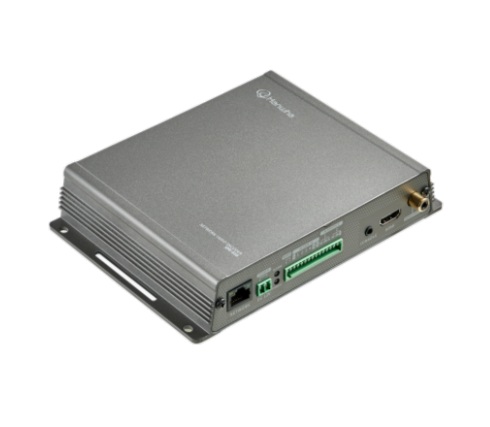
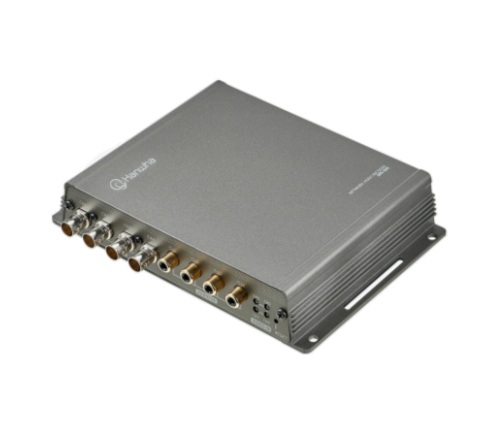
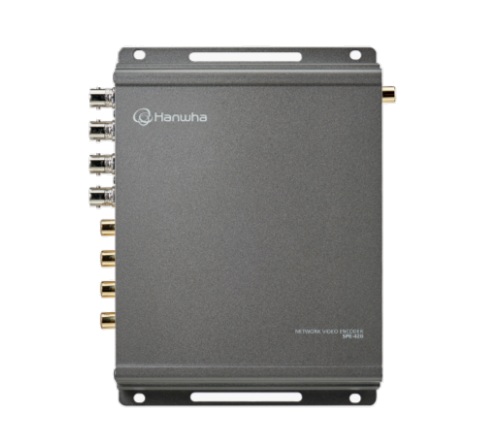
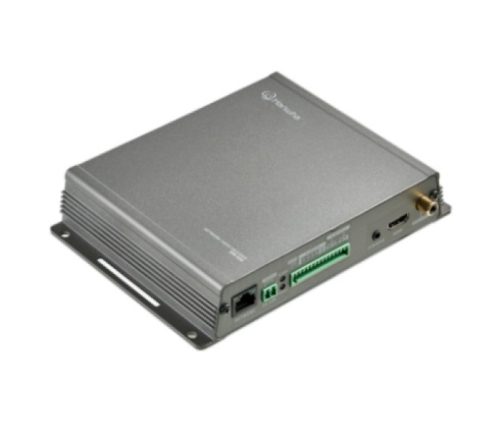
Product SKU: SPE-420
Product Overview
For integrators managing analogue-to-IP migration projects where replacing cameras and cabling is not practical, the Hanwha Vision SPE-420 provides a targeted 4-channel encoding solution. It accepts analogue video from CVBS, AHD, CVI, and TVI cameras with automatic standard detection, encoding those signals for delivery across an IP network using H.265, H.264, or MJPEG compression. The SPE-420 supports analogue camera inputs up to 5MP resolution, with a local HDMI output that displays up to 4 cameras simultaneously at 1920 x 1080 for on-site monitoring or commissioning. RS-485 and coaxial PTZ control interfaces allow compatible analogue pan-tilt-zoom cameras to remain operational within the upgraded system. Alarm I/O, 4 audio line inputs, and support for motion, tamper, and video loss events round out its integration capability. It is well suited to smaller commercial retrofit projects, branch-site upgrades, and mixed-standard analogue environments where infrastructure replacement is not yet viable.
Key Capabilities
4-Channel Analogue-to-IP Encoding
The SPE-420 converts up to 4 analogue camera channels into network-compatible video streams. This allows existing analogue cameras to feed into an IP video management system without requiring physical camera replacement, preserving the value of installed infrastructure.
Multi-Standard Analogue Auto-Detection
Automatic detection of CVBS, AHD, CVI, and TVI input standards removes the need to manually configure each channel. This is particularly useful on sites where cameras from different manufacturers or eras have been installed using different analogue formats.
Up to 5MP Analogue Input Support
The encoder handles analogue camera inputs up to 5MP resolution at 12fps. Sites that have already upgraded to higher-resolution analogue cameras can retain those devices and benefit from improved image quality compared to older standard-definition encoding systems.
Dual-Interface PTZ Control
RS-485 half-duplex control supports SAMSUNG-T and PELCO-P/D protocols, while coaxial PTZ control covers compatible CVBS, AHD, TVI, and CVI cameras. Both interfaces allow existing analogue PTZ cameras to be retained and controlled within a network video environment.
HDMI Multiview Local Output
A built-in HDMI output supports a 4-camera multiview layout at 1920 x 1080. This provides a convenient on-site monitoring option without requiring a separate NVR or display controller, and is useful during installation commissioning and day-to-day local review.
Best For
- Analogue Retrofit Without Cable Replacement: Sites that want IP-based video management while retaining existing BNC-wired analogue cameras and coaxial cabling.
- Mixed Analogue Standard Environments: Installations where CVBS, AHD, CVI, and TVI cameras from different eras or manufacturers are operating on the same site, supported by automatic format detection on each channel.
- PTZ Camera Retention Projects: Upgrade scenarios where existing analogue PTZ cameras still need to be controlled, supported by both RS-485 and coaxial PTZ interfaces.
- Smaller Commercial and Branch Site Upgrades: Offices, retail sites, schools, and branch locations with up to 4 analogue cameras where a full system replacement is not yet feasible.
Why Choose the SPE-420
The SPE-420 addresses one of the most common challenges in commercial surveillance upgrades: how to bring analogue systems into a network video environment without writing off existing camera infrastructure. Its automatic detection across CVBS, AHD, CVI, and TVI standards means it handles mixed analogue environments without manual per-channel configuration. Support for inputs up to 5MP ensures that higher-resolution analogue cameras already on-site are not limited by the encoder. The dual PTZ control interfaces, combining RS-485 and coaxial, cover a wider range of legacy PTZ hardware than encoders that provide only one method. Alarm I/O, 4 audio line inputs, and multiple streaming profiles per channel provide meaningful integration depth for a 4-channel device. Available at Security Wholesalers, the SPE-420 is a considered choice for integrators and installers managing targeted analogue-to-IP transitions at commercial and institutional sites.
Buyer Decision Tips
Channel Count: The SPE-420 supports 4 analogue inputs. If your site has more than 4 legacy cameras to encode, you will need multiple units or a higher-channel encoder. Plan your channel count before purchasing so the number of encoders required fits your rack space and network architecture.
Network Port Speed: The SPE-420 uses a single 10/100 Base-T network port. If you are encoding all 4 channels at higher resolution and frame rate simultaneously, confirm that your network switch and available bandwidth can support the combined stream output. For high-density multi-encoder deployments, total bandwidth planning across units is important.
Key Features & Technical Specifications
| Device Type |
4-channel video encoder |
| Video Input |
4 x BNC |
| Supported Analogue Standards |
CVBS, AHD, CVI, TVI (auto-detection) |
| Maximum Input Resolution |
Up to 5MP |
| Maximum Frame Rate at 5MP |
12fps |
| Video Compression |
H.265, H.264, MJPEG |
| Video Output |
1 x HDMI, 4-camera multiview at 1920 x 1080 |
| Streaming Profiles |
Up to 2 per channel |
| PTZ Control – RS-485 |
Half-duplex RS-485, supports SAMSUNG-T and PELCO-P/D protocols |
| PTZ Control – Coaxial |
Coaxial PTZ control for compatible CVBS, AHD, TVI, and CVI cameras |
| Alarm Input |
4 |
| Alarm Output |
2 |
| Audio Input |
4 x line in |
| Audio Output |
1 x line out |
| Network Interface |
1 x RJ-45 10/100 Base-T |
| Supported Events |
Motion detection, alarm input, video loss, tampering, network disconnect |
Ideal Use Cases
Small Analogue System Modernisation
Sites with up to 4 analogue cameras can migrate to IP-based video management using the SPE-420 without removing existing cameras or BNC cabling, reducing both cost and disruption during the upgrade process.
Commercial and Retail Retrofit Projects
Offices, shops, and smaller warehouses with legacy analogue infrastructure can use the SPE-420 to bridge existing cameras into a modern VMS or NVR platform, supported by H.265 compression for reduced bandwidth and storage overhead.
Mixed-Standard Camera Environments
Where a site operates a combination of CVBS, AHD, CVI, and TVI cameras, the SPE-420’s automatic detection handles each input independently, removing the need to standardise camera types before completing the network migration.
PTZ Camera Integration in Upgraded Systems
Installations with existing analogue PTZ cameras can retain full pan-tilt-zoom control through the SPE-420’s RS-485 and coaxial interfaces, avoiding the need to replace working PTZ hardware as part of an IP migration.
Branch Site and Remote Location Upgrades
The compact 4-channel format of the SPE-420 makes it a practical choice for branch sites and remote locations where a small number of cameras need to be integrated into a centralised IP video platform without deploying a full NVR system on-site.
Choosing the Right Model
- Choose this model if: You need to encode up to 4 analogue cameras from mixed standards (CVBS, AHD, CVI, or TVI) into a network video system, particularly where retaining analogue PTZ cameras or providing local HDMI display output is a requirement.
- Choose a different model if: Your site has more than 4 analogue cameras to encode, as a higher-channel encoder will be required. If you need Power over Ethernet for cameras or Gigabit network throughput for high-density multi-channel streaming, a different device type will better suit the deployment.
FAQs
- What does the SPE-420 do and how does it fit into an existing surveillance setup?
The SPE-420 is a 4-channel video encoder that takes analogue camera signals via BNC inputs and converts them into network video streams. It is designed to sit between existing analogue cameras and an IP-based video management system or NVR, allowing analogue infrastructure to be retained while gaining the benefits of network-based recording, remote access, and centralised management.
- Which analogue camera standards does the SPE-420 support?
It supports CVBS, AHD, CVI, and TVI analogue inputs across all 4 channels, with automatic detection of the input standard on each channel. This makes it suitable for sites where cameras from different manufacturers or different installation periods are operating alongside each other using different analogue formats.
- What is the maximum resolution and frame rate the SPE-420 can encode?
The SPE-420 supports analogue camera inputs up to 5MP resolution. At 5MP, the maximum encoding frame rate is 12fps. This allows higher-resolution analogue cameras already installed on-site to be retained and encoded at improved quality compared to standard-definition analogue systems.
- Can the SPE-420 control analogue PTZ cameras after migration to IP?
Yes. The SPE-420 provides PTZ control through both RS-485 (half-duplex, supporting SAMSUNG-T and PELCO-P/D protocols) and coaxial control for compatible CVBS, AHD, TVI, and CVI cameras. Both interfaces allow existing analogue PTZ cameras to be retained and controlled within a networked video environment without replacement.
- Does the SPE-420 allow local viewing without a separate recorder or display controller?
Yes. The SPE-420 includes a built-in HDMI output that displays all 4 cameras in a multiview layout at 1920 x 1080. This is useful for on-site monitoring at the encoder location and for installation commissioning, without requiring a dedicated NVR or display switching device to be co-located.
- What alarm and audio integration does the SPE-420 support?
The SPE-420 includes 4 alarm inputs, 2 alarm outputs, 4 line audio inputs, and 1 line audio output. Supported events include motion detection, alarm input triggers, video loss, tampering, and network disconnect. This integration depth makes it suitable for sites that need the encoder to participate in broader alarm and audio management workflows. The SPE-420 is part of the Security Wholesalers range and is suited to commercial and institutional retrofit projects where alarm integration is a requirement.
Additional Information